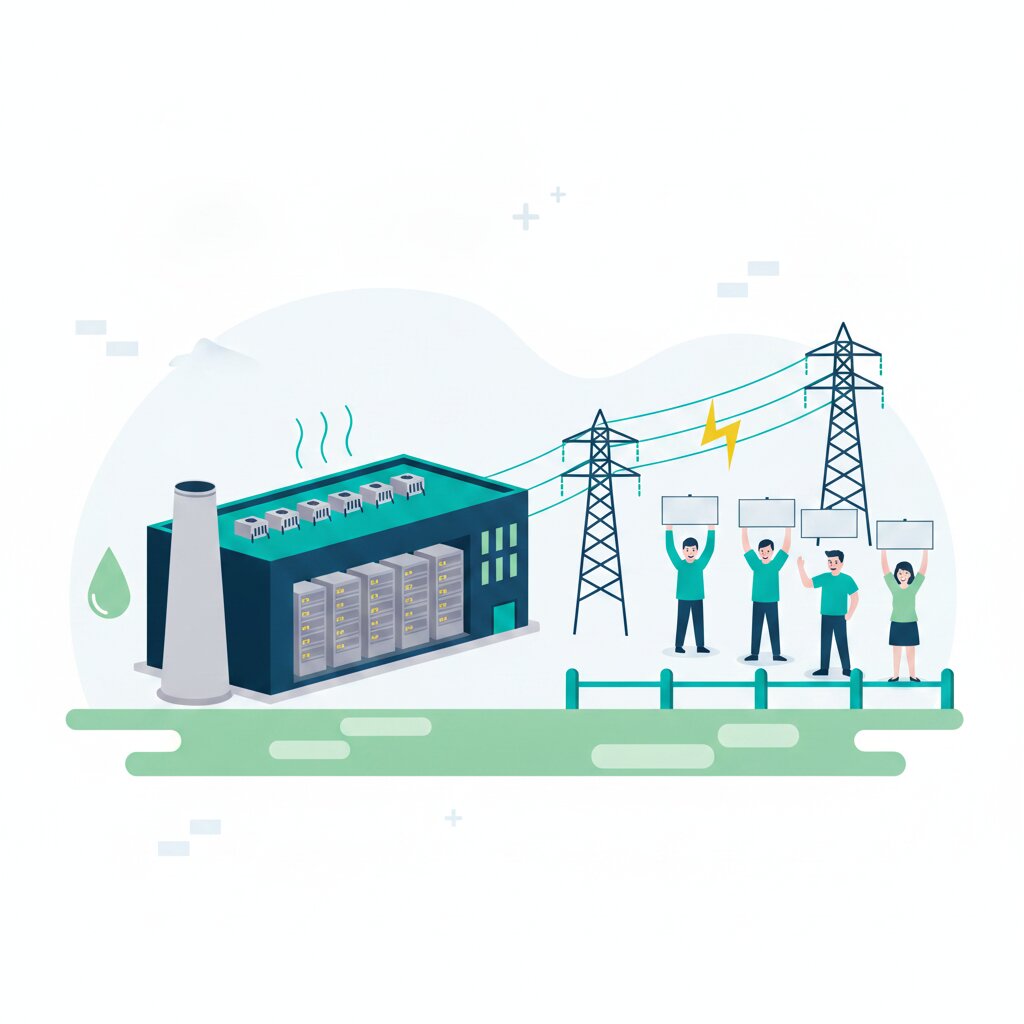

The infrastructure your business increasingly depends on has started colliding with the communities that host it. For a long time that collision was someone else’s problem, a planning dispute in a county you had never heard of. It isn’t anymore. Rate hikes, moratoriums, and blocked projects are becoming strategic planning variables, sitting right alongside latency, cost, and compliance in the decisions your team makes.
Four numbers show how quickly this moved. More than 550 U.S. jurisdictions have now enacted moratoriums or bans on new data center construction, up from roughly 300 in late June 2026. In Q1 2026 alone, 75 projects worth about $130 billion were blocked or delayed. Gallup’s March 2026 polling put opposition to local AI data centers at 71%, a 23-point swing from 47% in late 2025. And Virginia, America’s data center capital, absorbed a 76% electricity price spike attributed mostly to AI demand.
This page is a “what and why” briefing rather than an implementation playbook. It gives you the shape of the problem and routes the detail into five cluster articles. Read the hero, skim the sections that touch your decisions, and follow the links where you need more.
In This Series
- Why Communities Oppose AI Data Centers More Than Nuclear Power Plants: the grievance and polling story behind 71% local opposition, the 23-point swing, and the nuclear comparison.
- How Much Electricity, Water, and Land AI Data Centers Actually Use: the resource-footprint baseline behind the backlash, in megawatts, gallons, and acres.
- Data Center Moratoriums and Bans Explained Across the US: what moratoriums and bans actually do, and where 550+ jurisdictions have acted.
- New York’s Moratorium, Amazon’s Gilroy Loophole, and the Federal Data Center Bill: three flagship cases, from New York’s statewide pause to Amazon’s zoning bypass to the federal bill.
- Virginia’s Data Center Electricity Tax, Jobs, and the Subsidy Trade-Off: the economic reckoning, including rate spikes, the jobs question, and whether tax breaks pencil out.
Suggested reading order: start with Why Communities Oppose, then How Much Electricity, Water, and Land, then Moratoriums and Bans, then New York, Gilroy, and the Federal Bill, then Virginia’s Tax, Jobs, and Subsidy Trade-Off.
Why are seven in ten Americans now opposed to local AI data centers?
Gallup’s March 2026 survey found 71% of Americans oppose a local AI data center, up from 47% in late 2025. That is a 23-point swing in a matter of months, and it cuts across party lines and geography. Treat local opposition as a fast-moving variable that can harden mid-project.
The depth matters as much as the direction. Gallup found 48% strongly opposed and just 7% strongly in favour. The shift shows no meaningful split by age, race, education, income, or urbanicity. Opposition runs highest in the Midwest at 76% and the South at 75%, while even the more accepting West sits at 63%.
The trajectory is the real story. Data Center Watch, a project of 10a Labs, recorded 75 projects worth roughly $130 billion blocked or delayed in Q1 2026, the most in a three-month period since tracking began in 2023. The researchers described the quarter as a “structural shift” rather than a cyclical spike. Active opposition groups more than doubled to 833 across 49 states.
For planning, the speed itself is the warning. Opposition is a dynamic exposure that can harden while a project is already underway. For the full narrative on why the number moved so fast, see the community-opposition breakdown.
What grievances are driving community resistance to data centers?
Opposition is grounded in measurable externalities. The consistent grievances are continuous fan and cooling noise, water drawdown in stressed basins, grid strain and rate effects, land conversion, and diesel-generator air pollution. The useful split for your decisions: grievance-driven resistance responds to specific mitigations, while diffuse NIMBYism is harder to address directly.
In Gallup’s open-ended responses, respondents could name more than one concern. Water and energy lead: 18% name water and 18% name energy. About 16% name pollution, including noise, air, and water. Roughly one in five cite quality-of-life effects such as traffic and land use, and a similar share cite economic consequences such as higher utility bills.
Noise has become a permitting issue in its own right. Residents describe the 24/7 consistency of cooling fans and generators as the core problem. Diesel backup generators add a measurable air-quality cost, releasing particulate matter and more nitrogen oxides than natural gas plants. The same concern shows up at a larger scale in Memphis, where xAI’s plan to run more than 30 natural gas turbines at its Colossus site, for daily use rather than backup, triggered a Clean Air Act challenge from residents and the NAACP.
The distinction worth keeping is between generic “not in my backyard” sentiment and grievance-driven resistance. The first is hard to shift. The second responds to quieter cooling, water guarantees, and cost-sharing agreements, and most of what is happening now is the second. The full grievance analysis is in the grievance and polling deep dive.
Why do more Americans oppose a local data center than a nuclear power plant?
Nuclear power used to carry the heaviest siting stigma. Now a single-site, high-output plant with a contained footprint reads as more acceptable than a sprawling 100-750 MW data center that delivers thin local benefit while competing for water and grid capacity. Communities weigh perceived local return against visible local burden, and the data center’s return often looks thin.
In the same March 2026 Gallup survey, 53% opposed a local nuclear plant, compared with 71% who opposed a data center. Since Gallup first asked the nuclear question in 2001, nuclear opposition has never topped 63%. The 48% who are strongly opposed to data centers nearly matches the entire nuclear opposition figure.
The data center became harder to accept: a nuclear plant reads as one contained site producing a lot of output, while a data center reads as a sprawling facility with few permanent jobs and heavy competition for local water and grid capacity.
The decision insight is that acceptance hinges on perceived local return relative to visible burden. That is why the jobs and subsidy question later in this page carries weight. See the data center versus nuclear analysis for the complete comparison.
How much electricity and water do hyperscale AI data centers actually use?
A single hyperscale facility typically draws 100-750 MW, more than some cities. U.S. data center electricity is projected to roughly double by 2030, while water use could quadruple by 2028. Land footprints now run to thousands of acres. Anchor on these ranges rather than averages, because AI facilities sit at the top end and the marginal impact depends heavily on the host grid and water basin.
A hyperscale facility draws 100-750 MW, with 68 U.S. facilities already using at least 50 MW. U.S. data centers consumed 183 TWh in 2024, more than 4% of national electricity, and the IEA projects growth to 426 TWh by 2030. Lawrence Berkeley National Laboratory estimates data centers could hit about 12% of U.S. electricity by 2028.
Water is where the picture gets regional. Data centers used 17.4 billion gallons in 2023, and the EPA projects 38 to 73 billion gallons by 2028. Meta’s Hyperion campus in Louisiana spans 3,650 acres, about four times the size of Central Park. A medium facility consumes roughly 110 million gallons a year for cooling; the largest can use 5 million gallons a day.
The planning point is that marginal impact depends on the host grid and water basin, in addition to the facility’s own draw. Google’s The Dalles site in Oregon used about a quarter of that city’s total water in 2021. For the full resource accounting, read the electricity, water, and land footprint.
How does AI data center energy demand compare with traditional data centers?
AI facilities push power density and cooling load above legacy colocation. Traditional racks run at 5-10 kW, while AI training racks demand 40-100 kW or more. That is why AI campuses cluster at the 100-750 MW end while traditional facilities sit lower. AI concentrates demand in fewer, larger sites, which amplifies grid, water, and community impact at each one.
The split is easiest to see at the rack level. Legacy enterprise data centers run around 5-10 kW per rack. AI training racks now demand 40-100 kW or more, and NVIDIA’s latest NVL72 systems can draw up to 132 kW per rack, more than what most data halls were built to handle. The Financial Times puts it plainly: AI racks are liquid-cooled and need more than ten times the power of traditional air-cooled racks.
Cooling is where the water question lives. Evaporative, closed-loop, and dry cooling each trade water use against energy efficiency. QTS has said its Georgia campus will use a closed-loop system that does not consume water for cooling once running, a sign operators now pre-empt the water grievance.
For your evaluation, the difference changes the risk profile. AI’s concentration of demand in fewer sites magnifies local impact at each location, which is what fuels the backlash covered above. The full technical treatment, including how to judge vendor sustainability claims, is in the AI-versus-traditional footprint comparison.
What is a data center moratorium, and how does it differ from an outright ban?
A moratorium is a time-limited pause on new construction or permits, usually to commission a study or rewrite zoning. A ban is a permanent or indefinite prohibition. The practical difference for siting risk: a moratorium can expire or convert into new rules, while a ban removes the site from consideration. More than 550 U.S. jurisdictions had enacted one or the other, a near-doubling from roughly 300 in late June 2026.
The two instruments sound similar but behave differently. A moratorium is a “time-out” freeze, often short, while a council studies cumulative impacts and rewrites the rulebook. A ban is the stronger, permanent version. Legal weight also varies by instrument: a council vote, an ordinance, and a resolution carry different durability, and challenges hinge on things like vested rights for developers who already secured permits.
The count is the signal. The headline is more than 550 jurisdictions, a near-doubling from roughly 300 in late June 2026. Independent tallies vary by tracker and date, which is itself the point: the patchwork is moving fast enough that any single number needs a timestamp. Maryland alone has 13 counties with moratoriums, more than half the state.
Negotiated alternatives exist short of a ban. Enforceable community benefit agreements and early engagement are the path some communities accept. The full definitional and geographic treatment is in the moratorium-and-ban explainer.
State-level or local restrictions — which is gaining more traction, and why?
Local governments are moving faster because they absorb the direct externalities like noise, water, and traffic, while states still court the jobs-and-tax narrative. But states can override or pre-empt local action, which concentrates risk differently. Map each candidate site against the local-versus-state dynamic, because a supportive state cannot always shield a project from an aggrieved council.
The divergence is structural. Localities feel the immediate costs, so they act first. States weigh the jobs-and-tax pitch, so they hesitate, but they retain the power to override or pre-empt local restrictions. Under Home Rule, local governments legislate independently, which is where much of the fast action happens.
The range is broad. Maine’s legislature passed the first-in-nation statewide moratorium bill, though the governor vetoed it while still removing data centers from the state’s business tax incentives. South Dakota passed a law that bars the state from pre-empting local data-center rules. Chandler, Arizona spent nearly a decade on noise pushback before a 2022 zoning amendment restricted data center siting. New Orleans and Dublin, Ireland extend the range — the former through utility-scale load disputes, the latter through a de facto pause on new data center grid connections. Seattle’s council planned a one-year moratorium after four companies sought five data centers with a combined 369 MW draw.
The siting point is that a fast-moving council can create a moratorium mid-project. Voter-initiated ballot measures offer a path in 23 states to enact moratoriums directly. The full geography and planning considerations are in the state-versus-local policy map.
Why did New York impose the first statewide data center moratorium?
New York paused new environmental approvals while it runs a Generic Environmental Impact Statement on cumulative grid, water, and emissions impacts, and it shifted transmission costs onto operators rather than residents. The precedent matters because data center policy is leaving local zoning and entering state and federal arenas. Treat New York as a signal of how quickly statewide scrutiny can emerge.
The mechanism is worth understanding because it is likely to be copied. Governor Kathy Hochul signed an Executive Order creating the nation’s first moratorium on new hyperscale data centers, temporarily pausing state environmental permits for up to a year. During that window, the state develops a Generic Environmental Impact Statement covering energy demand, water use and quality, and air quality. The pause applies to facilities drawing 50 MW or more, sweeping in operators from Digital Realty to NTT.
New York also moved the cost question. Its Energize NY proceeding requires data centers to pay more for their energy or supply their own, keeping prices steadier for residents. The state is pursuing repeal of sales tax exemptions for massive data centers and a Grid Acceleration Fund that makes operators invest in the ageing grid.
The contrast pole is Amazon’s Gilroy, California project, where a 45-year-old zoning law let a $2 billion facility skip community review entirely. One state built a study-first framework; one company found a workaround. Both are covered in the New York and Gilroy case studies.
What would the Sanders/AOC AI Data Center Moratorium Act do?
The federal bill would pause new approvals, require environmental review, and study cumulative effects across energy, water, and land. Passage is unlikely, but its existence marks the federal horizon: even a stalled bill can shift investor and lender assumptions. Track it as a leading indicator of where national policy could move.
The Artificial Intelligence Data Center Moratorium Act, introduced in March 2026 by Senator Bernie Sanders and Representative Alexandria Ocasio-Cortez, would halt construction or upgrades of data centers drawing 20 MW or more until strong national safeguards are in place. The bill requires Congress to pass legislation on AI safety, worker protections, environmental standards, and privacy before construction resumes.
It is unlikely to pass this session. Its significance is that it marks the federal horizon. The Carnegie Endowment called it unlikely to take effect but acknowledged the opposition it represents “cannot be wished away.” Senator Mark Warner’s “idiocy” retort captures the counterargument: a pause means China moves faster.
The planning point is that a stalled bill still reshapes assumptions. It forms a policy stack with local action and state moratoriums, a layering of scrutiny rather than isolated moves. The full case study, including the Gilroy zoning bypass, is in the three flagship policy cases.
Why are residential electricity bills rising in data center host regions?
Grid upgrades built for data centers are spread across all utility customers, so households absorb costs for infrastructure they do not use. Virginia saw a 76% PJM price spike attributed mostly to AI demand, and high-concentration areas recorded 267% increases over five years. Ratepayer cost-shifting is a powerful political grievance, and it is triggering operator-pays rulings.
The mechanism is simple. Transmission and grid upgrades built for large loads get socialised across every ratepayer, so a household pays for infrastructure it does not use. In Virginia, PJM Interconnection raised prices 76%, which independent watchdog Monitoring Analytics attributed mostly to AI data centers. A Bloomberg analysis found some high-concentration areas now pay 267% more than five years ago.
The policy responses are stacking up. Virginia’s State Corporation Commission ordered data centers to pay for dedicated upstream transmission they will use exclusively. Oregon’s POWER Act puts large facilities in a higher rate class. The White House Ratepayer Protection Pledge, signed by the major hyperscalers, commits to paying for delivery upgrades.
This is a powerful political grievance that converts a technical grid issue into broad backlash. Cost-allocation reform is the leading indicator to watch. For the full economic treatment, see the Virginia ratepayer analysis.
Do data center tax breaks outweigh their community costs?
The evidence increasingly says no. Data centers are capital-intensive and create few permanent jobs relative to their land, power, and water footprint, while tax exemptions shift costs onto residents. That is roughly a billion dollars a year each in Virginia and Texas. Treat the subsidy settlement as movable: incentive repeal and ratepayer protections are now live policy directions.
The jobs-and-tax pitch has been the industry’s core argument, and it is now the least persuasive part of the case. Even the largest data centers employ fewer than 150 permanent workers, and sometimes as few as 25, per a review of more than 1,200 U.S. facilities. Meta’s $1 billion Kansas City campus generated about 1,500 construction jobs but only 100 ongoing operations roles. Research from Ben Green, discussed via the Harvard Gazette, documents the gap.
Meanwhile the subsidies are real. Virginia’s data center sales-tax exemption alone cost an estimated $1.6 billion in fiscal 2025. Texas was set to provide over a billion dollars in 2025, while Georgia has courted campuses with its own incentive stack and is now reconsidering. Brookings notes these incentives may simply be subsidising investments that would have happened anyway.

The strategic implication: where infrastructure is subsidised today, the political settlement can shift. New York and Maine are already moving to repeal or curtail incentives. Host-community economics have become a planning risk. The full trade-off analysis is in the subsidy-versus-jobs reckoning.
Resource Hub: The Data Center Backlash Deep Dives
Understanding the Backlash and Its Footprint
- Why Communities Oppose AI Data Centers More Than Nuclear Power Plants — The grievance and polling story behind 71% local opposition, the 23-point swing, and the nuclear comparison.
- How Much Electricity, Water, and Land AI Data Centers Actually Use — The resource-footprint baseline that every grievance, policy, and cost claim in this cluster references.
How Policy Is Reshaping Where Data Centers Can Go
- Data Center Moratoriums and Bans Explained Across the US — What moratoriums and bans actually do, the 2026 jurisdiction count, and why local action outpaces state action.
- New York’s Moratorium, Amazon’s Gilroy Loophole, and the Federal Data Center Bill — Three flagship cases: New York’s statewide pause, Amazon’s zoning bypass, and the Sanders/AOC federal bill.
The Economic and Ratepayer Reckoning
- Virginia’s Data Center Electricity Tax, Jobs, and the Subsidy Trade-Off — The 76% rate spike, the first-in-nation electricity tax, the jobs question, and whether tax breaks pencil out.
Suggested reading order: start with Why Communities Oppose (sentiment), then How Much Electricity, Water, and Land (footprint), then Moratoriums and Bans (mechanism), then New York, Gilroy, and the Federal Bill (cases), then Virginia’s Tax, Jobs, and Subsidy Trade-Off (economics).
Frequently Asked Questions
What does “power-plus-permission” mean for data center site selection?
Power-plus-permission means electricity is one of two requirements now. A project also needs a social licence to operate, which means legislative durability, ratepayer-protection commitments, and earned community acceptance. It marks a repricing of execution risk across legislative, regulatory, and community dimensions. See the moratorium definition and jurisdiction count and why communities are pushing back.
How can you assess whether a proposed data center will face community opposition?
Look at the measurable externalities a site will impose: noise, water drawdown, grid and rate effects, land conversion. Then look at the transparency record of the developer. Secretive approvals, such as non-disclosure agreements and staff-level bypasses, correlate with organised resistance. Early community engagement and enforceable community benefit agreements are the most reliable mitigations.
Why do data centers create so few permanent jobs relative to their scale?
Data centers are capital-intensive rather than labour-intensive. Construction employment is temporary, while ongoing operations need only a thin staff relative to the land, power, and water consumed. Research from Ben Green, reported via the Harvard Gazette, documents the gap — which is why the jobs-and-tax narrative is increasingly contested. The full jobs-versus-incentives evidence is in the Virginia jobs and tax analysis.
How did Amazon bypass community review for its Gilroy data center?
Amazon leveraged a 45-year-old zoning law to treat a $2 billion facility as a by-right use, avoiding environmental and community review. The case shows how legacy zoning classifications can let staff-level approvals substitute for public scrutiny — and why zoning modernisation has become part of the backlash. See the full policy-case breakdown.
Where can you find state-by-state data center moratorium and legislation trackers?
Trackers from the National Conference of State Legislatures, MultiState, and the Halt the Harm Network maintain running tallies of moratoriums, bans, and pending bills. Official state guidance, such as New York’s Community Investment Framework, adds the regulatory layer. See the running moratorium and ban tallies.
Behind-the-meter generation vs grid interconnection — how do the trade-offs compare?
Behind-the-meter generation, such as on-site gas turbines, solar-plus-storage, or fuel cells, sidesteps multi-year interconnection queues but carries fuel, emissions, and regulatory risk, and FERC‘s large-load rulemaking is closing the cost advantage. Grid interconnection offers more standardised rules but exposes projects to queue delays and cost-allocation battles.
Which states are banning versus regulating versus incentivizing data center construction?
The policy map splits three ways: states imposing or debating moratoriums (New York, Maine, South Dakota), states regulating cost allocation and water (Virginia, Oregon, Florida), and states still courting development with incentives (Texas, Georgia, though both are reconsidering). The policy landscape is a fast-moving patchwork.