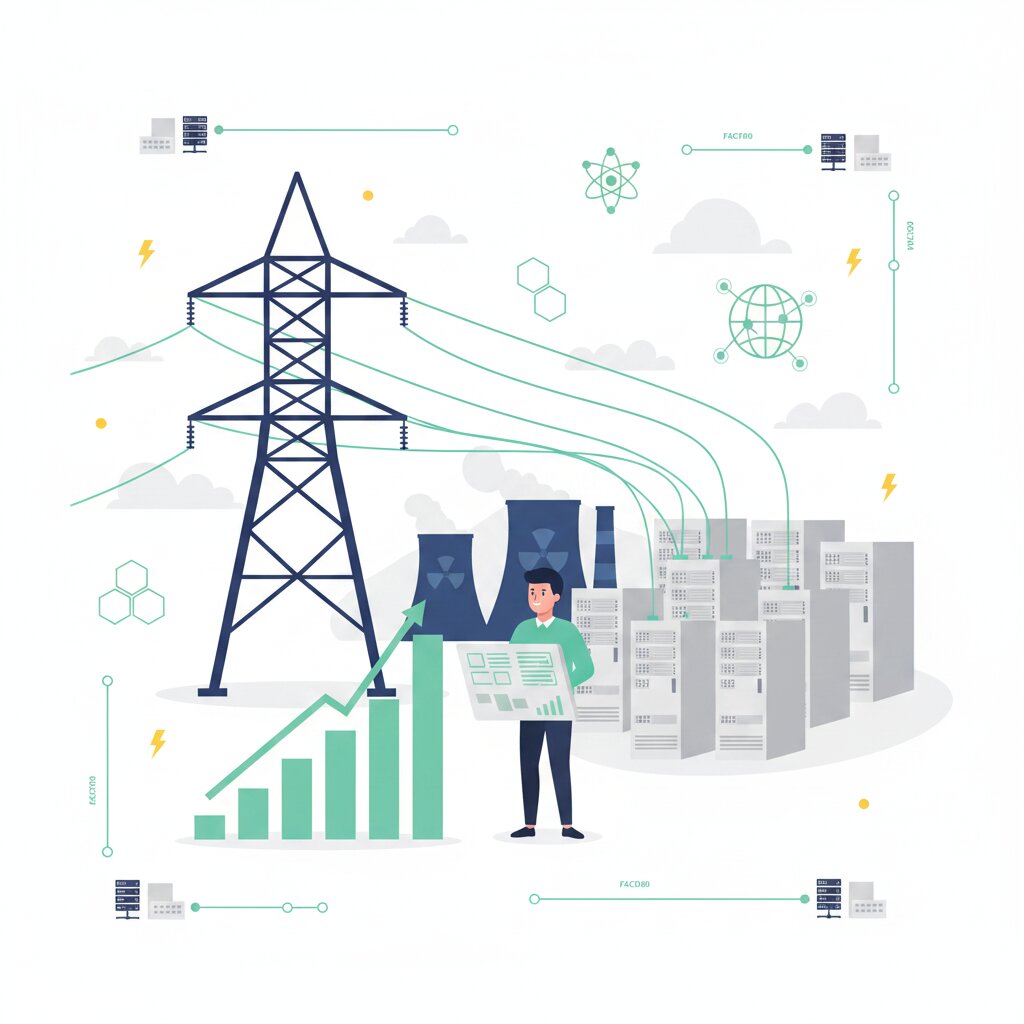

Hyperscalers are signing nuclear deals because the US power grid is running out of headroom in the exact regions where AI data centres are most densely packed. No new power means no new servers. It really is that simple.
The Uptime Institute‘s 2026 forecast says the binding constraint on data centre expansion is power. Not cooling, not connectivity, not land. Power. And in PJM Interconnection territory — the 13-state grid that covers Northern Virginia’s Data Centre Alley — that constraint is turning acute. Capacity auction prices surged 833% year-over-year. That is the market telling you, clearly and loudly, that headroom is gone.
This is not abstract infrastructure policy. If your workloads run on AWS us-east-1, Azure East US, or Google Cloud’s US-East regions, grid saturation has direct downstream consequences for your team. This article explains what those are.
This article is part of our series on the nuclear push reshaping AI infrastructure.
Why is the US power grid struggling to keep up with AI data centre demand?
The core problem is a timeline mismatch, and it is a bad one. A data centre can be built in two to three years. A gas turbine generation site takes roughly six. A solar farm takes five. A nuclear plant needs a minimum of ten. Demand arrives years before supply can respond.
AI is also not just more servers. It is a qualitatively different power load. Racks of Nvidia AI chips consume at least ten times as much electricity as conventional web servers. US data centre electricity consumption is expected to grow from 176 TWh in 2023 to somewhere between 325–580 TWh by 2028. The IEA is forecasting a 130% increase in US data centre power demand by 2030.
Uptime Institute’s 2026 report puts it bluntly: “Developers will not outrun the power shortage.” The 75–125 GW of projected growth in global data centre power demand through 2030 cannot be met on current grid expansion trajectories. Gas turbine generators — the most practical immediate backstop — now face multi-year waiting lists and significantly higher prices. Even the workaround has a queue.
What is PJM Interconnection and why does it concentrate the bottleneck?
PJM Interconnection is the regional transmission organisation managing electricity grid operations for 13 US states plus Washington D.C.: Virginia, Maryland, Delaware, Pennsylvania, New Jersey, Ohio, Indiana, Illinois, Michigan, West Virginia, Kentucky, Tennessee, and North Carolina. It is the largest wholesale electricity market in the US by load volume, and the backbone of the East Coast and Midwest electricity system, covering 67 million people.
Northern Virginia’s Loudoun County — Data Centre Alley — is the single most concentrated cluster of data centre capacity in the world. Over 4,900 MW of operating capacity sits there, another 1,000 MW is under construction, and about 70% of global internet traffic passes through it every day. Virginia is home to AWS us-east-1, Azure East US, and Google Cloud’s primary US East presence.
Data centres concentrated here for good structural reasons: proximity to the federal government and major financial institutions, low-latency fibre links to the East Coast internet backbone, and — historically — favourable land and electricity costs. That historical advantage is now a liability.
The capacity market tells you everything. PJM’s clearing prices jumped from $29 per megawatt-day to the market cap of $330 per megawatt-day in two auction cycles — an 833% increase. The total capacity bill rose from $2.2 billion to $16.1 billion. Aurora Energy Research projects a 24 GW power shortfall by 2030, growing to 55 GW by 2035. Virginia’s residential customers are already absorbing the cost: Dominion Energy proposed its first base-rate increase since 1992 in February 2025, adding around $8.51 per month to a typical household’s bill.
What does the Uptime Institute 2026 forecast say about data centre power limits?
Uptime Institute is the independent analyst authority for the data centre industry. Not a vendor, not a consultancy with a product to sell. Its Five Data Centre Predictions for 2026 names power as the defining constraint.
Global data centre electricity consumption is expected to reach approximately 600 TWh in 2026, up 14% from 2025. Uptime projects 75–125 GW of new global data centre power demand through 2030 — growth that cannot be met through grid expansion at current pace.
There is also a carbon dimension that adds a secondary constraint. Meeting power demand via gas turbines puts net-zero pledges at direct risk — some of which are contractually enforced in enterprise agreements with cloud providers. Goldman Sachs estimates $720 billion in US grid spending may be required through 2030. That is not a temporary supply hiccup. That is a structural constraint baked into the next decade.
What is the interconnection queue and why does it take 5–7 years?
The interconnection queue is a cascading engineering study process — not a straightforward permit approval.
Every new power generation project must complete it before connecting to the grid. Each application triggers a grid impact study that models how the new generator affects the entire transmission network. Because applications interact, one submission can force the re-study of dozens of already-queued projects. The timeline from application to commercial operation has grown from under two years in 2008 to over eight years in 2025. PJM’s “Transition Cycle 1” reform attempt demonstrated the limits clearly: high network upgrade costs assigned early caused widespread project attrition, and PJM’s minimum queue timeline still exceeds the DOE efficiency target by 75%.
The practical consequence is this: capacity decisions made today determine what power is available in the early 2030s. There is no shortcut.
What are tech companies doing right now while they wait for nuclear?
Hyperscalers are not waiting around. They are deploying on-site gas turbines — “behind-the-meter generation” — to power data centres immediately, bypassing the interconnection queue entirely.
Behind-the-meter means power produced on-site that does not draw from the public grid. A data centre installs its own gas turbines, goes live, and avoids the years-long queue. The trade-off is higher cost and direct fossil fuel emissions. xAI ran gas turbines at its Memphis data centre while waiting for a grid substation connection — locals criticised the air quality impact. This is not a one-off workaround. It is a template.
Meta is the most aggressive nuclear procurer, having committed to over 6 gigawatts across multiple deals — the largest nuclear purchasing commitment in the tech sector. The strategy plays across three time horizons: a 20-year PPA with Vistra Corp. for 2,176 MW from Ohio’s Perry and Davis-Besse plants near term; 1.2 GW from Oklo (backed by OpenAI) targeting delivery as early as 2030; and agreements with TerraPower (backed by Bill Gates and Nvidia) for SMR deployment in the 2030s.
All four major hyperscalers have now struck landmark nuclear deals. Microsoft’s restart of Three Mile Island with Constellation Energy is the most prominent. Bobby Hollis, Microsoft’s Vice-President of Energy, summarises the strategic logic neatly: “We very much prioritise energy and power first.”
On-site gas is the decade-long gap-filler — expensive, emissions-heavy, and increasingly difficult to site. Nuclear is the long-term answer. The gap between now and then is the problem.
What is the emergency power auction proposal and will it fix the problem?
In January 2026, US Energy Secretary Chris Wright and Interior Secretary Doug Burgum joined a bipartisan group of Mid-Atlantic governors to call on PJM to build more than $15 billion of new baseload generation. The proposal: PJM conducts an emergency auction offering 15-year power contracts, with data centres that do not self-procure power or agree to demand curtailment required to fund grid expansion directly. Democratic governors Josh Shapiro of Pennsylvania and Wes Moore of Maryland signed alongside Republican-aligned federal secretaries. AI electricity costs hit residential bills regardless of political affiliation.
The limits are equally notable. Neither the White House nor the governors can legally mandate the auction. PJM was not invited to the announcement. The maths is sobering: $15 billion buys approximately 6–10 GW of new generation capacity against a 24 GW shortfall by 2030. And new plants still must complete the full interconnection queue before connecting. The auction accelerates the investment decision. It does not accelerate physical construction.
What does grid saturation mean for cloud availability and pricing?
This is where the infrastructure story becomes your problem.
The causal chain is straightforward. Grid stress in PJM means no new power contracts. No new power contracts means no new data centre capacity. No new data centre capacity means no new availability zones. And that means a constrained ability to scale in that geography.
AWS us-east-1 (Northern Virginia) is the world’s largest cloud region by capacity. When a grid provider cannot allocate new capacity there, AWS cannot expand servers there. New availability zones get delayed or diverted to other geographies — Ohio, Texas, Ireland — increasing latency for workloads that need proximity to the US East Coast. Financial services, healthcare, and government workloads with data residency requirements cannot simply move elsewhere.
The pricing signal is already in the market. The 833% PJM capacity price surge is a cost that flows upstream to hyperscalers and downstream, eventually, to cloud pricing — particularly for power-intensive workloads like AI inference and model training. Cloud SLAs guarantee uptime against software and hardware failures. They do not guarantee insulation from regional capacity constraints on new resource provisioning. A grid-stressed region keeps serving existing workloads reliably, but slows new capacity provisioning, delays new instance types, and redirects investment elsewhere.

If your workloads are concentrated in a single US East Coast cloud region, this is relevant to your architecture decisions right now. The risk is not an imminent outage — it is constrained capacity expansion, slower provisioning, and pricing pressure over the next 12–36 months. Multi-region architecture and an honest assessment of which workloads genuinely require us-east-1 proximity are worth evaluating before this shows up on your cloud bill.
Grid saturation is not the only physical constraint operating here. Zoning and community opposition — the parallel hidden constraint blocked $98 billion in data centre projects in Q2 2025 alone, working alongside grid bottlenecks to slow supply growth. For a strategic framework on translating grid risk into infrastructure planning — including what to ask cloud providers and how to frame this for your board — see the companion article.
FAQ
What exactly is PJM Interconnection and what states does it cover?
PJM Interconnection manages electricity grid operations for 13 US states plus Washington D.C.: Virginia, Maryland, Delaware, Pennsylvania, New Jersey, Ohio, Indiana, Illinois, Michigan, West Virginia, Kentucky, Tennessee, and North Carolina. It is the largest wholesale electricity market in the US by load volume, covering 67 million people and the world’s highest concentration of AI data centre capacity.
Why are capacity auction prices up 833% in the PJM region?
PJM’s capacity auction procures commitments from generators three years in advance. When demand outpaces supply, clearing prices spike. The jump from $29 per megawatt-day to the market cap of $330 per megawatt-day reflects the gap between PJM’s surging data centre load and the new generation available to meet it. PJM’s own Market Monitor identifies data centre load growth as the primary cause.
What is “behind-the-meter generation” and why are hyperscalers using it?
Behind-the-meter generation is on-site power production — gas turbines, diesel generators, or eventually small modular reactors — that does not draw from the public grid. Hyperscalers use it because it bypasses the interconnection queue: a data centre can go live without waiting years for a grid connection. The trade-off is higher cost and direct fossil fuel emissions.
How does the PJM interconnection queue differ from a simple permit process?
Each application triggers a grid impact study that models how the new generator affects the entire transmission network. Because applications interact, one submission can force the re-study of dozens of already-queued projects. That is why timelines have expanded from under two years in 2008 to over eight years in 2025.
Does the Trump emergency power auction actually solve the grid crisis?
No. It is a financial incentive mechanism, not a technical fix. At best it brings 6–10 GW of new generation into development against a 24 GW shortfall by 2030. New plants still must complete the full interconnection queue after receiving contracts. Neither the White House nor the governors can legally mandate the auction. Better understood as political pressure than as a resolution of the bottleneck.
Will nuclear power actually solve the AI data centre power problem?
Existing nuclear plants — like Vistra’s Perry and Davis-Besse facilities in Ohio, now contracted to Meta — provide near-term capacity through PPAs. New nuclear requires 10+ years minimum to build. Small modular reactors from Oklo and TerraPower are not expected at commercial scale until the 2030s. Nuclear is the long-term answer. On-site gas turbines and renewables with storage are the near-to-medium-term reality.
What is Data Centre Alley and why did data centres concentrate there?
Data Centre Alley is the hyperscale cluster in Loudoun County, Northern Virginia — the world’s densest concentration of data centre capacity. Data centres concentrated here due to proximity to the federal government, financial institutions, the East Coast internet backbone, and historically low land and electricity costs. Roughly 70% of global internet traffic passes through daily. The advantages that drew data centres here are now liabilities as PJM grid capacity saturates.
Should companies running workloads in AWS us-east-1 be concerned right now?
Grid saturation does not mean imminent outages — existing cloud regions draw on established power contracts. The practical risk is constrained capacity expansion: slower availability of new compute resources and a harder time scaling rapidly. The longer-term risk is pricing: as hyperscalers absorb higher electricity costs, compute pricing for intensive workloads may increase over 12–36 months. Worth factoring into your architecture decisions now, not after it shows up on your cloud bill.