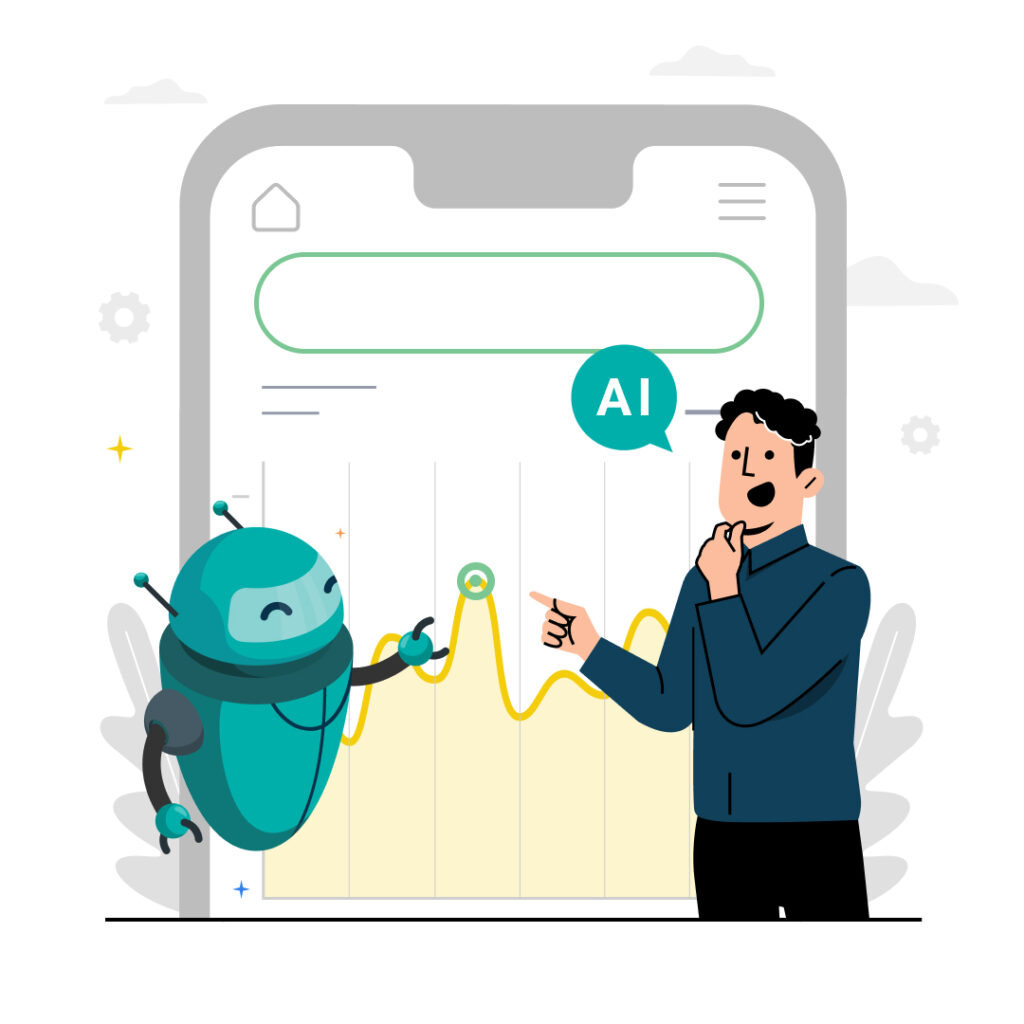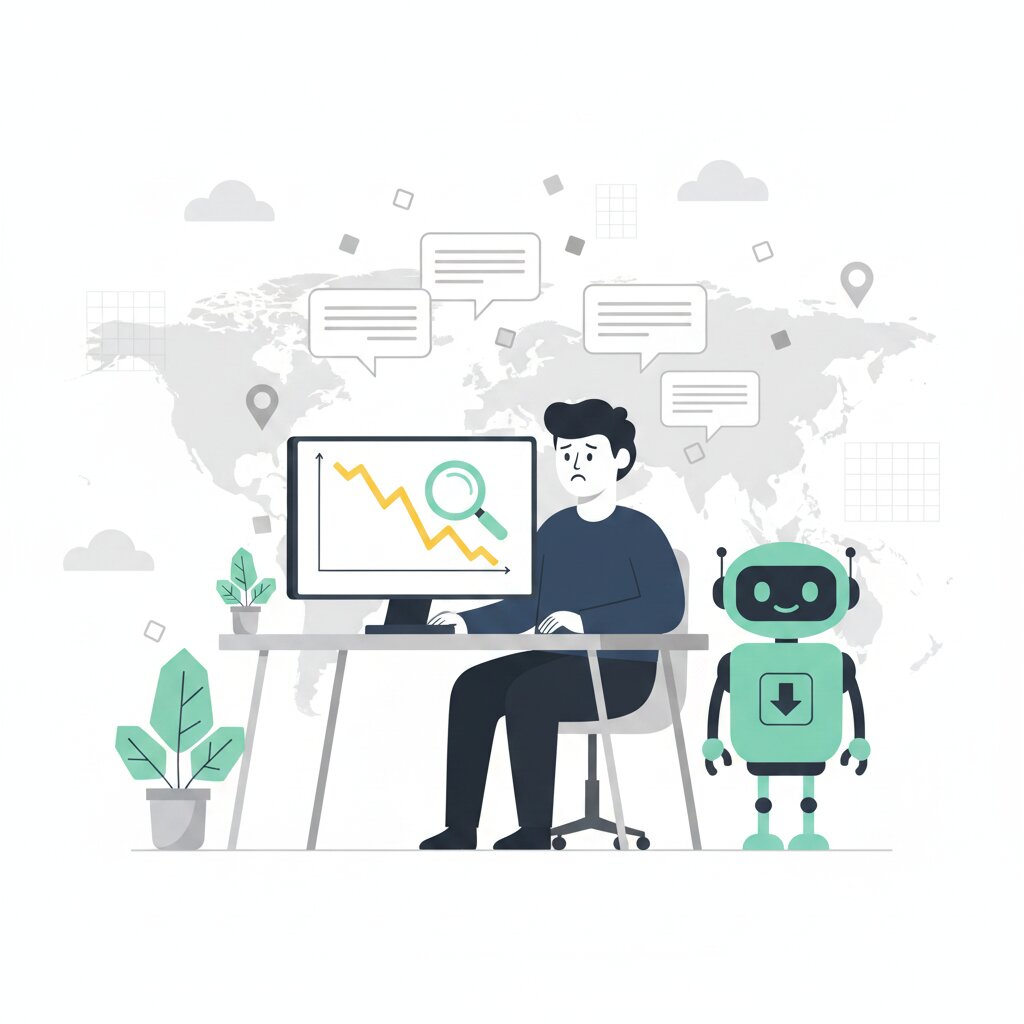

Your website traffic is falling. Your Google rankings haven’t changed. If that sounds familiar, something structural has shifted in how search works — and it is not coming back.
It’s called zero-click search. That’s when Google answers a query inside its own interface before the user has any reason to visit your site. 60% of all Google searches end without a click — a figure from SparkToro and Similarweb that rises to 83% when an AI Overview is present and 93% in Google AI Mode. Those three numbers are quietly demolishing the assumption that good content leads to traffic. This article introduces the crisis, explains the key concepts, and maps out the seven articles in this series.
Why Are 60% of Google Searches Ending Without a Click?
There are two kinds of zero-click. The first is navigational — the user was always going to type a URL. The second is AI-driven — the query gets answered inside Google before anyone clicks anywhere. The second kind is the one growing fast: from 58.5% in 2022 to 64.8% by 2026. 60% Zero-Click — The Numbers That Rewrite Every Traffic Assumption pulls apart all three figures and explains exactly what each one measures.
What Is Causing the Drop — How AI Overviews Actually Work
When an AI Overview appears above organic results, position-1 click-through rate drops by 58% according to Ahrefs — without your ranking changing at all. AI Mode goes further: it decomposes a query into up to 16 parallel sub-queries across Google’s web index, Knowledge Graph, Shopping Graph, Maps, and YouTube, which is why its zero-click rate hits 93%. AI Overviews Kill 61% of Clicks — The Mechanism Behind the Drop covers the full architecture of how this works under the hood.
Which Industries and Query Types Are Hit Hardest?
B2B technology queries trigger AI Overviews up to 70% of the time. Informational queries — “what is”, “how does” — are the most exposed category, with 99.9% triggering an AI Overview according to Ahrefs. HubSpot’s 70–80% organic traffic decline between 2024 and 2025 has become the standard warning sign for content-led B2B SaaS businesses. If that pattern matches your metrics, you need to read Publisher Revenue Crisis — When Traffic Dies, What Survives, which covers case studies in detail.
What Is GEO and AEO — The New Optimisation Disciplines
Three disciplines now coexist and you need to understand all of them. SEO optimises for traditional SERP rankings — still necessary, but no longer sufficient on its own. GEO (Generative Engine Optimisation) optimises for AI citation in Google AI Overviews, ChatGPT, and Perplexity. AEO (Answer Engine Optimisation) targets direct-answer boxes and featured snippets. The reason all three matter: only 17% of AI Overview citations come from pages in the top 10 organically, which means your SEO work alone is not getting you into AI results. AEO and GEO — Two New Disciplines, One New Optimisation Target covers where each discipline starts and how they differ.
What Is Happening to Publisher Revenue?
AI Overviews answer queries on-platform. Referral traffic falls. CPM revenue follows. OpenAI’s crawl-to-referral ratio sits at 1,700:1 — crawlers index your content without sending visitors back. The IAB Tech Lab puts the annual publisher ad revenue already displaced at $2 billion. And if you’re thinking about blocking AI crawlers, there’s a catch: blocking Google-Extended correlates with reduced AI Overview citations even when your content is still technically accessible. There’s no clean exit. Publisher Revenue Crisis — When Traffic Dies, What Survives covers the full revenue picture. For the other side of this equation — how Google’s search monetisation strategy is evolving while publisher revenue collapses — Article 4 analyses the structural paradox.
Where Is Search Heading — The Agent Manager Vision
In April 2026, Sundar Pichai said that “Search would be an agent manager” — AI agents completing tasks on behalf of users rather than retrieving information for them to act on. This is not a distant scenario. The Universal Commerce Protocol, launched in January 2026, already enables checkout within Google’s surfaces without a user ever visiting a merchant’s site. Google’s 2026 capital expenditure is $175–185 billion — they are not experimenting. AI Search for Agents — When the Searcher Isn’t Human covers what the agent vision means for your infrastructure.
What the Data Shows About Ranking in AI Responses
An Arxiv study 2604.27790v1 covering 11,500 queries found less than 20% overlap between organic rankings and AI Overview citations. Ranking and AI citation are different activities with different predictors. What actually predicts AI citation: entity clarity in Google’s Knowledge Graph, passage-level content structure, and topical depth. Ranking in AI Responses — What the Data Actually Shows covers the full evidence on what you need to change.
Start Here: Your Guide to This Series
Pick the article that matches what you need to decide:
- 60% Zero-Click — The Numbers That Rewrite Every Traffic Assumption — what the 60%, 83%, and 93% statistics each measure
- AI Overviews Kill 61% of Clicks — The Mechanism Behind the Drop — why position 1 no longer guarantees traffic
- AEO and GEO — Two New Disciplines, One New Optimisation Target — whether you need GEO and AEO alongside SEO, and where to start
- Google AI Search Monetisation — Can Google Fix Zero-Click Without Killing Its Business — how Google’s revenue keeps growing while publisher traffic collapses
- Publisher Revenue Crisis — When Traffic Dies, What Survives — which business models are showing resilience
- AI Search for Agents — When the Searcher Isn’t Human — what agentic search means for your web infrastructure
- Ranking in AI Responses — What the Data Actually Shows — the empirical evidence on what predicts AI citation
FAQ
What is zero-click search?
It’s when a query is answered within the search interface and no external website is visited. 60% of Google searches end this way. For content businesses the number that really matters is 83% — that’s what happens when an AI Overview is generated.
Is the zero-click crisis affecting all industries equally?
Not even close. Informational queries are the most exposed — 99.9% trigger an AI Overview according to Ahrefs. E-commerce sits at 3.2%, because Google pulled back after AI responses weren’t converting.
What is the difference between AI Overviews and AI Mode?
AI Overviews appear within standard search results and produce an 83% zero-click rate. AI Mode is a separate conversational interface — US-only since March 2026 — that produces a 93% zero-click rate. Same direction, just further along.
What is GEO and why is it different from SEO?
SEO improves your SERP ranking. GEO improves the probability of your content being cited in an AI-generated response. Only 17% of AI Overview citations come from pages in the top 10 organically — so your ranking work and your citation work need to be treated as separate problems.
What is AEO and how does it relate to GEO?
AEO targets direct-answer boxes and featured snippets. GEO handles complex AI summaries. Both share core tactics — structured data, declarative content, E-E-A-T — but they have different primary targets.
Why is my website traffic dropping even though my Google rankings haven’t changed?
An AI Overview reduces position-1 click-through rate by 58% according to Ahrefs, without changing the ranking itself. Stop monitoring position alone and start watching impressions and CTR in Google Search Console.
Who is Sundar Pichai and why does his “agent manager” vision matter?
He is the CEO of Google and Alphabet. His April 2026 framing of Search as an “agent manager” — a system that completes tasks rather than retrieves information — is the clearest public signal that the zero-click shift is structural and intentional, not a side effect.
How is Google’s ad revenue still growing if publisher traffic is collapsing?
Google captures value inside its own surfaces — sponsored AI Overviews, Shopping Graph ads, and commerce via UCP — making its revenue increasingly independent of whether anyone visits a publisher’s site.
Should I block AI crawlers from accessing my website?
Probably not without thinking it through carefully. The arxiv study found that blocking Google-Extended correlates with reduced AI Overview citations even when your content is still technically accessible. There’s no clean exit. Article 5 covers the dilemma properly.
What tools exist to monitor AI citation?
Standalone options include Profound, Peec AI, Scrunch AI, and Otterly AI. If you’re already using a major SEO platform, Semrush AI Visibility Toolkit and Ahrefs Brand Radar are the integrated options worth looking at.
Is the zero-click crisis structural or a phase that will stabilise?
Treat it as structural. Google’s $175–185 billion 2026 capex, Pichai’s agent manager framing, and the trajectory from 58.5% in 2022 to 93% in AI Mode all point in one direction. Regulatory proceedings may eventually impose some constraints, but the downside of not adapting far exceeds the downside of adapting prematurely.
What does “passage-level retrievability” mean?
AI systems extract at the passage level — paragraphs and sentences, not whole pages. The practical implication: structure each section of your content as a self-contained answer, not as part of a continuous essay.