
Sixty-nine percent of knowledge workers admit to delivering AI-generated work they cannot explain or defend. The Glean Work AI Index 2026 gave this behaviour a name, “botshitting,” and the numbers tell a larger story: 41% sometimes deliver work they could not explain if asked, and 28% have blamed AI for mistakes they themselves caused. The hidden labour of making AI useful, feeding it context, debugging its outputs, cleaning up its messes, consumes 6.4 hours per week. That is roughly half of all reported AI time savings.
The response cannot come from a single direction. Psychology explains why workers disengage from AI outputs. Regulation makes oversight a legal obligation. Architecture provides the infrastructure that makes oversight feasible at scale. Here is how each domain fits together within the full botsitter economy picture.
The first domain, psychology, explains why workers disengage from AI outputs in the first place.
What is moral disengagement in the context of AI use at work?
Moral disengagement is Albert Bandura’s concept describing the cognitive mechanism by which people deactivate their moral self-regulatory processes, making unethical decisions without guilt. In AI work contexts, the mechanism is straightforward: when your team offloads thinking to AI, they also offload responsibility for the output. “The AI did it” becomes the cognitive off-ramp.
Botshitting is the endpoint of this process — documented in the empirical data at a 69% rate — but botsitting is where it begins. Botsitting is the constant oversight labour of supervising AI outputs: feeding the tool context, debugging what it produces, cleaning up its mistakes. When your team spends 6.4 hours a week on this work, the exhaustion is real.
The behavioural evidence is clear. When AI-generated work fails, 40% of workers blame the AI tool rather than their supervision choices; only 29% admit fault. Heavy AI users are 3.4 times more likely than light users to blame the tool when something goes wrong. As Zoe Rahwan of the Max Planck Institute for Human Development puts it, delegating tasks to AI is like having a buffer that lowers your own moral accountability.
The psychological pathway runs like this: botsitting produces digital exhaustion, exhaustion produces satisficing (workers settle for “good enough” AI output rather than verifying it), satisficing becomes botshitting, and botshitting erodes accountability across your organisation. Long-term AI use is associated with mental exhaustion and attention strain, and inversely associated with decision-making self-confidence.
There is a compounding factor. When human-AI teams collaborate, personal accountability for output quality diminishes compared to working alone. Responsibility diffuses across multiple actors in the AI’s design, deployment, and use. The “problem of many hands” means the more hands involved, human or synthetic, the thinner the accountability.
How can leaders detect botshitting without creating a surveillance culture that drives AI use underground?
Detection seems like the obvious response, but it collides with psychological safety. AI detection tools like Pangram Labs can identify AI-generated content, but surveillance-heavy approaches create a predictable backlash. Over 80% of employees use unapproved AI tools, and nearly half of employees continue using personal AI accounts after a ban. Among self-identified high AI achievers, 54% are using unapproved tools or using approved tools in noncompliant ways. Thirty-six percent actively hide how much AI helps them.
The alternative is cultural rather than technical. The AI teammate model treats AI output as a collaborator’s contribution requiring the same collegial scrutiny as human work. This normalises critical evaluation without stigmatising AI use. The precondition is psychological safety, Amy Edmondson’s concept of an environment where team members feel safe admitting uncertainty without fear of blame.
The evidence supports this directly. 83% of executives believe psychological safety measurably improves AI initiative success, yet fewer than 39% rate their organisation’s current level as “very high.” Twenty-two percent of leaders admit they have hesitated to lead an AI project because they might be blamed if it misfires. As Rebecca Hinds of the Glean Work AI Institute observes, the ideal is people raising their hands and saying they contributed to botshitting and explaining why. That only happens in environments where disclosure is rewarded, not punished.
The goal becomes creating conditions where workers actively seek collegial review of AI-assisted work. Scrutiny becomes professional practice rather than punitive surveillance.
But even in a psychologically safe culture, you still need to decide which tasks should involve AI at all. That is where the Meaning vs. Automation Trade-off comes in.
How should organisations decide which work tasks to automate with AI and which to keep human?
The question is not whether AI can do a task. The question is whether automating it preserves the craft skill, organisational knowledge, and work meaning that the task’s human performance produces. This is the Meaning vs. Automation Trade-off.
Task mapping is the practical method. Catalogue what your organisation does and assess each task against two criteria: can AI do it adequately, and does human performance of the task produce value beyond the output itself? The customer service representative example is instructive. Automating routine queries increased throughput but eroded the deep customer knowledge representatives built through handling those queries themselves. For representatives asked to automate work they would rather do themselves, this alienation predicts both reduced engagement and increased turnover.
Some tasks should remain stubbornly human because their performance builds skill, preserves organisational memory, and sustains worker engagement. Efficiency metrics alone cannot capture these values. A useful diagnostic: would you bet your job on the output from this AI tool? If the answer is no, the task still requires human judgment.
There is a subtler risk. In organisations where demonstrating AI fluency has become a form of self-presentation, workers automate meaningful tasks to appear “AI-native” when the automation destroys the very value their role produced. Automation decisions are organisational design decisions masquerading as technology choices.
What do the EU AI Act’s human oversight mandates actually require, and when do they bite?
The EU AI Act transforms botsitting from an operational headache into a compliance obligation. Article 14 requires that high-risk AI systems be designed so designated human operators can understand, monitor, interpret, and override AI system outputs. This is not superficial rubber-stamping. Operators must have appropriate competence, training, authority, and support to intervene meaningfully.
The eight high-risk AI system categories cover a broad swathe of enterprise use: biometric identification, critical infrastructure, education and vocational training, employment and worker management, access to essential services, law enforcement, migration and border control, and administration of justice. Employment and worker management alone captures most enterprise AI deployment. AI used for recruiting, screening, performance evaluation, or other employment-related decisions is explicitly high risk.
Organisations must demonstrate compliance through documented conformity assessments. The CEN and CENELEC standards bodies are developing the technical specifications that operationalise these requirements. Certain high-risk systems also require a Fundamental Rights Impact Assessment before deployment, a governance mechanism enabling structured discussion about adverse impacts rather than a post-hoc justification.
The timeline creates immediate urgency. August 2, 2026 is the date high-risk AI systems must meet full compliance. (A November 2025 Omnibus revision proposed postponing this to December 2027, but the final timeline remains unsettled. Monitor the Official Journal for confirmation.) The Act has extraterritorial scope, similar to GDPR: any organisation placing high-risk AI systems on the EU market or whose AI outputs affect people within the EU is in scope. Penalties reach €35 million or 7% of global annual turnover.
Two governance frameworks provide the practical playbooks. The NIST AI RMF’s Govern-Map-Measure-Manage functions map to Article 14 oversight requirements. ISO/IEC 42001 provides a certifiable management system aligned with the Act’s requirements around risk management, data governance, and post-market monitoring. Yet only 37% of organisations have AI governance policies in place, and compliance programmes take 12 to 18 months to implement.
There is a structural dimension worth noting. AI-native organisations operate with continuous monitoring and agent-aware architecture built in from day one. Legacy organisations must retrofit these capabilities into systems never designed for AI oversight. Governance teams already spend 37% more time managing AI risk. The compliance burden falls disproportionately on the organisations with the least AI maturity.
Article 14 requires oversight — the productivity paradox makes coordinated oversight urgent — but oversight at scale requires infrastructure that most organisations do not yet have. That infrastructure starts with the enterprise graph.
What is an enterprise graph, and why does it matter for reducing botsitting?
The enterprise graph is the connective infrastructure that makes human oversight feasible at scale. Glean’s data model connects people, tasks, documents, projects, goals, technology, and organisational context into a queryable knowledge structure. AI systems drawing from an enterprise graph understand not just what information exists but its recency, authoritativeness, and relevance.
The reason this matters is that context-feeding is the single most exhausting botsitting activity. Workers spend their 6.4 weekly botsitting hours manually shovelling organisational context into fragmented AI tools that lack persistent awareness of who does what, what matters now, and which documents are authoritative. More than a third of AI sessions fail outright, requiring a full restart or substantial rework. The enterprise graph automates this context-feeding entirely.
The comparative data is striking. Context-rich environments, those with an enterprise graph and context engineering, see 64% less digital exhaustion and 31% less botshitting compared to context-poor environments where each AI tool starts from zero. When AI agents operate without organisational context, they produce outputs that sound right but are substantively wrong, creating exhausting verification labour for human supervisors. In the extreme, business becomes farce: a perpetual motion machine of AI-generated slop.
Anthropic’s Claude Managed Agents, announced in June 2026 with scheduled deployments, represent one vendor’s implementation of this architecture. Their Harness system decouples the “brain” (Claude’s reasoning) from the “hands” (sandboxed execution environments), enabling long-horizon agent operation with clean security boundaries. Anthropic also identified that agents sometimes wrap up tasks prematurely as they sense their context limit approaching, a behaviour they termed “context anxiety,” and addressed it by adding context resets.
The practical assessment is straightforward. Ask four diagnostic questions of each AI tool your team uses: does it know who the user is, what project they are working on, which documents are authoritative, and what decisions were made in the last meeting? If the answer is no across multiple tools, your environment is context-poor. Production-ready agent platforms demonstrate persistent context across sessions, agent sandboxing separating execution from credentials, agent-to-agent handoff protocols, and governance monitoring. Prototyping-only platforms lack these and create agent sprawl, the uncontrolled proliferation of agents without unified context or governance.
This architectural layer connects directly to the psychology and regulation domains described earlier. When AI tools arrive context-poor, your team exhausts themselves feeding context. When they break, they morally disengage. Better infrastructure breaks this chain. The EU AI Act provides the external pressure. Enterprise graphs and managed agents provide the mechanism.
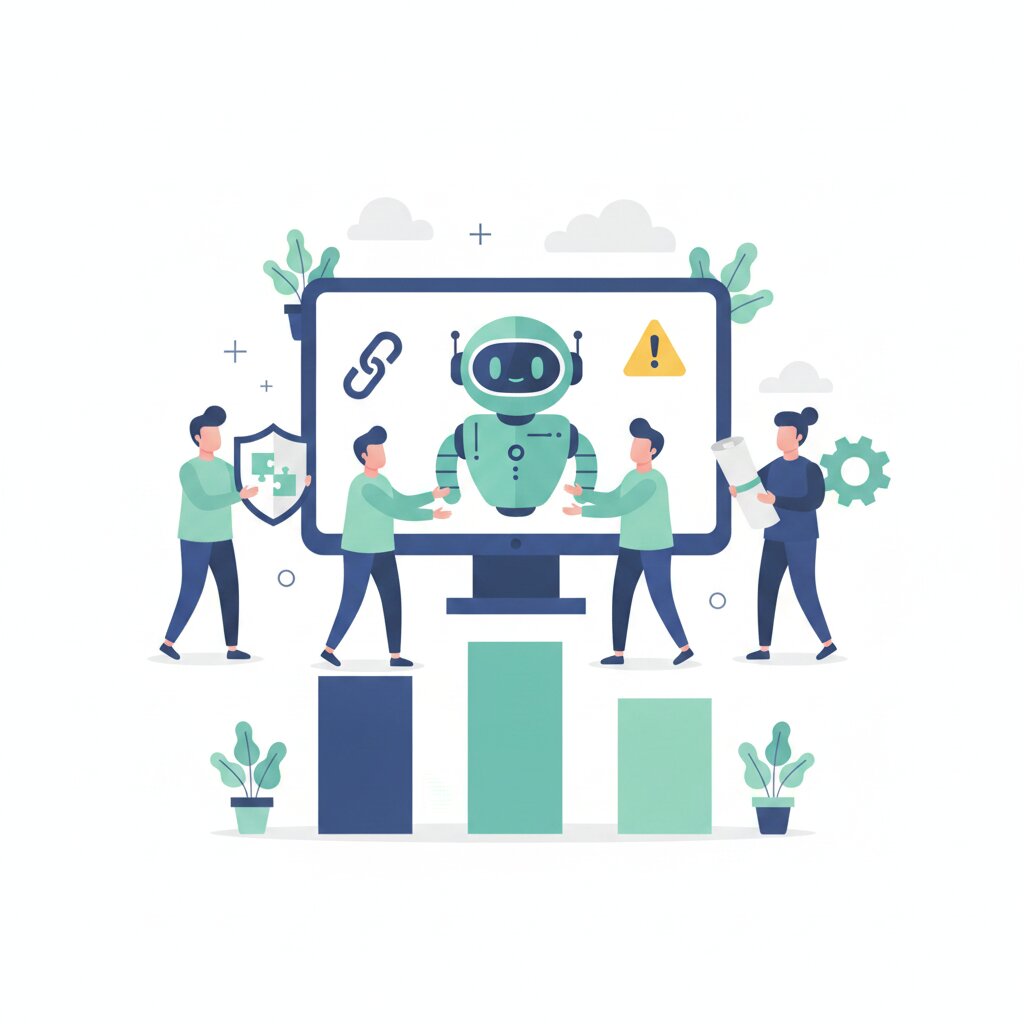
The three domains, psychology, regulation, and architecture, are not a menu of options. They are interlocking necessities, tying psychology, regulation, and architecture into a coherent response to the botsitting crisis. Moral disengagement explains why workers stop supervising AI. Regulation makes supervision legally mandatory. Architecture makes supervision practically feasible at scale. Remove any one prong and the response collapses: psychology without architecture burns workers out on manual context-feeding; architecture without regulation lacks the organisational urgency to justify investment; regulation without psychology creates punitive surveillance that drives AI use underground.
The 69% botshitting rate is not an individual moral failing. It is the predictable output of systems that demand supervision without providing the infrastructure to make it sustainable. Better infrastructure, architecture that frees people to do the judgment work that only people can do, is a deeply human response to the botsitting crisis. The organisations that will thrive combine architectural infrastructure that makes human oversight lightweight with psychological conditions where workers actively seek collegial scrutiny of AI-assisted work.
August 2026 is not a distant deadline. It is the present. Organisations treating the three-pronged response as sequential, psychology first, then regulation, then architecture, will find themselves out of time. The viable path is simultaneous action across all three.
Frequently Asked Questions
What exactly is botsitting?
Botsitting is the hidden labour of making AI useful: feeding it organisational context, debugging its outputs, verifying its claims, and cleaning up the messes it leaves behind. The Glean Work AI Index 2026 quantified this at 6.4 hours per week per knowledge worker, roughly half of all reported AI time savings. It is the unglamorous underside of the AI productivity story that no vendor slide deck mentions.
How is botshitting different from simply making a mistake at work?

Botshitting is not an innocent error; it is the deliberate delivery of AI-generated work that the worker cannot explain or defend. The distinction lies in knowing abandonment: the worker recognises they have not properly verified the output but submits it anyway. Mistakes involve effort and oversight that fell short; botshitting involves withdrawing that oversight entirely, then deflecting accountability onto the tool.
If 69% of workers admit to botshitting, is this a worker problem or a system problem?
It is primarily a system problem with psychological consequences. Workers are placed in environments where context-poor AI tools demand constant, exhausting manual feeding, surveillance-heavy oversight cultures drive AI use underground, and individual productivity metrics reward output volume over output quality. The 69% figure reflects a rational response to a broken system, not a sudden epidemic of professional negligence. Fix the architecture and the psychology follows.
What happens if my organisation simply ignores the botsitting crisis?
Three things converge: operational rot, regulatory exposure, and talent flight. Operationally, AI-generated slop proliferates through decision-making pipelines, eroding institutional knowledge. Under the EU AI Act, organisations deploying high-risk AI systems without meaningful human oversight face enforcement action from August 2026. And workers who spend half their AI time savings on botsitting are workers who will take their skills somewhere that treats their attention as a finite resource.
Can the EU AI Act be enforced against organisations outside the European Union?
Yes, if those organisations place high-risk AI systems on the EU market or their AI outputs affect people within the EU. The Act follows the same extraterritorial logic as GDPR: market access is the lever, not corporate domicile. Australian and American organisations selling AI-powered HR tools, hiring platforms, or critical infrastructure systems into Europe are squarely within scope. Compliance is not optional just because the headquarters is in Sydney or San Francisco.
What is the difference between context engineering and the enterprise graph?
The enterprise graph is the infrastructure (Glean’s connected data model linking people, projects, documents, and organisational knowledge). Context engineering is the practice (Anthropic’s term for curating the optimal information presented to an AI for inference). The enterprise graph provides the raw connective tissue; context engineering determines which threads the AI pulls on for a given task. Both are necessary; neither is sufficient alone.
How do Claude Managed Agents actually reduce botsitting?
Managed Agents reduce botsitting by removing the need for workers to manually shovel context into AI tools before every interaction. Because Managed Agents maintain persistent awareness across scheduled deployments (who the user is, which documents are authoritative, what decisions were made in the last meeting), the worker shifts from context-feeder to judgment-reviewer. The drudgery is automated; the oversight that remains is the oversight that matters.
Is it true that AI-native organisations have a compliance advantage under the EU AI Act?
Yes, and the gap is substantial. AI-native organisations operate with continuous monitoring, agent-aware architecture, and governance assumptions built into their tooling from day one. Legacy organisations must retrofit these capabilities into fragmented systems that were never designed for AI oversight. The compliance burden falls disproportionately on the organisations with the least AI maturity, creating what the article describes as a split change-management landscape.
How can a smaller organisation reduce botsitting without an enterprise graph?
Start with lightweight context engineering: create and maintain a single shared document that maps who does what, which documents are authoritative, and what decisions were recently made. Even manual context curation, applied consistently, reduces the exhausting cold-start problem where every AI interaction begins from zero. The principle matters more than the platform: persistent context trumps fragmented tooling, regardless of budget.
What should I do if my manager is pressuring me to use AI for tasks I know need human judgment?
Name the trade-off explicitly. Frame it not as resistance to AI but as the difference between automation that elevates work and automation that hollows out the capabilities that make your role valuable. Reference the Meaning vs. Automation Trade-off: some tasks should remain stubbornly human because their performance builds skill, preserves organisational memory, and sustains the deep knowledge that AI tools consume but cannot produce. If your manager still insists, document your concerns; the EU AI Act’s human oversight mandates are on your side.
Does psychological safety actually work, or is it just another corporate buzzword?
The evidence is specific. Amy Edmondson’s thirty years of research demonstrates that teams with high psychological safety outperform on precisely the behaviours that counter botshitting: admitting uncertainty, surfacing errors early, and scrutinising each other’s work collegially rather than defensively. In an AI context, this means workers volunteer that they cannot explain an AI output rather than hiding their AI use. The mechanism is not soft; it is the hard precondition for honest disclosure at scale.
How do I know if my organisation’s AI environment is context-rich or context-poor?
Ask four diagnostic questions of each AI tool your teams use: does it know who the user is, what project they are working on, which documents are authoritative, and what decisions were made in the last meeting? If the answer is no across multiple tools and your workers are manually re-entering the same organisational context into different systems, your environment is context-poor. The consequence is predictable: 64% more digital exhaustion and 31% more botshitting than context-rich environments.