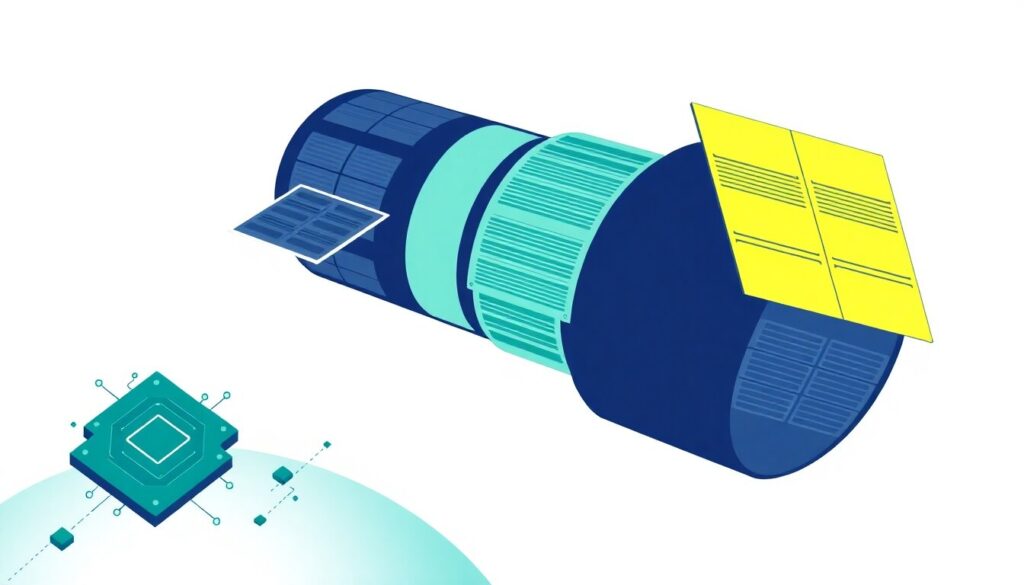

At GTC in March 2026, Jensen Huang announced that “Space computing, the final frontier, has arrived.” Great line. The hardware reality behind it is a bit more specific — and a lot more useful for your planning — than that headline lets on.
NVIDIA rolled out a three-product space computing platform: the Space-1 Vera Rubin Module for orbital AI at scale (not yet shipping), IGX Thor for mission-critical edge work (available now), and Jetson Orin for compact inference on mass-constrained satellites (available now and already in orbit). Alongside those products, NVIDIA announced six launch partners: Aetherflux, Axiom Space, Kepler Communications, Planet Labs PBC, Sophia Space, and Starcloud.
The engineering constraints that make orbital data centre (ODC) deployments tricky come down to three things: SWaP (Size, Weight, and Power), thermal management in vacuum, and radiation tolerance. This article breaks down what each constraint means for your hardware planning, which products address which, and where the six partners actually sit today versus the roadmap.
Space-1 is a 2027 story. IGX Thor and Jetson Orin are ready to go right now.
What Did NVIDIA Announce at GTC March 2026, and Why Does It Matter?
The GTC announcement was more a formalisation of existing momentum than a launch from scratch. Starcloud had already put an H100 into orbit on 2 November 2025 — the first NVIDIA GPU in space — and run Google’s Gemma LLM on it. NVIDIA’s announcement put a name to that trajectory and extended the hardware roadmap.
The three-tier product hierarchy is deliberate. Space-1 is aimed at high-density ODCs running LLMs and foundation model inference in orbit. IGX Thor handles mission-critical edge applications where reliability and functional safety matter most. Jetson Orin covers small form-factor satellites where power and mass budgets are tight.
Naming six partners at launch also signals that NVIDIA wants to be an ecosystem builder, not just a chip vendor. Over 35 companies make up the ODC ecosystem as of mid-2026 — a number ABI Research expects to double by 2027.
How Does the Space-1 Vera Rubin Module Differ From a Standard H100 GPU?
The Space-1 Vera Rubin Module is an integrated CPU-GPU system with high-bandwidth interconnect, built from the ground up for orbital data centres running LLMs and foundation models. NVIDIA claims 25x more AI compute than the H100 for orbital inferencing workloads — no independent methodology backs that figure yet, so treat it as a marketing claim until third-party benchmarks arrive.
Space-1 draws on NVIDIA’s Vera Rubin architecture and is engineered to the SWaP and thermal envelope of space deployment. The design target is the Starcloud milestone — first LLM inference in orbit on an H100 — scaled natively.
Two gaps are worth flagging. NVIDIA has not disclosed silicon specs — die size, memory type, or power envelope. And Chen Su, NVIDIA’s head of edge AI product marketing, confirmed availability in 2027, with no further details on CUDA software-stack compatibility for Space-1. If ground-based CUDA workloads can’t port cleanly, that changes the value proposition significantly. Plan accordingly.
Why Can’t You Put a Standard GPU in a Satellite? The SWaP Constraint Explained
SWaP stands for Size, Weight, and Power — the three-dimensional engineering budget every satellite payload must stay within. SWaP-C adds Cost as a fourth dimension.
Size: a standard H100 PCIe card plus its supporting infrastructure has to fit inside a satellite bus that was never designed around a data centre GPU. Weight: SpaceX has brought LEO launch costs to roughly $1,400/kg for Falcon Heavy, with Starship targeting $100/kg — every kilogram has a direct dollar cost attached to it. Power: an H100 at peak draw is 700W TDP. In LEO, solar power is available roughly 60% of each orbit. For a 2,000-kg satellite generating 100 kW, around 670 kg may go to solar panels alone, leaving very little budget for compute.
Philip Johnston, CEO of Starcloud, put it plainly: “An H100 is probably not the best chip for space, to be honest, but the reason we did it is we wanted to prove that we could run state of the art terrestrial chips in space.” Starcloud’s 59 kg satellite was purpose-built around a single H100. It proved feasibility. But it required engineering an entire spacecraft around the chip.
Jetson Orin is designed for missions where the SWaP envelope leaves no room to move. Compact, low-power, CUDA-enabled — and available now.
How Much Radiator Does Orbital AI Actually Need?
In a vacuum, convection doesn’t exist. No fans. No liquid loops that vent to open air. The only way to shed heat is through radiative cooling — emitting accumulated heat as infrared radiation, governed by the Stefan-Boltzmann law. To shed more heat, you either increase radiator area or increase operating temperature, which affects chip longevity.
ABI Research’s numbers make this concrete: a single H100 GPU needs approximately 1.1 m² of radiator surface. A full DGX H100 system needs approximately 16 m² — larger than a king-sized bed — plus 33 m² of solar panels.
Three design approaches are in use today. Starcloud uses deployable radiators — panels that unfurl after reaching orbit. Sophia Space integrates passive radiators across the entire spacecraft surface. Axiom Space is testing thermal tiles with Spacebilt that radiate heat toward the cosmic microwave background. Active thermal control using space-rated heat pumps is expected to improve radiator efficiency from 2027. The physics of orbital cooling article in this cluster goes deeper on radiator sizing and thermal constraints.
COTS or Radiation-Hardened? Why the Industry Chose Commercial Silicon
Traditional space hardware uses radiation-hardened chips — semiconductors purpose-designed for the ionising radiation of space. They’re reliable. But they’re also expensive, low-volume, and typically one to several generations behind commercial silicon. The most capable rad-hard processor available today can’t run current-generation AI workloads.
COTS — Commercial Off-The-Shelf — means using standard commercial chips in orbit without full radiation-hardening certification. The risk is Single-Event Upsets (SEUs): bit-flip errors in semiconductor memory caused by cosmic radiation. The mitigations are shielding, hardware redundancy, and error-correction software.
Starcloud went COTS. The performance advantage of a current-generation commercial GPU is simply too large to forfeit. But Philip Johnston confirmed that a predecessor mission using an NVIDIA A6000 GPU failed during or shortly after launch — the GPU did not survive. The H100 mission succeeded. That failure is the industry’s concrete data point that COTS in orbit is an engineering tradeoff, not a solved problem.
NVIDIA has not disclosed the radiation tolerance or SEU mitigation approach for Space-1. That’s an unaddressed gap as of mid-2026.
Who Is Building What in Orbit? The Six NVIDIA Space Computing Partners
NVIDIA named six partners at GTC. Each occupies a different position in the orbital compute stack, and they are not all at the same stage.
Starcloud (CEO Philip Johnston) is the furthest along. It launched the first NVIDIA GPU in orbit in November 2025, ran Gemma LLM inference, and raised $170 million Series A. Starcloud-2 will use Blackwell architecture plus an AWS server blade before end of 2026.
Kepler Communications (CEO Mina Mitry) has the largest NVIDIA footprint in orbit today: 10 satellites, approximately 40 Jetson Orin processors — an operational fleet, not a pilot.
Axiom Space launched dedicated ODC nodes in January 2026, handling cloud compute, AI/ML workloads, and data fusion. See the Axiom Space ISS deployment article for the full picture.
Planet Labs PBC (CEO Will Marshall) is integrating NVIDIA platforms across its space-to-ground pipeline for GEOINT workloads, using CorrDiff AI models for near real-time insights.
Sophia Space (CEO Rob DeMillo) raised $10 million seed in February 2026 and is testing its ODC software on Kepler satellites, with its own launch planned for 2027.
Aetherflux (CEO Baiju Bhatt) is pre-launch, planning its first data centre satellite around Space-1 once the module ships.
So: one partner (Kepler) is running substantial NVIDIA hardware in orbit today. One (Starcloud) ran a milestone demonstration. Two (Axiom, Planet Labs) are in active deployment. Two (Sophia Space, Aetherflux) are pre-launch. That gap between announced and deployed is the planning factor that matters most right now.
Orbital data centres currently cost somewhere between 3x and 78x the terrestrial equivalent — 3x per IEEE Spectrum’s operational cost comparison, up to 78x per ABI Research’s full TCO analysis. ABI Research projects convergence by 2035. If your use case is GEOINT, satellite data management, or defence/ISR, the economics work for some operators now. For general compute, not yet. SpaceX’s orbital constellation plans will shape that timeline considerably.
FAQ
What is the NVIDIA Vera Rubin Space-1 module?
An integrated CPU-GPU module on NVIDIA’s Vera Rubin architecture, designed for ODCs running LLMs and foundation models. Claims 25x more AI compute than the H100 for orbital inferencing; no independent benchmark available yet. Announced at GTC March 2026; projected availability 2027 per Chen Su, NVIDIA’s head of edge AI product marketing.
When will the NVIDIA Space-1 be available?
No formal release date. IGX Thor, Jetson Orin, and RTX PRO 6000 Blackwell Server Edition are available now. Space-1 is in the announced-but-not-shipping category; Chen Su confirmed “2027.”
What NVIDIA hardware is available now for orbital deployment?
IGX Thor: mission-critical edge on Blackwell; 8x performance over the previous gold standard. Jetson Orin: ultra-compact AI inference; deployed by Kepler across ~40 processors on 10 satellites. RTX PRO 6000 Blackwell Server Edition: ground-based GEOINT analysis GPU.
What does SWaP mean in the context of satellite computing?
SWaP = Size, Weight, and Power — the engineering budget every satellite payload must stay within. SWaP-C adds Cost. Tighter envelopes require lower-power, lighter, more compact hardware — the reason Jetson Orin exists at the low end of NVIDIA’s space stack.
How does NVIDIA cool a GPU in space if there’s no air?
In vacuum, heat dissipation is only possible through radiation. ABI Research puts the requirement at 1.1 m² of radiator per H100 GPU; 16 m² per DGX H100 system. Approaches: deployable radiators (Starcloud), passive surface radiators (Sophia Space), thermal tiles (Axiom Space/Spacebilt).
What happened to Starcloud’s first satellite attempt?
Starcloud’s predecessor mission using an NVIDIA A6000 GPU failed during or shortly after launch — the GPU did not survive. The H100 mission in November 2025 succeeded, running Gemma LLM inference in orbit. It’s the industry’s concrete data point that COTS in orbit carries real risk.
What is the difference between radiation-hardened and COTS chips for space?
Rad-hard: purpose-designed for ionising radiation; expensive, low-volume, typically one to two generations behind commercial silicon. COTS: modern performance at commercial cost, but carries radiation risk via Single-Event Upsets. The industry chose COTS because modern GPU performance simply isn’t available in rad-hard products.
Does NVIDIA Space-1 support existing CUDA workloads?
NVIDIA has not disclosed CUDA compatibility for Space-1. Jetson Orin is confirmed CUDA-enabled. For Space-1, ground-based workload portability is still an open question.
What is an orbital data centre (ODC)?
A compute facility in orbit — aboard a satellite — running AI inference or data processing workloads in space. Primary advantage: processing sensor data before downlinking reduces bandwidth and latency. Primary challenges: SWaP constraints, thermal management, radiation tolerance, and intermittent solar power.
Is orbital AI computing economically viable?
ABI Research puts current ODC TCO at up to 78x a terrestrial equivalent; IEEE Spectrum at roughly 3x depending on what’s being measured. ABI Research projects $/W convergence with terrestrial by 2035. If your use case is GEOINT or defence/ISR, the economics work for some operators now. For general compute, not yet.
What is the NVIDIA IGX Thor and who uses it?
Industrial-grade, mission-critical edge computing on Blackwell architecture; available now; 8x the compute of the previous gold standard for space-based AI. Supports functional safety, real-time AI processing, and autonomous operation for spacecraft sensor workloads.
Who is Kepler Communications and what are they running in orbit?
Kepler Communications operates the largest NVIDIA deployment in orbit — approximately 40 Jetson Orin processors across 10 satellites, linked by optical laser, for AI-driven data management. CEO Mina Mitry. Not a proof-of-concept — an operational fleet.
The Space-1 hardware story is one layer of a broader shift. Orbital vacuum cooling, underwater data centres, orbital solar power, and the first commercial deployments are each changing the economics of where compute runs. For a complete overview of all the environments and the strategic questions they raise, see our guide to orbital and underwater computing environments.