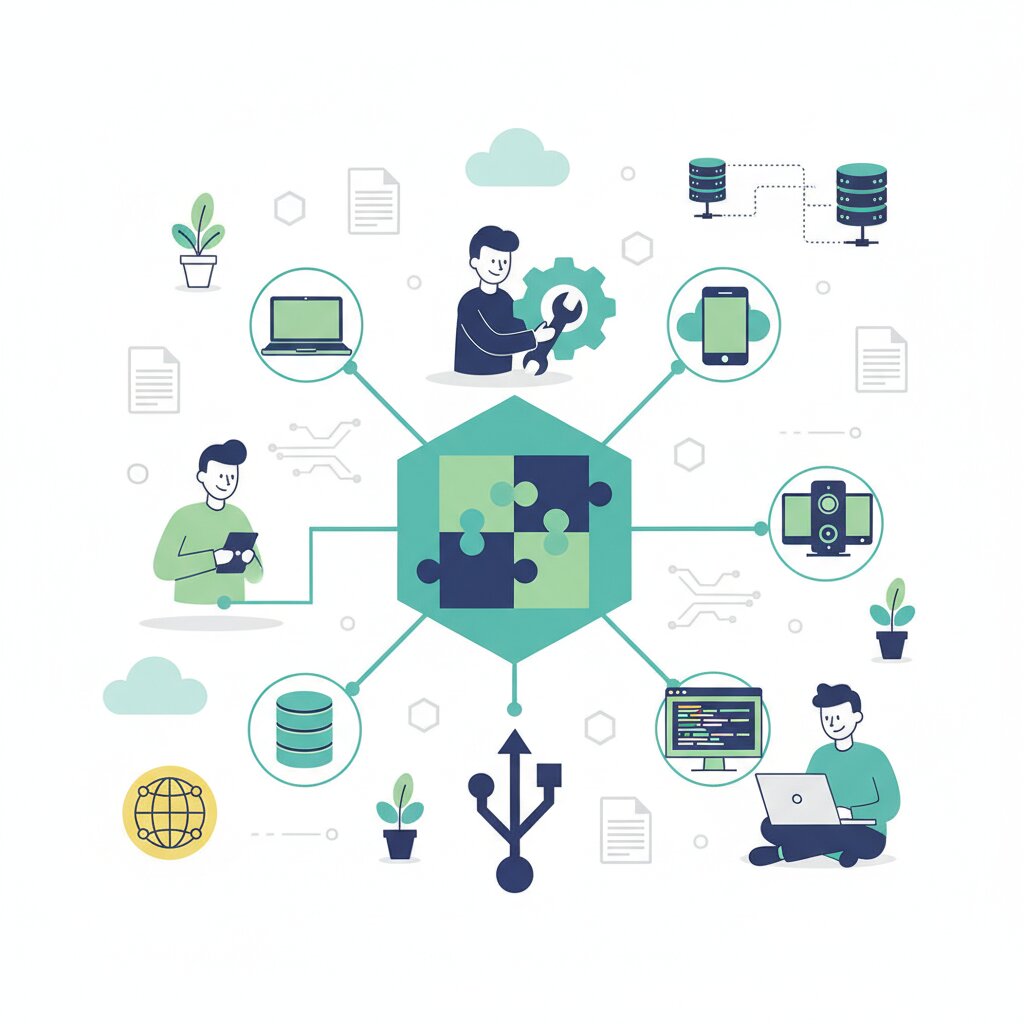

AI agents are stuck in walled gardens. Every vendor, every framework, every platform has its own integration method. This is the N-times-M problem: connect 10 tools to 5 agents and you need 50 custom integrations. The complexity scales quadratically.
This guide is part of our comprehensive multi-agent orchestration overview, where we explore the infrastructure decisions shaping how AI agents coordinate and communicate.
Three protocols are fighting to solve this: MCP from Anthropic, A2A from Google, and AGNTCY from Cisco. MCP is winning. It has 10,000+ public servers, 75+ Claude connectors, and adoption from ChatGPT, Gemini, and Microsoft Copilot.
Think of MCP as USB-C for AI. Just like USB-C killed proprietary charging cables, MCP is killing proprietary agent integrations.
What Is the Model Context Protocol and Why Does It Matter for AI Agents?
MCP is an open standard that enables AI applications to connect dynamically with external data sources, tools, and services through one standardised interface. It’s a universal adapter for AI agents.
The protocol defines three building blocks. Resources give you structured data access from databases, files, and APIs. Tools are executable functions your agents can invoke. Prompts are reusable context templates for common patterns.
Here’s the integration problem in real terms. Without MCP, 10 tools and 5 agents need 50 custom integrations. Every tool needs its own connector for every agent platform. That’s N-times-M complexity.
With MCP, you need 15 integrations total. One MCP server per tool, one MCP client per agent. Build one MCP server wrapper for your tool and it works with every MCP-compatible agent. That’s N+M instead of N-times-M.
MCP uses a client-server architecture with a hub-and-spoke model. Your agent sits at the centre with structured connectors to tools, databases, and APIs. It’s built on JSON-RPC 2.0, giving you bidirectional, stateful communication. Servers can push updates and progress notifications straight into your agent’s context loop. This matters for multi-step workflows.
The key difference from traditional APIs is dynamic discovery. With REST APIs you hardcode endpoints and schemas into your application. If the API changes, your integration breaks until you update the code.
MCP servers expose a machine-readable capability surface discoverable at runtime. When your agent connects to an MCP server, it asks: “What can you do?” The server responds with its available resources, tools, and prompts. Your agent discovers available tools, understands their capabilities, and invokes them without bespoke integration code. Add a new tool to the server and agents discover it automatically.
This dynamic discovery is particularly important for context management implementation with MCP, where agents need to share temporal, social, task, and domain context across orchestration patterns.
Anthropic donated MCP to the Linux Foundation’s Agentic AI Foundation, co-founded with Block and OpenAI. This ensures neutral governance and keeps any single vendor from controlling it.
Why Is MCP Called the USB-C for AI Agents?
The USB-C comparison captures MCP’s role as a universal connector. Just as USB-C replaced fragmented proprietary charging cables with one standard, MCP replaces fragmented agent-tool integrations with one protocol.
Before USB-C you needed different cables for iPhone, Android, laptops, cameras. Before MCP every AI platform required custom integrations with every data source and tool. LangChain had its own connector format. CrewAI had its own. AutoGen had its own. Every integration was bespoke.
The analogy holds at the architectural level. USB-C gives you a standardised physical and logical interface regardless of what device or peripheral is connected. Any USB-C cable into any USB-C port and it just works. MCP gives you a standardised communication interface regardless of which AI agent or tool is connected. Any MCP client can talk to any MCP server.
MCP’s hub-and-spoke integration model mirrors USB-C’s universal port concept. One standard interface, multiple connections, no custom adapters required.
USB-C adoption accelerated once major manufacturers committed. MCP adoption accelerated once ChatGPT, Gemini, Copilot, and Visual Studio Code integrated support. Standards succeed when they hit this tipping point.
The limitation: USB-C is point-to-point while MCP operates in a networked environment with multiple concurrent connections. But the core idea holds.
How Does MCP Compare to A2A and AGNTCY Protocols?
Three major protocols are competing: MCP (agent-to-system), A2A (agent-to-agent), and AGNTCY (enterprise governance).
MCP focuses on standardising how agents connect to external tools, data sources, and services using a hub-and-spoke model. Your agent sits at the centre and all interactions flow through it. Think of it as the vertical integration layer. Your agent needs to query a database? MCP. Call an API? MCP. Access files? MCP.
A2A focuses on enabling direct agent-to-agent communication using a peer-to-peer model where agents discover each other’s capabilities through Agent Cards and collaborate without central orchestration. This is horizontal coordination. One agent handles customer service, another handles billing, a third handles inventory. They need to communicate with each other directly to handle a complex customer request. That’s A2A.
AGNTCY targets enterprise deployments with emphasis on governance, security enforcement, multi-agent system standards, and corporate IT environment requirements. It’s designed for organisations that need strict control, audit trails, and compliance patterns built in from the ground up.
Here’s the thing: MCP and A2A are complementary rather than competing. MCP handles vertical integration (agent-to-system) while A2A handles horizontal coordination (agent-to-agent). Many businesses see benefits when MCP and A2A work together.
Both MCP and A2A have been donated to the Linux Foundation’s Agentic AI Foundation, while AGNTCY remains under Cisco Outshift’s direction.
Governance: MCP and A2A are under open foundation governance. AGNTCY is corporate-controlled.
Vendor support: MCP has adoption from Anthropic, OpenAI, Google, Microsoft, and AWS. A2A has Google’s backing. AGNTCY has Cisco’s support but a narrower ecosystem.
Ecosystem maturity: MCP leads with 10,000+ servers and 97M+ SDK downloads. A2A is newer. AGNTCY has the smallest ecosystem.
Architecture: MCP uses hub-and-spoke centralised control. A2A uses peer-to-peer coordination. AGNTCY uses enterprise governance layers.
Both MCP and A2A sitting under AAIF governance suggests eventual interoperability between them. As OpenAI engineer Nick Cooper noted: “We need multiple protocols to negotiate, communicate, and work together to deliver value for people.”
What Does the MCP Ecosystem Look Like Today?
The ecosystem tells the adoption story. MCP has 10,000+ active public MCP servers. That’s validation that developers are building on this foundation.
Claude has 75+ MCP-powered connectors enabling integration with databases, APIs, development tools, and enterprise systems. The MCP SDKs for Python and TypeScript have hit 97M+ monthly downloads.
Major AI platforms have adopted MCP: ChatGPT, Gemini, Microsoft Copilot, Visual Studio Code, and Cursor. You’re not locked into Anthropic’s ecosystem. This is cross-vendor interoperability actually happening, not just promised.
Infrastructure providers including AWS, Google Cloud, Microsoft Azure, and Cloudflare provide enterprise-grade deployment support for MCP servers.
The Agentic AI Foundation hosts MCP alongside A2A, Goose, and AGENTS.md. AAIF members include AWS, Bloomberg, Cloudflare, and Google.
Real-world deployment numbers matter. OneReach.ai uses MCP as backbone for multi-agent systems, documenting results including 41-point NPS increases and 62% more sessions handled at Lebara telecom. A Global Fortune 50 consumer goods company using MCP reduced onboarding time from 6 weeks to 1 week, achieved 35% reduction in IT helpdesk calls, and 83% employee CSAT.
Popular MCP server implementations connect AI systems to services like Google Drive, Slack, GitHub, and PostgreSQL databases. If you need common integrations, someone has likely built the MCP server already. For detailed analysis of framework MCP compatibility across CrewAI, LangGraph, and AutoGen, we examine which frameworks offer native MCP support versus requiring custom adapters.
How Does Protocol Choice Affect Vendor Lock-in and Interoperability?
Protocol choice directly determines how tightly your AI infrastructure is coupled to specific vendors. Proprietary protocols create lock-in. Open standards enable flexibility.
MCP’s open standard model under Linux Foundation governance means no single vendor controls the protocol’s direction. The Linux Foundation has a track record governing projects like Linux Kernel, Kubernetes, and PyTorch.
Interoperability through MCP means a CrewAI agent can use LangGraph tools without custom integration, because both speak the same protocol. Context sharing standardised through MCP reduces the walled garden problem where agents from different vendors can’t share state, history, or task context.
For switching costs, vendor lock-in means data migration, retraining, and integration rework when you change platforms. It means negotiating new contracts, rebuilding pipelines, and hoping the new platform supports what you need.
With MCP you can swap the agent platform while keeping tool integrations. You can swap tools while keeping the agent platform. The decoupling is the point. Your MCP servers for Salesforce, Postgres, and Slack work the same whether you’re using Claude, ChatGPT, or Gemini as your agent.
This vendor lock-in avoidance becomes especially critical when evaluating whether multi-agent complexity is justified for your use case. Protocol affects integration complexity directly.
Here’s a vendor lock-in risk assessment framework:
Governance model: Foundation-governed or corporate-controlled? Foundation governance reduces risk.
Independent implementations: Are there multiple implementations from different vendors?
Migration paths: Can you switch protocols without rebuilding everything?
Ecosystem diversity: Is the ecosystem dominated by one vendor or distributed?
Choose protocol-agnostic architectures that support MCP today while remaining adaptable to emerging standards. That future-proofs your infrastructure investment.
Which Protocols Are Likely to Emerge as Industry Standards?
Looking beyond current adoption, historical patterns from technology standardisation give us context for predictions. Technology ecosystems typically consolidate around 2-3 dominant protocols while others fade. HTTP, TCP/IP, and USB-C all consolidated from fragmented fields.
MCP is best positioned as the primary standard for agent-to-system integration. The evidence: ecosystem momentum with 10,000+ servers, breadth of vendor adoption across all major AI platforms, and neutral governance under the Linux Foundation.
A2A is likely to emerge as the complementary standard for agent-to-agent communication. Google’s backing provides resources and credibility. Donation to AAIF alongside MCP signals commitment to interoperability rather than competition.
The MCP plus A2A combination addresses the full stack. MCP handles how agents talk to systems (vertical integration). A2A handles how agents talk to each other (horizontal coordination). This is a more likely outcome than a winner-take-all scenario.
AGNTCY faces headwinds as a broad industry standard. Enterprise governance focus is valuable but narrower appeal than general-purpose protocols. Cisco backing provides credibility but limits perceived neutrality. It hasn’t been donated to AAIF, suggesting Cisco intends to maintain control.
That doesn’t mean AGNTCY disappears. It may become a niche enterprise standard for organisations that need its specific governance capabilities. But it’s unlikely to achieve the ecosystem scale of MCP or A2A.
Many organisations adopt a hybrid approach, using A2A for agility while leveraging MCP for regulated, mission-critical workflows. 85% of enterprises plan to implement AI by 2025, and 78% of SMBs are accelerating their AI initiatives. That market shift increases pressure for standardisation.
Convergence signals: both MCP and A2A under AAIF governance suggests eventual interoperability standards bridging the two protocols. OpenAI’s Nick Cooper emphasised: “I don’t want it to be a stagnant thing. They should evolve and continually accept further input.”
Risk factors that could disrupt this: a major vendor could fork or create a competing standard if they decide MCP doesn’t serve their strategic interests, regulatory requirements could fragment standards by jurisdiction (GDPR in EU, different requirements in China), or adoption could stall if the promised interoperability doesn’t deliver in practice.
What Should Organisations Consider When Evaluating Protocol Support?
Prioritise protocols with broad ecosystem support and neutral governance. These are most likely to survive the standardisation shakeout and receive continued investment from multiple vendors.
Evaluate protocol maturity through concrete signals, not marketing claims. Look for production-ready servers, SDK download trends showing sustained adoption, diversity of independent implementations (not just the reference implementation), and real-world case studies with measurable outcomes.
Consider the complementary nature of protocols rather than betting on a single winner. Supporting both MCP (agent-to-system) and A2A (agent-to-agent) gives you complete interoperability coverage across your infrastructure.
Plan for protocol coexistence. Use abstraction layers in your architecture to swap protocols without rebuilding entire systems. Don’t hardcode protocol-specific logic throughout your application. Build interfaces that can be swapped.
Factor in team capabilities. MCP’s JSON-RPC 2.0 foundation and well-documented SDKs lower the barrier for teams already familiar with REST APIs and JSON. If your team knows JavaScript and HTTP, they can learn MCP quickly.
Start with MCP for tool and data source integration as the lowest-risk entry point given ecosystem maturity. Then evaluate A2A when agent-to-agent coordination needs arise. Many organisations begin with MCP, then evolve toward A2A as workflows span multiple functions.
Here’s an evaluation checklist:
Governance: Foundation governance or corporate control?
Ecosystem size: How many servers, connectors, SDK downloads?
Vendor diversity: Adoption concentrated or distributed?
SDK quality: Well-documented and actively maintained?
Case studies: Production deployments with measurable outcomes?
Avoid proprietary protocol commitments without clear migration paths. Architecture decisions matter. The choices you make today about abstraction layers and protocol interfaces determine how flexible your infrastructure will be three years from now.
FAQ Section
What is the difference between MCP and traditional REST APIs?
MCP provides dynamic discovery, bidirectional communication, and stateful sessions that REST APIs lack. While REST APIs require hardcoded endpoints and predefined schemas, MCP servers expose capabilities at runtime through standardised primitives, letting agents discover and use new tools without code changes.
Can MCP and A2A be used together in the same system?
Yes. MCP and A2A are designed to be complementary. MCP handles vertical integration (how agents connect to tools and services) while A2A handles horizontal coordination (how agents communicate with each other).
Is MCP only for Anthropic’s Claude or can it work with any AI model?
MCP is model-agnostic. While Anthropic created MCP, it has been adopted by ChatGPT, Gemini, Microsoft Copilot, Visual Studio Code, and Cursor. The donation to the Linux Foundation ensures MCP is governed as a neutral open standard.
How does the Agentic AI Foundation ensure protocol neutrality?
The AAIF operates as a directed fund under the Linux Foundation, co-founded by Anthropic, Block, and OpenAI with support from Google, Microsoft, AWS, Cloudflare, and Bloomberg. Governance is handled through technical steering committees.
What are MCP primitives and why do they matter?
MCP defines three core primitives: resources (structured data access), tools (executable functions), and prompts (reusable context templates). These primitives provide a standardised vocabulary for what agents can do, enabling any MCP client to understand and use any MCP server’s capabilities without custom integration code.
How many organisations have adopted MCP in production?
MCP ecosystem data shows 10,000+ active public servers, 75+ Claude connectors, and 97M+ monthly SDK downloads. Major platforms including ChatGPT, Gemini, Copilot, and Visual Studio Code have integrated MCP support.
What happens if I choose a protocol that does not become the standard?
The risk is manageable with abstraction layers between application code and protocol implementations. Protocols under foundation governance (MCP, A2A) are lower risk than corporate-controlled alternatives. Starting with MCP represents the lowest-risk entry point given current ecosystem momentum.
Does MCP handle security and access control for enterprise deployments?
MCP supports TLS for encrypted communication, strict tool permissions, scoped credentials, rate limiting, input validation via JSON Schema, audit logging, and least-privilege permission grants. However, organisations must implement these security controls in their MCP server deployments. For comprehensive coverage of security standards including prompt injection threats, tool misuse risks, and governance frameworks, we examine how protocol choice affects security posture.
How does MCP relate to Retrieval-Augmented Generation (RAG)?
MCP and RAG are complementary. RAG handles static indexed content by retrieving documents from pre-built vector stores. MCP provides live lookups from transactional systems, databases, and APIs in real time. An enterprise might use RAG for knowledge base queries and MCP for accessing live customer data.
What is the cost of implementing MCP?
MCP is an open standard with free SDKs for Python and TypeScript. Primary costs are developer time to build MCP servers for internal tools, infrastructure to host those servers, and integration testing. Many common integrations already have community-built MCP servers available.
How does MCP handle multi-agent coordination differently from A2A?
MCP uses a hub-and-spoke model where each agent connects to shared MCP servers for tool and data access. Coordination happens implicitly through shared resources. A2A explicitly manages agent-to-agent communication through capability declarations, task delegation, and direct messaging.
Will MCP replace existing API integrations or work alongside them?
MCP is designed to work alongside existing APIs. MCP servers typically wrap existing APIs, databases, and services with a standardised interface. Organisations can incrementally adopt MCP without rewriting underlying systems.