It feels like 2025 has been the year that AI’s impact shifted from “this could change things” to “this is changing everything”. That might just be our slanted perspective and your experience of AI might be different.
But at SoftwareSeni, our slant is in our name. We’re a software development company and AI’s ability in coding has radically advanced this year.
It seemed to start with a tweet from ex-OpenAI scientist Andrej Karpathy in early February:
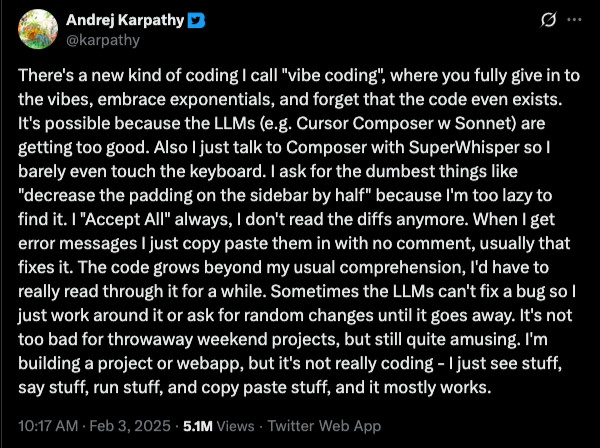
“Vibe coding” turned out to be the first evidence of the growing ability of AI models to take the billions of tokens of code they have been trained on and output not just a line of code or a function, but complete features and basic application architectures.
With the launch of Anthropic’s Claude Sonnet 4 model three months later in May, “vibe coding” transformed into “agentic coding”. Sonnet could perform complex, multi-step tasks that mixed coding, documentation research via web searches, running command line tools, and debugging web applications while they ran in the browser.
The rise of agentic coding
Since May there has been a constant evolution of models, tools, and techniques for integrating these powerful yet error prone “agentic coding assistants” into a software development workflow that remains reliable while maximising the productivity boost they promise.
At SoftwareSeni we’ve been following the progress of Gen AI since OpenAI made GPT-3 publicly accessible in November 2021. You can’t stop developers from playing with new technology, and members of our team have been experimenting with LLMs since the beginning. They’ve built tools around frontier models, run small models locally and practised fine-tuning models.
Another evolution that began in May is the interest from our clients in AI. We have a range of clients and they have a range of technical interests and levels of risk tolerance. It was right after Sonnet 4 was released that the earliest of the early adopters among them started providing coding assistants to our developers on their teams.
Talk of model providers training models on users’ code, and the dangers of having customer IP being transferred piece-by-piece to third parties just by using AI assistants like ChatGPT, Copilot and Cursor, meant that AI usage was always going to be our clients’ decision. The providers have come out with better messaging and product agreements that make it clear they do not train on the data of paying customers, making that decision easier now.
Even though at this stage we couldn’t switch our teams over to use AI coding assistants on client projects, the writing was on the wall and we knew it was only going to be a matter of time before most, if not all projects would be using AI for coding. The reports of increasing developer efficiency and speed of feature development meant that competition in every market was going to accelerate. Anyone who did not adapt would be left behind.
Embracing the change
To make sure our team would be ready when clients moved to integrate AI coding we developed and ran a company-wide AI adoption plan. It covered AI usage across all roles in SoftwareSeni, but with the bulk of the training focused on our developers.
Over three months we took our nearly 200 developers through general training on prompting and context management before doing deep dives across AI assisted architecture and design, coding, and testing.
Alongside these formal sessions we had developers sharing their learnings and we ran “vibe coding” competitions where developers worked in small, product focused teams to rapidly prototype and build MVPs to test their skills and get a better understanding of the capabilities of the AI coding assistants.
We’re seeing the payoff for all that training. Coding is just one part of the software developer’s role, but it is one of the largest parts. And for that part our developers report they are working up to 3 times faster with AI coding assistants. That 3x speed-up is impressive, but only certain coding situations reach such a high multiple.
And there is a price to pay for the speed up. Accelerating code production generates more work for other parts of the process. Unlike code generation, the gains from AI are much smaller throughout the rest of the software development process. Combining this with the increased burden of specifications and reviews created by AI and the result is projects completing 30% faster.
30% is a substantial improvement, with more no doubt to come, but you just need to keep in mind that when you hear about huge speed increases they are often only in one part of a complex process.
The path forward from here
At this point in time the current best practices for using AI coding assistants have started to stabilise. The different platforms – Microsoft Copilot, Claude Code, OpenAI Codex, Google Gemini, Cursor, Windsurf, Amp, Factory…(there are so many) – are all building towards the same set of features where agents code and humans manage and review.
There have been no recent step changes in AI coding ability like the world saw with Sonnet 4 in May. There had been hopes GPT-5 would be the next big advance, but instead its release in August made everyone reduce their expectations of AI taking over the world any time soon.
At SoftwareSeni, the team has worked solidly to advance our developers to the forefront of AI coding assistant practice. With so many talented developers we now have an established practice and systems in place so that as the frontier of AI coding and AI-assisted software development advances, we, and our clients, will be advancing with it.