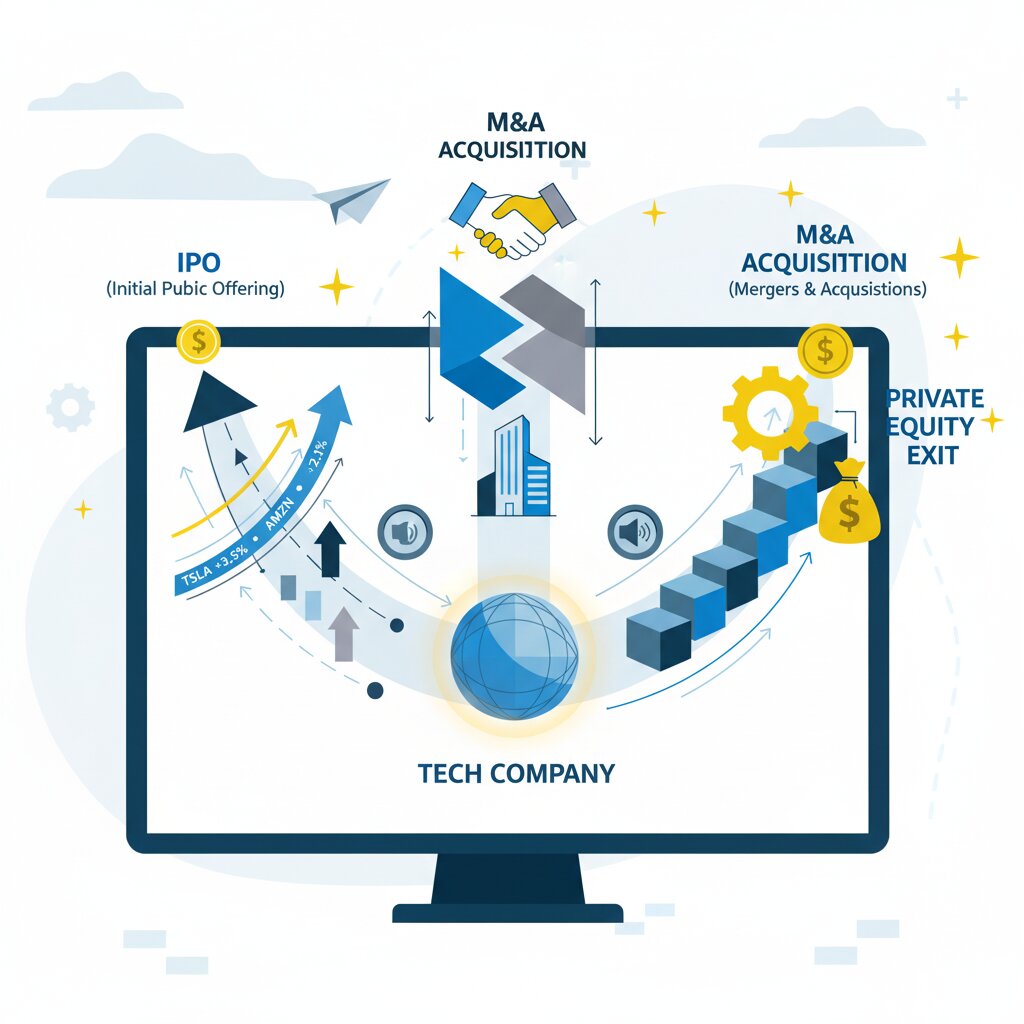

IPO vs Acquisition vs Private Equity Comparing Tech Company Exit Paths
You’re running a mid-market tech company at around $50M ARR. You’ve built something solid, and now you’re facing the big question: which exit path makes sense?
This guide is part of our comprehensive analysis of the IPO market compression reshaping tech company exit strategies. The bar is now at $400-500M ARR. That’s not a small shift—it fundamentally reshapes your options.
Here’s how the three paths break down:
An IPO gives you ongoing liquidity, but you’re looking at 18-24 months of prep and then living with the burden of being a public company. M&A is faster—6-12 months—and you get immediate cash, but you’re handing over the keys. PE buyouts sit in the middle. You get liquidity while keeping operational control, though you’ll roll over some equity and eventually face a second exit down the track.
Let’s break down what each path actually delivers—the valuations, the timelines, and the real outcomes.
What are the main exit paths available for tech companies?
Tech companies have three primary exit paths: IPO, where you sell shares to public markets; M&A, where another company buys you; and PE buyouts, where financial sponsors take controlling stakes.
At $50M ARR in 2025, you’re too small for an IPO (which now requires $400-500M ARR). But you’re large enough to attract strategic acquirers and mid-market PE firms.
The IPO path includes traditional IPOs, direct listings, and SPAC mergers. The M&A path splits between strategic buyers and PE firms. Around 80% of tech startups pursue M&A alternatives rather than going public.
The compressed IPO window is the big issue here. Companies below $100M ARR face poor trading liquidity and depressed valuations if they try to list publicly.
How do valuations compare across IPO, M&A, and PE exits?
Public SaaS companies are trading at a median 6.1x revenue in Q3 2025. Meanwhile, M&A median multiples reached 10.8x EBITDA. Strategic buyers pay 12-15x revenue when they see real synergies. PE firms offer 12-15x EBITDA for profitable companies.
Here’s where it gets tricky. Public markets use revenue multiples. PE uses EBITDA multiples. So a company with $50M ARR and $10M EBITDA might be valued at 6x revenue ($300M) in public markets or 12x EBITDA ($120M) from PE. Same company, completely different frameworks.
All multiples are down 30-40% from 2021 peaks, as detailed in our valuation multiple trends analysis. Private SaaS M&A shows median 4.7x revenue, with the top quartile above 8.2x.
High-quality ARR commands premium valuations. If you’ve got net dollar retention above 110%, gross margins of 75-85%, and churn under 10%, you’re in a strong position. Rule of 40 performance drives value—a 10-point improvement equals about a 2.2x revenue multiple increase.
Deal structure matters more than the headline number. Earn-outs reduce your upfront cash. Stock consideration adds risk. And management rollover in PE deals cuts your net proceeds by 10-30%.
What are the timeline differences for each exit path?
IPO requires 18-24 months. M&A executes in 6-12 months, though competitive situations can accelerate to 90 days. PE buyouts take 9-15 months including due diligence and financing.
The IPO timeline breaks down like this: months 0-3 readiness assessment, months 4-9 systems uplift, months 12-18 execution. The preparation checklists for IPO versus M&A differ substantially—IPO demands SOX compliance and extensive financial systems uplift, while M&A focuses on clean data rooms and quality of earnings. Once you file the S-1, 85% of companies go public within 6 months.
M&A follows a different cadence. You start with teasers and NDAs, run management presentations, sign an LOI, then spend 60-90 days in due diligence.
PE mirrors M&A but adds debt financing complexity. Quality of earnings reports and arranging leverage extend the timeline.
Company readiness is the biggest factor. Clean financials and strong systems accelerate all paths.
How does founder control differ across exit paths?
With an IPO, you answer to public shareholders but you retain operational control if you maintain a voting majority. M&A means immediate transition of complete control. PE buyouts give PE firms board control, but founders often continue as CEO with day-to-day authority.
The IPO control equation revolves around voting power. Dual-class structures let you retain control while selling equity. Though exchanges and investors are increasingly pushing back on this.
Full acquisition means losing control over your brand and product. Earn-outs may preserve autonomy for 1-2 years, but the acquirer holds ultimate authority.
PE control operates through board composition. PE firms take majority board seats and require approval for major decisions. Growth equity allows more autonomy while traditional PE involves heavier involvement.
For CTOs, this plays out differently across paths. M&A often means roadmap control shifts to acquirer priorities. PE preserves technical autonomy while adding financial discipline—you’ll need board approval for a $5M platform rewrite, but not for sprint decisions.
What is the cost difference between IPO, M&A, and PE transactions?
IPO costs run 15-25% of proceeds: underwriter fees of 5-7%, legal and accounting of $5-10M, ongoing SOX compliance of $1-3M annually. M&A costs 3-8%: banker fees of 1-3%, legal of $1-3M. PE deals cost 5-10% for advisors, plus management rollover cuts net proceeds by 10-30%.
For a $100M IPO, underwriter fees alone hit $5-7M. SOX compliance costs $1-2M annually and consumes 10,000 hours of staff time. 43% of executives report accounting costs exceeding expectations.
M&A banker fees follow the Lehman formula: 5% on the first $1M, declining to 1% above $5M. For a $50M deal, expect around $1.5M, roughly 3%.
PE’s hidden cost is management rollover. Expecting $50M in proceeds? A 20% rollover means you only receive $40M in cash upfront.
How do employee equity outcomes differ by exit path?
IPO employees get publicly traded stock with 90-180 day lockup periods. M&A provides immediate cash or acquirer stock, but acceleration caps often reduce outcomes. PE buyouts cash out employees fully but may offer new equity with extended vesting.
The liquidity implications of each exit path vary dramatically—from immediate cash in M&A to extended lockups in IPO to partial liquidity through tender offers for companies staying private. Understanding these trade-offs is essential for communicating with your team and structuring competitive retention packages.
Double-trigger RSUs create major tax hits at IPO. All time-based vested shares fully vest and become taxable as regular income before employees can sell.
M&A outcomes depend on acceleration clauses. Single trigger vests all options at acquisition close. Double trigger requires both acquisition and termination. Many acquirers cap acceleration, which substantially reduces employee outcomes.
Tender offers provide partial liquidity for companies staying private longer. They typically allow employees to sell 20-30% of vested equity.
When should a $50M ARR SaaS company choose each exit path?
Choose IPO when your ARR exceeds $100M with 40%+ growth and you’ve achieved Rule of 40. Choose M&A when strategic buyers offer premiums, you need immediate liquidity, or you’re below the IPO threshold. Choose PE when you’re seeking partial liquidity while continuing to grow, you lack IPO scale, or you need operational expertise.
Here’s the decision framework:
IPO: Not viable at $50M ARR in 2025. The exception: you have a clear path to $100M+ ARR within 18 months.
M&A: A strategic buyer offers >8x revenue, you need liquidity in 6-12 months, and you’re comfortable handing over control.
PE: You want 60-70% liquidity now while keeping 20-30% upside, you’re comfortable with a 3-7 year commitment, and you want to preserve your culture.
Companies need $400-500M ARR for viable IPO. Only 47 tech IPOs occurred in 2024, down from 400+ in 2021. The Stripe and Databricks examples demonstrate how mega-unicorns are using secondary markets and strategic patience to avoid compressed public market valuations—lessons that smaller companies can extract when evaluating their own exit timing.
M&A suitability comes down to strategic fit. If your technology plugs a gap in a larger company’s offerings, you’ll command premium valuations.
Running dual-track processes maximises optionality. You can prepare for IPO while entertaining M&A and PE conversations simultaneously.
What are the tax implications of different exit structures?
Stock sales get long-term capital gains treatment of 20% federal plus 3.8% NIIT if held over 1 year. Asset sales create higher ordinary income taxes up to 37%.
Stock versus asset sale creates buyer-seller conflicts. Buyers want asset purchases for depreciation benefits. Sellers want stock sales for capital gains treatment. The tax rate difference is massive—effective rates of 50-51% for ordinary income versus 34-35% for capital gains in high-tax states.
QSBS provides extraordinary benefits. Founders can exclude up to $10M in gains if they hold shares 5+ years. This creates powerful incentives to delay exits.
State tax variations matter. California imposes 13%+ state tax on capital gains. Texas has none. Some founders establish low-tax state residency before exits to save millions.
How viable are SPACs and direct listings as IPO alternatives in 2025?
SPACs face severe scrutiny after the 2021-2022 failures. They’re only viable for companies with strong fundamentals now. Direct listings work for companies with existing shareholder liquidity needs and brand recognition, but they lack price support. Traditional IPO remains the gold standard.
The SPAC market collapsed. SPAC IPOs raised $9.6 billion in 2024, down from $163 billion in 2021. New SEC rules mandate disclosure of sponsor compensation, dilution risks, and conflicts upfront.
Direct listings save you the 5-7% underwriter fees—that’s millions on large offerings. Spotify and Slack pioneered the approach. But you can’t raise new capital simultaneously, and there’s no price support, which creates volatile opening trading.
What happens to company operations and culture after each type of exit?
IPO companies maintain independence but add public reporting burden, quarterly earnings pressure, and conservative decision-making. M&A involves integration, platform consolidation, and culture absorption over 12-24 months. PE preserves operational independence but adds financial discipline and board oversight.
IPO means SOX compliance, expanded audit teams, and investor relations functions. Disclosure obligations slow strategic moves. Short-term earnings pressure creates tension with long-term investments. But employee equity liquidity improves retention.
M&A integration follows the 100-day plan: systems consolidation, team restructuring, process alignment. Full acquisition means your brand disappears, your roadmap serves acquirer priorities, and your culture gets absorbed.
PE focuses on financial discipline. Profitability becomes paramount—optimise costs while driving revenue growth. Add-on acquisitions often accelerate growth.
FAQ Section
What is the minimum company size needed for each exit path?
IPO requires $100M+ ARR in 2025’s market, up from $50M in 2021, plus 40%+ growth rates. M&A is viable at any scale, but premium valuations start at $20M+ ARR. PE buyouts typically target $30M+ ARR for traditional funds, though growth equity firms invest in companies at $10M+ ARR.
Can a company pursue multiple exit paths simultaneously?
Yes. Sophisticated companies run dual-track processes. This maximises optionality and creates leverage. However, it requires substantial management bandwidth. Prolonged processes can exhaust teams if neither path closes within 6-9 months.
How long do PE firms typically hold companies before exit?
Traditional PE holding periods run 3-7 years. 47% of PE-owned companies were acquired before 2020, showing aging portfolios struggling to exit. Secondary buyouts and continuation funds provide interim liquidity when exit markets are challenging.
What is a direct listing and how does it differ from a traditional IPO?
Direct listing allows existing shareholders to sell shares directly to public markets without underwriter intermediation or raising new capital. This saves the 5-7% underwriter fee and avoids lockup periods. But it provides no price support from banks and faces legal uncertainty around Section 11 liability.
Do strategic buyers or PE firms pay higher valuations?
Strategic buyers typically pay higher valuations when they see significant synergies. PE firms focus on cash flow and often pay lower upfront prices. Which is higher depends on your profitability profile. Profitable companies may get better PE offers, while high-growth companies often see strategic premiums.
What is management rollover in PE deals?
PE firms typically require founders to reinvest 10-30% of proceeds into the newly capitalised entity. This aligns incentives and ensures leaders have “skin in the game” for the 3-7 year hold period until the next exit.
How does QSBS affect exit timing decisions?
Qualified Small Business Stock allows founders to exclude up to $10M in capital gains if they hold shares for 5+ years from issuance. This creates powerful incentive to delay exit until hitting the 5-year anniversary, potentially sacrificing optimal market timing for tax benefits.
What are the odds of a successful IPO in 2025?
The 2025 IPO market remains compressed. Only 47 tech IPOs occurred in 2024 compared to 400+ in 2021. Companies need $400-500M ARR with 40%+ growth for viable IPO. Below these thresholds, M&A or PE exits are far more realistic.
Can founders maintain control after a PE buyout?
PE firms take board control through majority seats and protective provisions. However, they often preserve the founder as CEO with day-to-day authority. You’ll run daily operations independently while needing board approval for major initiatives.
What happens to unvested employee options in an acquisition?
This depends on acceleration clauses. Single trigger vests all options at acquisition close. Double trigger requires both acquisition and termination. Many acquirers cap acceleration, substantially reducing employee outcomes.
How much does it cost to take a company public?
Total IPO costs run 15-25% of proceeds: underwriter fees of 5-7%, legal and accounting of $5-10M, roadshow expenses, and exchange fees. Ongoing costs add $1-3M annually for SOX compliance, audit fees, investor relations, and D&O insurance.
What is the fastest exit path for urgent liquidity needs?
Strategic M&A can execute in 90 days for competitive situations, though 6-12 months is typical. PE deals take 9-15 months. IPO requires 18-24 months minimum. For partial liquidity, secondary sales or tender offers can complete in 30-60 days.
Conclusion
The exit path decision comes down to your scale, growth trajectory, and what you’re optimising for. For a comprehensive view of the market reality overview driving these dynamics, see our full analysis of why public offerings are unrealistic below $100M ARR. For $50M ARR companies, the choice becomes M&A versus PE.
M&A makes sense when strategic buyers offer premiums that reflect synergy value, when you’re ready to hand over control, or when you need liquidity urgently. PE fits when you want to take meaningful chips off the table while having another at-bat, when operational expertise and add-on acquisition support would accelerate your growth, or when you lack IPO scale but aren’t ready to exit completely.
The valuations, timelines, costs, and control implications differ substantially across paths. Understanding these trade-offs before you need to decide puts you in a stronger negotiating position and helps you prepare appropriately. In compressed markets like this one, preparation and optionality matter more than ever.