
It’s September 2026 and thanks to capable large models like Anthropic Fable and OpenAI Astra’s cost and ability to orchestrate hundreds of subagents working in parallel, AI can burn through every dollar you’ve budgeted for your software development team and for your entire company in a matter of days if not hours.
It took Uber a few months to burn through their annual AI budget back in May, giving their C-suite a wake-up call in the midst of the “tokenmaxxing” trend. Meta, Microsoft and other orgs had established leaderboards tracking who was burning the most tokens. It was first-order thinking trying to accelerate AI adoption.
The second-order consequences publicised by Uber killed off tokenmaxxing and set the industry working on “valuemaxxing” instead.
Uber returned this month with a long article showing how they’re leading the charge on the value trend. They captured how they’ve halved costs while 9.4x-ing usage in this little diagram, which we will walk through.
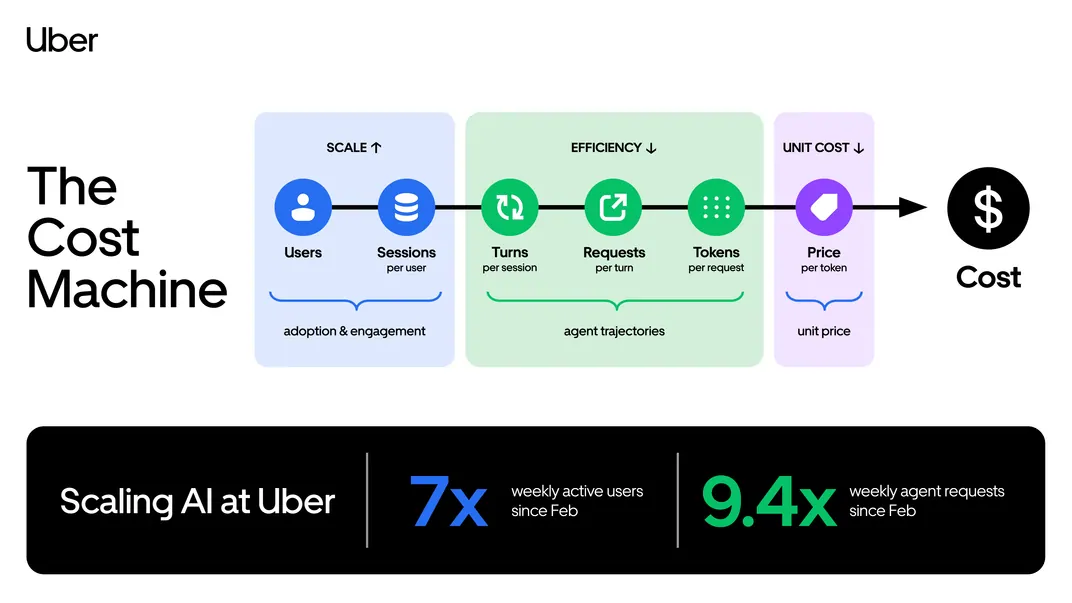
You want your team using AI
You can’t reap any of the gains AI might make possible if you don’t use it. A magic genie (or a monkey’s paw) in a window that can do almost anything involving the operating system, application and data infrastructure society has spent the last 50 years building, and your business has selectively implemented and perhaps documented, needs to be taken advantage of before your competitors.
Using AI agents requires agency in the user. It is not programming, but it requires planning, understanding of processes, and judgement. Not every role currently requires these skills. Quite a few roles are a human behaving as an over-engineered interface between systems , and these are the roles agents can replace, or, taking a more positive approach, the roles that agents can help expand and add value (pour one out for middle management – they were the interface between teams).
Uber put effort into AI adoption across the entire org, not just engineering. But note that they didn’t measure tokens. Instead they measured sessions, a better proxy for usage that maps to value being extracted from AI.
You don’t want to waste AI
If you’re lucky your org is small and you are still using subscriptions instead of paying per token. But, subscriptions need optimisation as much as tokens do. If your team and their processes are relying on Fable to hit the next delivery you don’t want to run out of tokens 5 days away from your next reset.
For companies like Uber it’s $/MToks. They approach this first from the viewpoint of efficiency – the models need to do work, let’s not give them unnecessary work.
They manage the tokens sent for each request to a model by putting a hard cap on the maximum context length. Model performance does deteriorate as context grows, so a cap can add to token reduction if the model gets things right faster. It does require discipline in planning what you will ask the model to do or structuring your work to handle compaction cleanly when your session hits the cap.
The other lever in tokens/request is thinking level. Higher thinking levels means more tokens burned. And the math isn’t simple. A more expensive model might burn fewer tokens than a cheap model for the same request, and that lower token count might result in a lower overall cost. Uber do lots of benchmarking. You might want to establish a process, or a team, for that as well.
The next opportunity is Requests/Turn. This is how much work the agent has to do in order to complete a request. A request where the agent has to scan 5 directories, write 3 scripts and pull down a github repo is going to cost much more than a request where they can query a local RAG store or use a skill that has pre-existing scripts.
This is process optimisation. Even agents need it. If you’re big like Uber you might have people dedicated to this (and a centralised skill repository with monitoring and dashboards…), but for everyone else it’s just asking your agent to dig through your past sessions and look for repeated requests and build a skill to perform them.
You want the cheapest tokens
Reducing the price of tokens sits on three legs: using the cheapest model that can do the work, using the cheapest provider for the model (which may be you), and maximising caching.
Finding the cheapest (normally the smallest) model that can complete a request depends on the request. Is it a recurring request? Then you should have evals that you can use to benchmark new models on that request and switch when a cheaper model passes.
For novel requests that are part of day-to-day agent use, smart routers use a dedicated small model to review the request and direct to the cheapest effective model that can handle it. OpenRouter provides this intelligent model selection in their Auto Router service. Instead of requesting a particular model (like xai/grok-4.6) you request openrouter/auto and it handles the rest.
The challenge with this on-the-fly model selection is that it busts caches. And caching agent sessions is where the money is saved. Even for top tier models caching can save 90-97% on input tokens. And given that agents love reading files and script outputs, the savings are enormous.
There is one other big win in token costs: serving them yourself. For enterprise this means running models on their own racks of GPUs, but “local AI” has undergone a transformation over the last three months, powered by highly capable Chinese open source (and open weight) models. These are models that match the frontier that everyone was so excited about back in April, but they can run consumer grade and workstation grade hardware. Which means they are available to most businesses to run on premises.
With free models matching coding and agentic benchmarks of paid models, if you can keep a machine capable of running a 27 billion parameter model or a 125B A6B model busy (on tasks you’ve benchmarked it against) it can now return a positive ROI in under 3 years, sometimes less than 2 depending on the current costs you’re benchmarking it against.
And, of course, you always need to wonder if there will be a token rug pull once model providers have their IPO and have shareholders. Today’s token prices might be the cheapest they will ever get, even as they continually creep upward. On the other hand, today’s open models that you can run locally are the worst they will ever be.
How are you controlling AI costs?
AI is only just now spreading out of engineering into the rest of the org and we’re already talking about processes and benchmarks and evals.
Who knew that adding agents would reduce your product team headcount while also increasing your internal tooling headcount? It’s almost like if you have enough forklifts you need someone to maintain the forklifts. Agent infrastructure engineers? Perhaps this role is one of the first clearly new roles AI is responsible for. We expect it will last longer than “prompt engineer”.
At SoftwareSeni we’re also in the middle of this. From first steps with Copilot and the initial ChatGPT launch, through late 2025’s agentic awakening our developers have been building with and around AI.
We’re navigating changes across team composition and size, operation roles and headcount, and of course the costs and ROI of adopting AI.
We’re also meeting another challenge – training the next generation of engineers. Like the pure pre-2022 data untainted by AI (which the frontier labs are desperate for), our cadre of experienced engineers, who built their skills on raw brain power, are helping us grow while ensuring our staff remain on the forefront of not just agentic AI, but the skills and knowledge to use it effectively.
If you’re in the market for software engineers or just want to chat about integrating AI into your team and swap notes, hit us up for a chat.