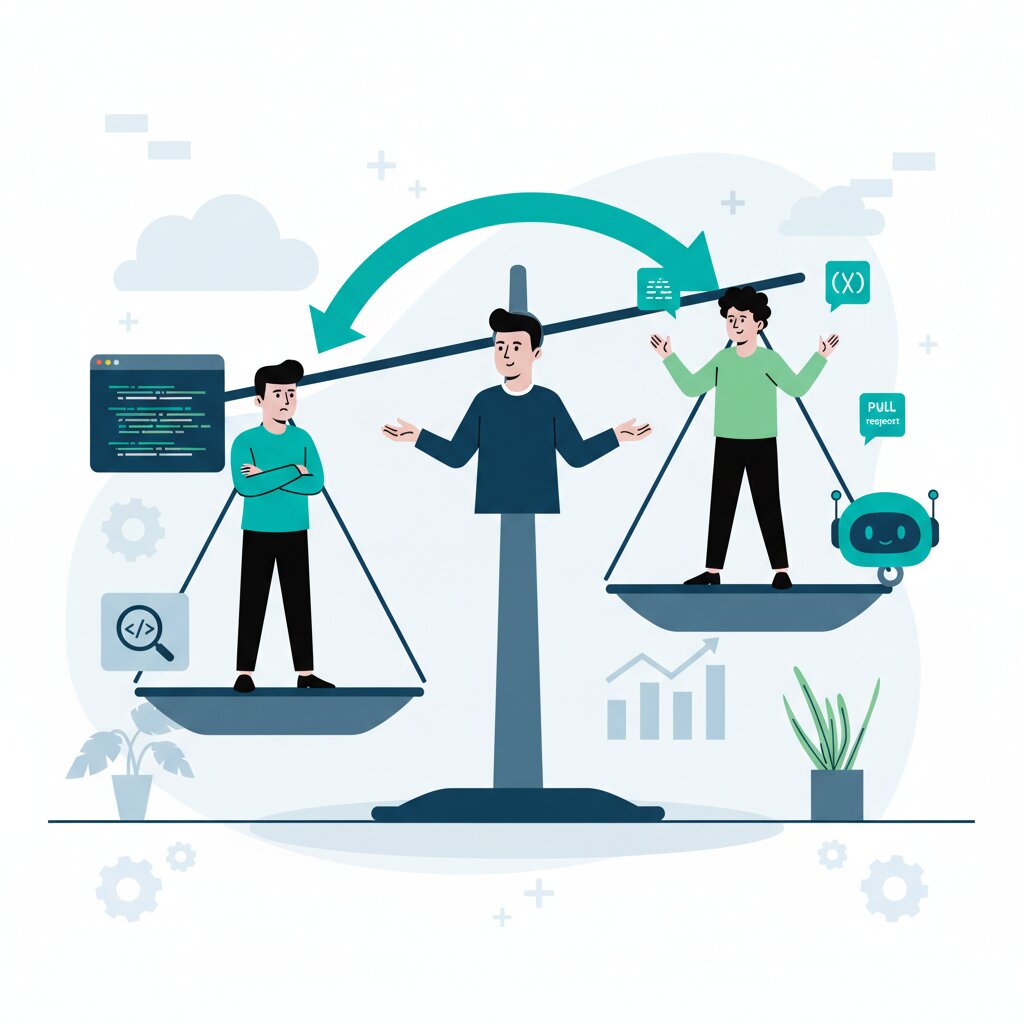

There’s a weird paradox happening in engineering teams. Senior engineers are the group most sceptical about AI coding tools. But research shows that when seniors do adopt, they ship 2.5x more AI-generated code than juniors and deliver big returns through architectural prototyping and AI-assisted debugging.
Meanwhile, juniors who are excited about AI are producing 98% more pull requests, and sceptical seniors are drowning in review work that takes 91% longer. Teams are splitting along experience lines over code quality standards.
This article is part of our comprehensive guide to vibe coding and the death of craftsmanship, where we explore the cultural and technical implications of AI coding tools for engineering leaders.
This is a political and cultural problem with real organisational risk. For small to medium businesses that can’t afford to lose institutional knowledge, this tension needs your attention.
The good news is there’s a practical path: data-backed frameworks for building consensus, redesigning review processes, and finding middle ground without forcing adoption or banning tools.
Why Are Senior Engineers More Resistant to AI Coding Tools Than Juniors?
Faros AI analysed telemetry from over 10,000 developers across 1,255 teams and found that less experienced engineers lean harder on AI tools. Senior engineers with deep system knowledge resist.
It’s not that they’re stubborn or set in their ways. It’s rational caution that comes from experience.
Seniors have lived through hype cycles before. They’ve seen short-term speed create long-term technical debt. They’re on the hook for system health that spans years, not sprints.
Four related barriers drive senior resistance. First, trust and reliability concerns from years of watching cascading errors play out. Second, the complexity gap where AI excels at common patterns but struggles with unique, context-heavy architectural problems. Third, professional identity and craftsmanship values under threat from delegating work they actually enjoy. Fourth, time pressure from juggling technical leadership with hands-on coding that leaves little room for tool experimentation.
Junior enthusiasm comes from different conditions. They work on well-defined tasks with clear requirements. AI helps fill knowledge gaps. They’ve had less exposure to the downstream consequences of subtle code errors. For more on junior developers in the age of AI and skill development concerns, see our dedicated analysis.
Senior developers work on fundamentally different problems. Designing distributed systems. Debugging performance bottlenecks. Making architectural trade-offs. Navigating decades of piled-up technical debt.
The institutional knowledge about why certain architectural decisions were made, where performance bottlenecks exist, and how different systems interact—this context is invisible to AI tools.
As seniority increases, engineers spend less time coding and more time on high-value tasks like collaborating with stakeholders, designing APIs for dozens of teams, optimising queries handling millions of requests, and making architectural decisions with years-long implications.
Trust erosion is real and measurable. Favourable views of AI tools declined from 70% to 60% despite 84% adoption. Only 3% of developers report “highly trust” in outputs, while 46% actively distrust AI tool accuracy.
66% of developers report frustration with “AI solutions that are almost right, but not quite.”
What matters here is that senior scepticism isn’t Luddite resistance. It’s legitimate stewardship and it needs to be validated rather than dismissed.
How Does AI-Generated Code Create a Review Bottleneck for Senior Engineers?
The review bottleneck is where this tension creates concrete organisational pain. Faros AI research shows teams with high AI adoption merge 98% more pull requests, but PR review time increases 91%, and average PR size grows 154%.
The burden falls hardest on senior engineers. They perform code review, they’ve got the architectural context to catch subtle errors, and they understand system-wide implications of changes.
AI-generated code is “almost right but not quite.” CodeRabbit’s analysis of 470 pull requests found AI-authored code contains 1.7x more issues overall.
Logic and correctness errors are 75% more common. Security issues are up to 2.74x higher. Error handling and exception-path gaps are nearly 2x more common. Readability issues spike more than 3x.
PRs per author increased 20% year-over-year thanks to AI, but incidents per pull request increased 23.5%.
Here’s the review paradox – the group sceptical of AI tools is now drowning in AI-generated output they didn’t create and didn’t ask for. They’re forced to spend more time verifying code from a tool they don’t trust.
AI lacks local business logic and infers code patterns statistically, not semantically. Without strict constraints, models miss the rules of your system that senior engineers have internalised.
AI generates surface-level correctness. Code that looks right but may skip control-flow protections or misuse dependency ordering.
Just under 30% of senior developers reported editing AI output enough to wipe out most of the time savings, compared to 17% of junior developers.
Amdahl’s Law applies here – AI accelerates code generation but review, testing, and release remain sequential bottlenecks. The system moves only as fast as its slowest link.
What Is the Unspoken Political Challenge When Half the Team Loves AI and Half Doesn’t?
The team dynamics challenge stems from politics and culture. Engineering teams are dividing into camps along experience lines. Enthusiastic juniors in one corner. Cautious seniors in the other. Code quality debates becoming personal.
The adoption spectrum shows four groups. Enthusiastic Adopters around 25%, mostly juniors. Strategic Users around 35%, mixed experience. Cautious Sceptics around 30%, mostly seniors. Resisters around 10%, predominantly senior.
For SMBs, losing a senior engineer means losing institutional knowledge. Why architectural decisions were made. Where performance bottlenecks exist. How systems interact. Knowledge that no AI tool can replace and no junior can immediately backfill.
You’re caught in the middle. Mandate AI adoption and risk alienating seniors who may leave. Ban AI tools and risk losing enthusiastic juniors who see the organisation as backward. Do nothing and let the tension fester into team dysfunction.
Code quality debates become proxy wars for deeper tensions. Professional identity. Organisational direction. Who gets to define “good engineering.”
Senior developers are essential to your engineering organisation. Win over your senior developers, and scattered AI wins become compounding, org-level impact.
Why Is Senior Scepticism About AI-Generated Code Legitimate?
Senior concerns are backed by independent research, not personal bias. METR’s randomised controlled trial found experienced developers using AI took 19% longer despite believing they were 24% faster.
That’s a perception-reality gap.
The study involved 16 experienced developers working on 246 real open-source issues. Each issue was randomly assigned to allow or disallow AI use.
Code quality data supports senior instincts. GitClear found a 4x increase in code duplication and refactoring collapsed from 25% of changed lines in 2021 to under 10% in 2024.
CodeRabbit found 2.74x more security vulnerabilities in AI-generated code. Logic and correctness errors were 75% more common.
The 70% problem explains why perceived speed gains disappear. After AI generates initial code (the fast 30%), developers face the remaining 70% of work. Integration. Authentication. Security. Edge cases. Debugging. Understanding generated code.
Seniors have seen this pattern before. Short-term velocity gains creating long-term technical debt. AI accelerates this cycle by producing code that looks correct but embeds subtle mistakes at scale.
Kent Beck’s augmented coding framework resonates with seniors because it maintains the values they hold. Caring about code complexity, tests, coverage, and quality while still using AI assistance. In contrast, vibe coding prioritises system behaviour over code quality.
What Is Kent Beck’s Augmented Coding Framework and Why Does It Bridge the Gap?
Augmented coding is Kent Beck’s framework for using AI tools while maintaining code quality. “In augmented coding you care about the code, its complexity, the tests, and their coverage. The value system is similar to hand coding—tidy code that works. It’s just that I don’t type much of that code.”
In vibe coding you don’t care about the code, just the behaviour of the system. If there’s an error, you feed it back into the genie in hopes of a good enough fix. For a detailed exploration of augmented coding vs vibe coding terminology, see our comprehensive definitions guide.
The framework provides common ground because it satisfies both camps. Juniors can use AI tools for code generation. Seniors see their quality standards maintained through TDD, code review, and test coverage requirements.
Tidy First methodology separates structural changes from behavioural changes. Never mix them in the same commit. Always make structural changes first. Validate with tests before and after. Creating disciplined guardrails around AI output.
Kent Beck’s B+ Tree project demonstrates the approach. Write the simplest failing test. Implement minimum code to pass. Refactor after tests pass. Always following the TDD cycle Red → Green → Refactor.
Warning signs that AI is going off track: Loops. Functionality that wasn’t requested. Any indication that the genie was cheating, for example by disabling or deleting tests.
This represents disciplined AI usage that avoids the extremes of blanket adoption or total bans. Seniors maintain authority over architectural decisions and quality standards while embracing AI for eliminating cognitive toil, writing tests, generating boilerplate, and handling routine patterns.
How augmented coding preserves professional identity – it keeps consequential decisions with humans while delegating routine work to AI.
How Can CTOs Build Consensus on AI Tools Without Alienating Seniors or Juniors?
Understanding the augmented coding framework gives you the foundation for building team consensus. Here’s how to implement it across your organisation.
Start by acknowledging concerns with data in Week 1. Present METR data showing 19% slower despite 20% faster belief. GitClear findings of 4x duplication and refactoring collapse. CodeRabbit results showing 1.7x more issues. Validate that senior scepticism is backed by independent research, not personal bias.
Week 2: Establish quality standards. Adopt Kent Beck’s augmented coding framework as the organisational standard. Define requirements for TDD, code review, and test coverage. Implement DORA metrics as objective measurement baseline.
Weeks 3-6: Pilot with volunteers. Start with enthusiastic adopters who volunteer. Measure cycle time, defect rate, and review time. Document what works versus what fails. Keep sceptics informed without pressuring participation.
Week 7: Measure outcomes objectively. Compare pilot group against control group using DORA metrics and cycle time. Present findings to the full team with transparency about both gains and problems discovered.
Week 8 and beyond: Adjust based on evidence. Expand successful patterns. Restrict problematic ones. Iterate with continuous improvement. Avoid both blanket adoption mandates and total bans.
Peer-to-peer learning proved 22% more effective than top-down mandates.
Visible leadership advocacy made developers 7x more likely to become daily users.
Start by identifying respected technical leads inside your company. Empower them to be early champions who openly share their own experiments and lessons with AI.
Give engineers time on the calendar, budget for tool exploration, and a clear message that experimentation is encouraged—even if not every attempt succeeds.
Encourage senior engineers to share their success stories in simple, bite-sized formats. Short demos. Quick team videos. Informal knowledge swaps.
DORA metrics serve as objective, non-partisan measurement framework for evaluating AI tool impact. Deployment frequency. Lead time for changes. Change failure rate. Mean time to recovery.
How Should Teams Redesign Code Review to Handle the AI-Generated Volume?
The problem is structural. 98% more PRs, 91% longer review times, 154% larger PRs, and the same senior capacity. Solutions must address process, not just headcount. For comprehensive review process redesign strategies, see our implementation framework.
Pair review for AI-generated code works like this – assign two reviewers for AI-generated code touching authentication, authorisation, or security-sensitive paths. One focuses on logic. One on security. Reduces individual burden while maintaining quality.
AI code review checklists should cover: project pattern adherence (not generic boilerplate), hard-coded secrets, authorisation checks, comprehensive error handling (not just happy path), edge case test coverage, and project naming conventions.
Automated quality gates include SAST scanning like CodeQL and SonarQube. Secrets detection using git-secrets and TruffleHog. Linting and formatting enforcement with ESLint, Prettier, Black. Test coverage requirements like 80% for new code.
The PR Contract framework requires every PR to include four elements. What and why in 1-2 sentences. Proof it works via tests or manual verification. Risk tier and AI role disclosure. Specific review focus areas for human input.
Break AI-generated work into small, reviewable pieces with clear commit messages. This counters AI’s tendency to generate massive changes that overwhelm reviewers.
AI review tools like CodeRabbit can serve as effective first-pass filters, catching common issues before human review. But they can’t replace senior engineers for architectural alignment, system-wide impact assessment, and context-dependent quality decisions.
The recommended approach is layered review. Automated tools catch formatting, security, and pattern violations. Seniors focus on architectural oversight and business logic validation.
What Should CTOs Say to Juniors, Seniors, and the Board About AI Adoption?
To enthusiastic juniors: “I’m excited you’re exploring AI coding tools. They can eliminate cognitive toil and accelerate certain tasks. To maintain code quality and avoid the productivity paradox we’re seeing industry-wide, we’re adopting Kent Beck’s augmented coding framework: use AI, but with TDD, code review, and test coverage. This ensures we capture velocity gains without piling up technical debt.”
To sceptical seniors: “Your concerns about AI-generated code quality are backed by independent research. GitClear found 4x code duplication and refactoring collapsed by 60%. CodeRabbit found 1.7x more issues in AI code. We’re not doing blanket adoption. We’re implementing Kent Beck’s augmented coding framework with enhanced quality gates. You’ll have authority to require manual implementation for complex or security-sensitive code. Your expertise is indispensable for reviewing AI-generated code and maintaining our standards.”
To the board: “We’re taking a strategic selective adoption approach to AI coding tools. Industry research shows a productivity paradox: developers feel 24% faster but measure 19% slower due to review bottlenecks and code quality issues. We’re piloting AI usage with quality gates (automated testing, security review, enhanced code review) to capture genuine gains while avoiding technical debt accumulation that would slow delivery long-term. We’ll measure outcomes with DORA metrics and adjust based on evidence.”
For the broader strategic context on how AI is reshaping engineering culture and what this means across your organisation, see our vibe coding complete guide for engineering leaders.
The engineers who turn AI tools into real leverage are senior by definition — and scarce by market reality. SoftwareSeni’s extended development teams add experienced developers to your roadmap, working hours that overlap yours, without running a hiring round first.
add senior developers to my roadmap without a hiring round →
“I’ve worked with SoftwareSeni for many years now across different CTO roles. Davo and his team are such a pleasure to work with and they have always provided the best and most capable resources when I needed them. They run a well oiled process to ensure they find and present the best candidates, plus they ensure smooth onboarding process. I highly recommend SoftwareSeni to any company that is wanted to expand their team and keen to explore an embedded team model.”
— Simon Farrell, VP of Engineering, Forage
Frequently Asked Questions
Do senior engineers who adopt AI tools become more productive than juniors?
Yes. Fastly’s survey of 791 developers found that about a third of senior developers say over half their shipped code is AI-generated—nearly 2.5x the rate reported by junior developers at 13%. Their architectural knowledge and system understanding mean they can direct AI tools more effectively, catching errors juniors miss and applying AI to higher-impact tasks. The challenge is getting them to adopt in the first place.
Why do developers believe AI makes them faster when research shows it makes them slower?
METR’s randomised controlled trial found a perception-reality gap – developers expected AI to speed them up by 24%, and even after experiencing a 19% slowdown, they still believed AI had sped them up by 20%. The likely explanation is that AI eliminates tedious typing and boilerplate work, which feels faster, but the time spent prompting, reviewing, correcting, and integrating AI output exceeds the time saved.
Should I ban AI coding tools on my team?
Banning AI tools risks losing enthusiastic team members and falling behind industry adoption. Instead, adopt a “strategic selective” approach using frameworks like Kent Beck’s augmented coding – allow AI usage with quality gates including TDD, code review requirements, and test coverage thresholds. This maintains quality standards while capturing genuine productivity gains.
How do I know if AI tools are actually improving my team’s productivity?
Measure organisational outcomes rather than individual activity. Track DORA metrics (deployment frequency, lead time, change failure rate, mean time to recovery). Compare pilot groups against control groups. Look at cycle time and defect rates rather than lines of code or PR counts. Faros AI’s research shows individual gains often fail to translate to company-level improvements.
What is the difference between vibe coding and augmented coding?
Vibe coding prioritises speed over correctness – developers accept AI-generated code based on whether it “feels right” without thorough verification. Augmented coding, Kent Beck’s framework, maintains traditional engineering values: caring about code complexity, tests, coverage, and quality while using AI to generate code. The distinction is whether you care about the code itself or only the behaviour of the system.
How much does AI-generated code increase code review time?
Faros AI’s analysis of 10,000+ developers found AI adoption increases PR review time by 91%, with PRs growing 154% larger and teams merging 98% more of them. CodeRabbit’s study found AI-authored PRs contain 1.7x more issues, meaning each review requires more thorough scrutiny. The review bottleneck is now the primary constraint on delivery velocity in AI-augmented teams.
Can I use AI code review tools to replace senior engineer review?
AI review tools like CodeRabbit can serve as effective first-pass filters, catching common issues before human review. However, they can’t replace senior engineers for architectural alignment, system-wide impact assessment, and context-dependent quality decisions. The recommended approach is layered review – automated tools catch formatting, security, and pattern violations; seniors focus on architectural oversight and business logic validation.
How do I convince sceptical senior engineers to try AI tools without mandating adoption?
Peer-to-peer learning is 22% more effective than top-down mandates. Identify respected senior engineers who are willing to experiment. Give them dedicated time and budget for exploration. Have them share results with colleagues. Faros AI’s case studies show that visible leadership advocacy makes developers 7x more likely to become daily users, but the advocacy must come from trusted technical voices, not management directives.
What should I measure during an AI coding tool pilot?
Track four categories: velocity (cycle time, deployment frequency), quality (defect rate, change failure rate, code review feedback), volume (PRs merged, PR size, review time), and team health (developer satisfaction, context switching, review burden distribution). Compare these metrics between the pilot group and a control group over at least 4-6 weeks to get meaningful signal.
Are there specific tasks where AI tools help seniors versus tasks where they should be avoided?
AI excels for seniors at: documentation drafts, test data generation, boilerplate code, exploring unfamiliar frameworks, writing performance benchmarks, and routine bug fixes. Seniors should avoid AI for: core architectural decisions, performance-sensitive code sections, complex debugging of production systems, and security-sensitive authentication and authorisation logic. Kent Beck’s augmented coding framework provides specific guidance on this boundary.
For more strategic guidance on navigating the vibe coding phenomenon, explore our complete strategic framework for engineering leaders, which synthesizes team dynamics, consensus-building approaches, and actionable implementation strategies.
Wondering where you’ll find senior engineers who can make AI tools actually pay off? Talk to us about extending your team