
Most engineering teams are using AI coding tools. The majority are still at the autocomplete stage — accepting or rejecting single-line suggestions from tools like GitHub Copilot. Useful, sure. But ergonomic improvement is not a productivity transformation.
A qualitative shift has already happened. A new category of autonomous AI coding agents now operates asynchronously, writes multi-file changes, runs tests, and submits pull requests — without a human in the loop. At Ramp, an internal agent called Inspect handles roughly 30% of pull requests across both frontend and backend repositories. At Uber, FlakyGuard processed 1,115 flaky tests over six months and delivered 197 merged fixes, without a human engineer assigning a single task.
Understanding where autocomplete ends and autonomous agents begin actually matters — the implications for team structure, governance, and process hygiene are fundamentally different at each level. This article is part of our complete guide to AI coding agents as autonomous teammates, uses the Swarmia five-level autonomy taxonomy as its organising framework, and grounds every claim in verified production evidence.
What is an autonomous coding agent — and why is it different from the AI in your IDE?
An autonomous coding agent performs multi-step software engineering tasks — writing, testing, debugging, and submitting code — without you watching over its shoulder after the task is assigned.
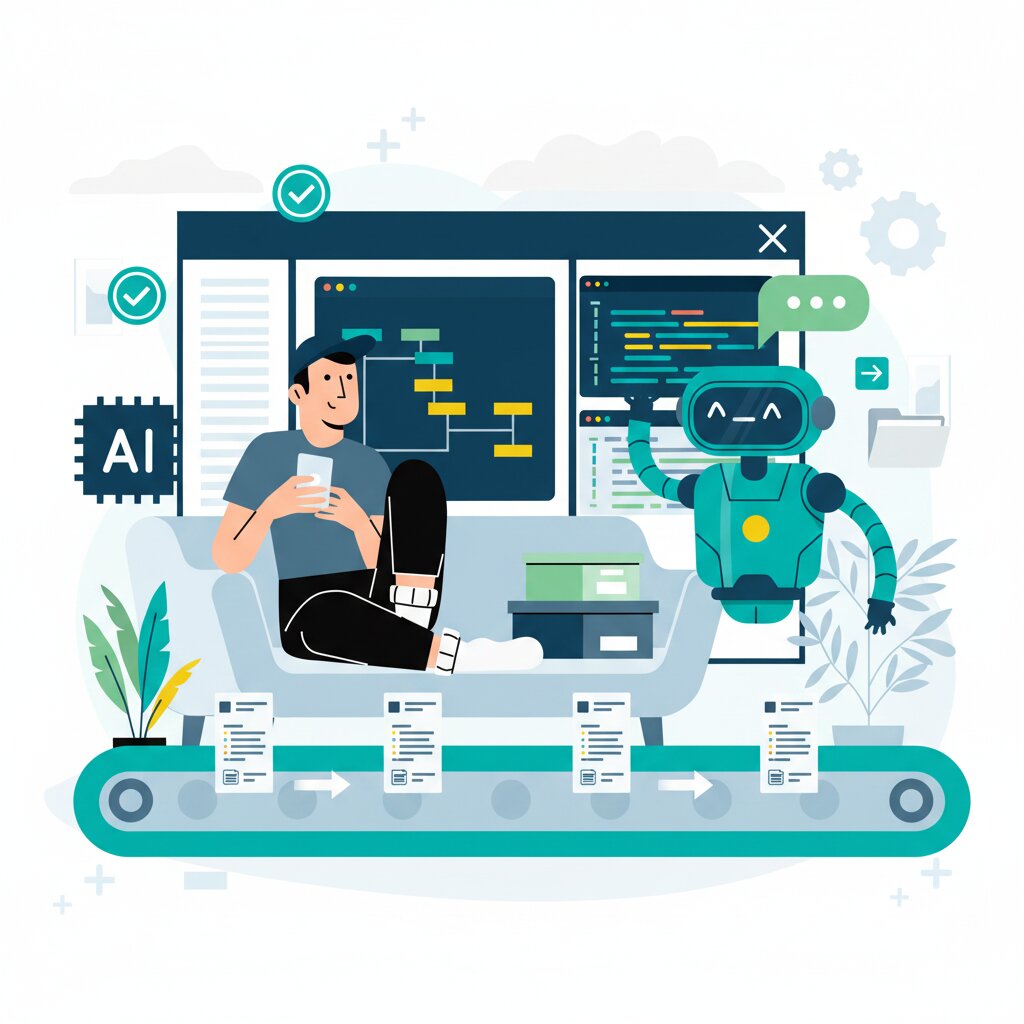
The defining characteristic is asynchronous operation. Unlike GitHub Copilot, which operates inline and requires you to accept or reject each suggestion before anything happens, an autonomous agent receives a task, works on it independently, and returns with a completed pull request for you to review.
Here’s the practical test: can you assign a coding task from your phone, close your laptop, and come back later to review a finished PR? If yes, you are working with a Level 3 or Level 4 agent. If the AI stops whenever you stop, you are working with an assistant.
At Level 1–2, engineers remain the author of every line of code they accept from the AI. At Level 3–4, engineers become reviewers of agent-submitted work. The agent is the author; the engineer is the gatekeeper. That changes what you govern, what process hygiene matters, and what infrastructure you need.
The practitioner term for this second category is “background coding agent” — used by both Ramp and Spotify to describe agents running outside the editor, asynchronously, while developers work on other things.
What are the five levels of AI coding agent autonomy?
The Swarmia five-level autonomy taxonomy, published March 2026, classifies AI coding tools along a single dimension: how much of the work the agent completes autonomously before returning to you for feedback. It is not a ranking where higher is always better. Think of it as a staffing decision — using a powerful autonomous agent for work requiring constant human judgement is wasted potential; putting one in charge of mission-critical systems without oversight is a different kind of mistake.
Level 1 — Assistive: Inline suggestions within a single file. You feed it context, it responds in isolation. GitHub Copilot is the canonical example. Useful, widely adopted, limited to synchronous single-file operation.
Level 2 — Conversational: Multi-turn dialogue that can navigate the repository and write across multiple files while you steer. The agent moves fast, but you decide where it goes. Copilot Chat and Cursor in chat mode operate here.
Level 3 — Task Agent: You hand off a task and come back to a pull request. The agent plans, edits across multiple files, runs tests, opens a PR, and responds to review comments — without you watching each step. Bug reports, dependency updates, features with complete specs — tasks that slip down the backlog because triage overhead outweighs the actual work — get resolved without consuming senior engineering time. Ramp Inspect and Spotify Honk operate here.
Level 4 — Autonomous Teammate: The agent stops waiting for you to assign it work. It picks tasks on its own and runs continuously. Best candidates are flaky test repair, documentation drift, and dependency updates. Uber FlakyGuard is the primary documented example. GitHub Agentic Workflows (technical preview, February 2026) also ships prebuilt scheduled agents at this level.
Level 5 — Agentic Avalanche: Multiple agents working together — orchestrators spawning subagents, coordinating across repositories — with minimal human supervision. Most teams are not here. Cursor’s FastRender project offers a glimpse: a three-tier Planner/Worker/Judge hierarchy running up to 2,000 parallel instances generating over one million lines of code.
The taxonomy is the organising framework for this entire content cluster — knowing where you sit tells you which subsequent articles on context engineering, code rot and the hidden costs, safe sandbox infrastructure, and the build vs. buy decision are immediately relevant to you.
What does Ramp’s 30% pull request figure actually tell us about production-scale adoption?
Ramp’s Inspect agent handles roughly 30% of pull requests across both frontend and backend repositories — the most thoroughly documented production metric for a Level 3–4 background coding agent.
Ramp is an SMB-scale FinTech company. That matters, because it is not Google or Meta. Level 3–4 is accessible outside hyperscaler contexts.
The 30% figure emerged organically — Ramp did not mandate Inspect’s use. Engineers adopted it for tasks where it matched human output in quality, speed, or convenience. Sustained voluntary adoption, not a top-down pilot.
The key differentiator is the Verification Loop. Earlier code generation tools produced output and submitted it. Inspect validates its own output using the same tools Ramp’s engineers use: CI/CD pipelines, Sentry, Datadog, and GitHub. The agent runs tests, checks monitoring dashboards, and confirms frontend changes visually in a real browser before submitting — producing the same evidence a human engineer would produce.
Ramp built Inspect internally rather than buying off-the-shelf. Internal tools integrate deeply with proprietary systems that external vendors cannot reach — trading upfront engineering investment for long-term architectural control. It is the primary case study for the build vs. buy decision companion article.
What does Uber’s FlakyGuard tell us about Level 4 autonomous operation?
FlakyGuard is Uber’s autonomous flaky test repair system, published as a peer-reviewed paper on arXiv in November 2025 (arXiv:2511.14002). In six months of daily autonomous operation it analysed 1,115 flaky tests, generated fixes for 380, and had 197 merged into the codebase.
The Level 4 characteristic: the agent owns both detection and repair. At Level 3, a human assigns the task; at Level 4, the agent identifies what needs fixing without being told. No engineer assigned individual tests to FlakyGuard — it runs as a continuous, self-directed repair loop.
Flaky test repair is a good first domain for Level 4. The problem recurs predictably, the outcome is measurable, and the risk is bounded — a broken fix shows up in CI before reaching production. Bounded-scope Level 4 agents are more achievable than general-purpose autonomous systems, and they still deliver real throughput on the work senior engineers least want to do.
What does the DORA report say about AI adoption and engineering performance?
The 2025 DORA State of DevOps report, surveying nearly 5,000 technology professionals, found something that cuts against vendor marketing: AI does not create organisational excellence. It amplifies what already exists.
The core finding, as analysed by CircleCI: for teams with solid foundations, AI is a force multiplier. For teams with broken processes, it magnifies the chaos.
Organisations with strong CI/CD pipelines and fast review cycles saw measurable gains. Those with weak practices saw the dysfunction worsen — code volumes increased, deployment frequency stayed flat or declined.
The review burden is the primary mechanism. A developer using AI can generate a 2,000-line pull request in five minutes. The senior engineer reviewing it needs three hours. AI accelerates code production; the review bottleneck absorbs the gain. High AI adoption correlates with larger pull requests and longer review times — autonomous agents can outpace human review capacity if processes are not adapted.
So the real question shifts. It’s not “does AI make teams more productive?” It’s “is my team’s practice good enough to benefit at higher autonomy levels?” Moving from Level 1–2 to Level 3–4 without addressing process hygiene is likely to worsen outcomes, not improve them.
What does the shift from autocomplete to autonomous agent mean for how engineering teams work?
The shift from Level 1–2 to Level 3–4 changes what engineering teams govern, not just what tools they use.
Review skills change. Reviewing an agent-generated PR means assessing code you did not watch being written, often across multiple files, where changes may reflect the agent’s interpretation of the spec rather than your design intent.
Review processes need to adapt. Without adapted processes, agent-generated PRs create a bottleneck at the review stage. Keep tasks scoped: small changes, strong CI, clear diffs. Inspect’s Verification Loop is one architectural response — self-validation reduces review burden by providing evidence rather than requiring the reviewer to reconstruct it.
The prerequisites matter. Level 3 only works well if your engineering pipeline is already in good shape. Teams that have optimised for fast CI, high test coverage, and short lead times are better positioned at higher autonomy levels.
The production evidence shows this shift is real and underway — not a future state. Since mid-2024, around half of Spotify’s pull requests have been automated by their Fleet Management system, achieving 60–90% time savings across complex changes.
For engineering leaders, the question is not “should we adopt autonomous coding agents?” It is: at which level are we currently operating, and what would it take to move to the next level safely?
The subsequent articles provide the practical depth: context engineering for reliable agent operation, the hidden code quality costs of higher autonomy, safe sandbox infrastructure for Level 3–4 deployment, and the build vs. buy decision. For the complete view of the autonomous coding agent landscape, see our complete guide to AI coding agents as autonomous engineering teammates.
Frequently Asked Questions
What is the difference between an AI coding assistant and an AI coding agent?
An AI coding assistant (such as GitHub Copilot) provides inline suggestions and requires human acceptance of every output. An AI coding agent operates asynchronously, performs multi-step tasks across multiple files, runs tests, and submits pull requests without continuous human input. The assistant helps you write code; the agent submits code for you to review.
What are the five levels of AI coding agent autonomy in the Swarmia taxonomy?
Level 1 (Assistive): inline single-line suggestions, human-accepted — GitHub Copilot. Level 2 (Conversational): multi-turn dialogue in-editor, iterative refinement. Level 3 (Task Agent): scoped task completion, PR submission, human reviews output — Ramp Inspect, Spotify Honk. Level 4 (Autonomous Teammate): recurring autonomous operation without human task assignment — Uber FlakyGuard. Level 5 (Agentic Avalanche): coordinated multi-agent systems across repositories.
How does Ramp’s Inspect coding agent actually submit pull requests?
Inspect runs in sandboxed virtual machines, uses Cloudflare Durable Objects for state management, and validates its own output using Ramp’s CI/CD pipeline, Sentry, Datadog, and GitHub before submitting a PR. This Verification Loop — where the agent checks its work using the same tools human engineers use — enables autonomous PR submission without human oversight during execution.
Can an AI agent really handle 30% of my engineering team’s pull requests?
Ramp’s Inspect agent handles approximately 30% of PRs across both frontend and backend repositories — sustained production throughput from voluntary adoption, not a pilot metric. The DORA 2025 report makes clear this depends on strong underlying engineering practices. Teams with weak pipelines are unlikely to replicate this without addressing prerequisites first.
What is a “background coding agent” and how is it different from a chatbot?
A background coding agent runs asynchronously outside the developer’s editor. Chatbots require a human to initiate each exchange and accept each output; a background coding agent is assigned a task (or identifies one autonomously at Level 4), executes multi-step work in an isolated environment, and delivers a completed pull request. Both Ramp’s Inspect and Spotify’s Honk are described by their teams this way.
What did Uber’s FlakyGuard actually accomplish?
FlakyGuard processed 1,115 flaky tests over six months in daily autonomous operation and produced 197 merged fixes without human task assignment. The agent identified which tests needed fixing, generated repairs, submitted PRs, and measured merge outcomes — Level 4 autonomy. Results were published as a peer-reviewed arXiv paper in November 2025.
What does “AI is an amplifier” mean in the DORA report?
The DORA 2025 finding, analysed by CircleCI, is that AI coding tools amplify existing strengths and weaknesses rather than uniformly improving output. Teams with strong CI/CD pipelines see measurable gains; teams with weak practices see their dysfunction worsen. Fixing process problems before increasing autonomy levels is a prerequisite, not an optional step.
Why do AI coding agents make pull requests larger and review times longer?
High AI adoption correlates with larger pull requests and longer review cycle times. Autonomous agents generate multi-file changes faster than human review capacity can process them. Without adapting PR review processes, the net effect on delivery lead time can be negative despite higher code output.
Is building an internal coding agent (like Ramp) better than buying a third-party tool?
Ramp built Inspect internally rather than buying off-the-shelf, giving them full control over the Verification Loop and deep integration with existing tools. The build decision trades upfront investment for long-term architectural control. Whether build or buy is right depends on team capacity, integration depth, and timeline — explored in the build vs. buy companion article.
How is Level 3 autonomy different from Level 4 autonomy in practice?
At Level 3, a human assigns the task and the agent completes it autonomously. At Level 4, the agent identifies what needs doing without being assigned — running on a schedule, detecting problems, generating fixes, and submitting PRs. FlakyGuard is the clearest example: no engineer assigns individual flaky tests; it operates as a continuous, self-directed repair loop.
What infrastructure do autonomous coding agents require?
Level 3–4 agents require sandboxed execution environments, a state management mechanism for long-running tasks, and integration with the team’s CI/CD pipeline for output validation. Running agents unattended without this creates risk of unsafe code execution — the architectural requirements are covered in the companion article on safe sandbox infrastructure for unattended agents.
Are autonomous coding agents replacing software developers?
The production evidence — Ramp, Uber, Spotify — shows autonomous agents handling bounded task categories while human engineers handle architectural decisions, complex debugging, and PR review. The human reviewer role becomes more important, not less, as agent PR volume increases. The shift is from developer-as-writer to developer-as-reviewer-and-architect.