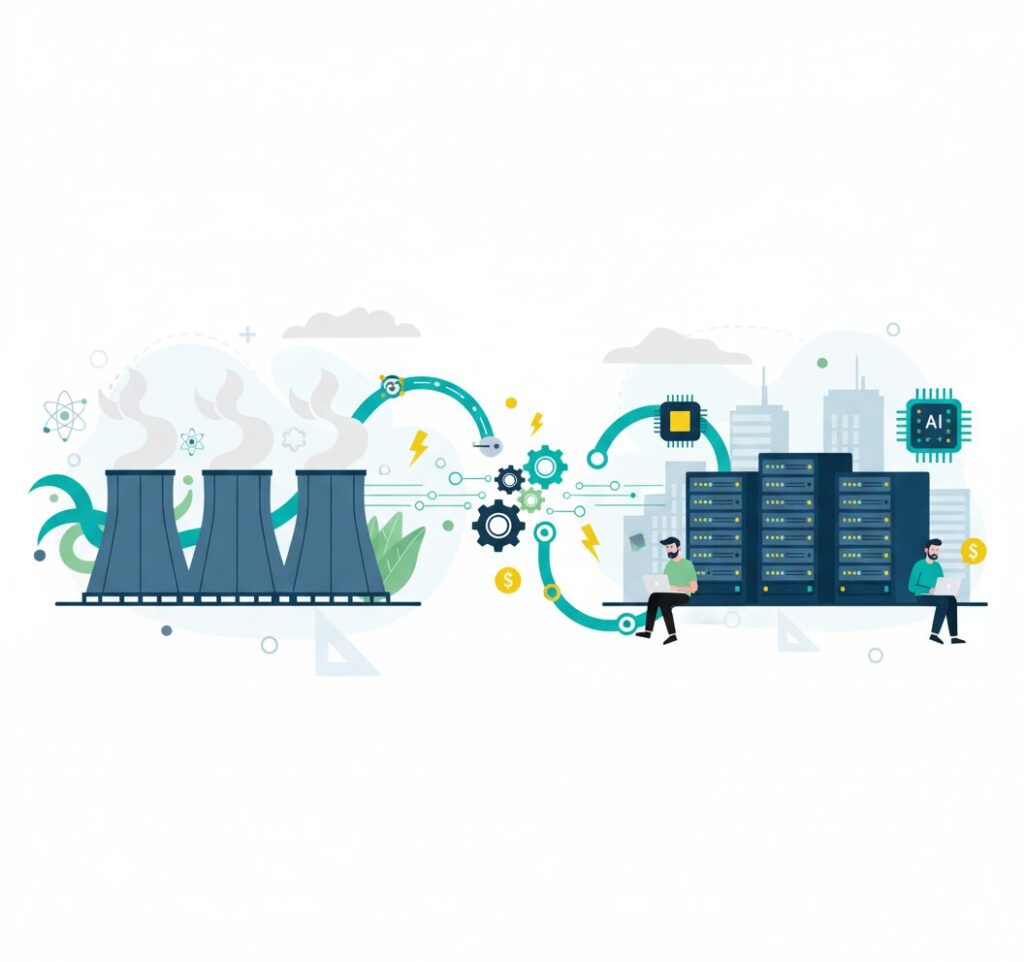

Big Tech Goes Nuclear to Power Artificial Intelligence and What It Means for the Future of Data Centres
Microsoft restarting Three Mile Island. Amazon investing $500 million in small modular reactors. Google partnering with nuclear startups. The world’s largest technology companies are making multi-billion dollar bets on nuclear power to fuel artificial intelligence—and the implications extend far beyond their own data centres.
AI workloads consume 10 times more electricity per query than traditional web searches, driven by power-hungry GPU clusters processing billions of parameters. U.S. data centre electricity consumption could surge from 176 TWh in 2023 to 350 TWh by 2030—equivalent to adding 75 million homes to the grid. This explosive growth outpaces grid expansion and renewable energy deployment, creating urgent demand for reliable, carbon-free baseload power that operates 24/7 regardless of weather conditions. The unprecedented electricity demand crisis driven by AI explains why hyperscalers cannot simply wait for conventional grid expansion.
That’s where nuclear comes in. Small modular reactors offer what renewables cannot economically provide alone: continuous gigawatt-scale generation with 90%+ capacity factors, factory-fabricated components that reduce construction time, and advanced fuel designs that eliminate meltdown scenarios. But the path from announcement to operational reactor spans regulatory approvals, first-of-a-kind deployment risks, and cost uncertainties that range from competitive to prohibitively expensive depending on which analyst you ask.
This guide provides the strategic context you need to understand Big Tech’s nuclear pivot across six critical dimensions: why AI is creating an electricity crisis, what small modular reactors are and how they differ from traditional nuclear plants, how Microsoft, Amazon, Google, and Meta strategies compare, what regulatory hurdles these projects must clear, when nuclear-powered cloud services will be available, and how this affects cloud computing costs and corporate energy strategy.
Navigate to detailed analysis:
- Why AI Data Centres Are Driving an Unprecedented Electricity Demand Crisis examines the scale of AI power consumption and grid capacity constraints
- Small Modular Reactors Explained and How They Differ from Traditional Nuclear Power Plants provides technical but accessible explanation of SMR technology and TRISO fuel safety
- How Microsoft Amazon Google and Meta Are Betting Billions on Nuclear Power for AI compares hyperscaler nuclear strategies side-by-side
- The Regulatory Roadmap for Nuclear Powered Data Centres in the United States demystifies NRC licensing, FERC rulings, and the ADVANCE Act
- The True Cost and Timeline for Deploying Small Modular Reactors at Data Centres provides evidence-based financial analysis and realistic deployment windows
- How Big Tech Nuclear Investments Will Affect Cloud Computing Costs and Energy Strategy connects macro trends to actionable implications for mid-market companies
Each article addresses distinct informational needs whilst building comprehensive understanding of the nuclear-AI nexus.
Why Are AI Data Centres Driving an Unprecedented Electricity Demand Crisis?
AI data centres consume 10 times more electricity per query than traditional web searches, driven by power-hungry GPU clusters processing billions of parameters in large language models. Current data centres account for 4% of US electricity, projected to reach 9-12% by 2030. This explosive growth outpaces grid expansion and renewable energy deployment, creating urgent demand for reliable, carbon-free baseload power that operates 24/7 regardless of weather conditions—precisely what nuclear provides.
Training GPT-3 consumed 1,287 megawatt hours of electricity—enough to power 120 average American homes for a year. Multiply this across hundreds of planned AI training clusters and the grid faces strain it hasn’t experienced in decades. Generative AI training clusters consume seven to eight times more energy than typical computing workloads, with power density requirements that existing infrastructure struggles to accommodate.
Grid capacity constraints compound the challenge. Interconnection queues average five years or more in many regions, with data centre developers competing against solar and wind projects for limited transmission capacity. The U.S. power industry, accustomed to nearly zero growth for two decades, must now deliver capacity equivalent to 34 new full-size nuclear power plants over the next five years. Building that additional capacity can take a decade—time that hyperscalers racing to deploy AI services simply don’t have.
Why renewables alone fall short becomes clear when examining reliability requirements. Solar and wind provide intermittent power with capacity factors of 25% and 35% respectively, whilst data centres require 99.999% uptime. Pairing renewables with battery storage sufficient for data centre reliability adds $150-200 per megawatt hour to generation costs. For a 5 GW facility, battery backup alone would exceed $5 billion—assuming supply chains could even deliver at that scale. Natural gas backup avoids battery costs but undermines carbon-free commitments, leaving nuclear’s 90%+ capacity factor as the compelling solution for continuous, reliable, zero-carbon power.
This demand crisis explains the urgency behind nuclear investments. With grid constraints limiting renewable deployment and AI workloads multiplying faster than capacity can expand, hyperscalers need power solutions that don’t depend on transmission availability or weather patterns. Understanding the full scope of the electricity demand crisis reveals why traditional energy expansion timelines cannot keep pace with AI’s exponential growth.
Deep dive: Why AI Data Centres Are Driving an Unprecedented Electricity Demand Crisis provides comprehensive analysis of GPU power consumption, Jevons paradox implications, and detailed grid capacity challenges.
What Are Small Modular Reactors and How Do They Differ from Traditional Nuclear Power Plants?
Small modular reactors (SMRs) are compact nuclear reactors generating 50-300 MW, compared to traditional gigawatt-scale plants. Factory-fabricated modules ship to site, reducing construction time to 24-36 months versus 5-10 years for conventional reactors. Advanced SMR designs use TRISO fuel—uranium kernels encased in ceramic coatings that remain structurally stable even at temperatures exceeding 1,600°C, effectively eliminating meltdown risk. This enhanced safety profile enables smaller emergency planning zones and co-location with data centres, making SMRs ideal for behind-the-metre power generation.
Three main reactor types serve different data centre applications. Gas-cooled reactors like X-energy’s Xe-100 use helium to cool TRISO pebble fuel, generating 80 MW per module with a 60-year design life. Molten salt reactors such as Kairos Power‘s Hermes circulate fuel dissolved in fluoride salt, offering continuous online refuelling that reduces downtime. Sodium-cooled fast reactors including TerraPower‘s Natrium use liquid sodium coolant and can consume nuclear waste whilst generating power. Each offers different advantages for specific deployment scenarios.
Modular construction benefits address the cost overrun challenge that has haunted nuclear power. Traditional nuclear plants suffer budget escalation—Vogtle Units 3 and 4 in Georgia cost $35 billion, more than double initial estimates. SMRs leverage factory fabrication quality control and serial production learning curves, promising more predictable economics through assembly-line manufacturing rather than custom on-site builds. Components manufactured off-site ship via rail or road, dramatically simplifying logistics.
Data centre fit explains why hyperscalers are pursuing this technology. SMRs match data centre power requirements—most facilities consume 10-100 MW—allowing right-sized capacity without the overhead of gigawatt plants. Compact designs fit on a few city blocks rather than occupying square miles, enabling co-location close to computing load without requiring extensive transmission infrastructure. Reduced water cooling requirements in advanced designs also expand viable site locations, addressing constraints that plague both traditional nuclear and renewable deployments.
Understanding SMR advantages clarifies why hyperscalers view nuclear as viable despite higher capital costs. The technology offers unique attributes that align with data centre operational requirements in ways that renewables and traditional nuclear cannot match. For a complete technical explanation of small modular reactors, including reactor design comparisons and TRISO fuel properties, consult the detailed guide.
Deep dive: Small Modular Reactors Explained and How They Differ from Traditional Nuclear Power Plants provides technical comparison of reactor designs, detailed TRISO fuel safety properties, and comprehensive baseload power advantages.
How Are Microsoft, Amazon, Google, and Meta Approaching Nuclear Power Differently?
Big Tech companies are pursuing four distinct nuclear strategies reflecting different risk tolerances and timelines. Microsoft is restarting an existing reactor at Three Mile Island for proven technology operational by 2028. Amazon invested $500 million in X-energy to develop new SMRs, targeting 5 GW capacity by 2039. Google partnered with Kairos Power via the Tennessee Valley Authority for 500 MW by 2030-2035. Meta issued a request for proposals and secured power purchase agreements with existing plants. Each strategy balances speed, cost, and technological risk differently.
Microsoft’s restart strategy prioritises speed and proven technology. The company signed a 20-year power purchase agreement with Constellation Energy to restart Three Mile Island Unit 1, securing 837 megawatts of carbon-free power by 2028—the earliest nuclear-powered data centre timeline among hyperscalers. This approach minimises technological risk since reactor infrastructure already exists, requiring regulatory approvals, safety upgrades, and equipment refurbishment rather than years of new construction. Microsoft even hired directors of nuclear technologies and nuclear development acceleration, signalling serious institutional commitment beyond financial investment.
Amazon’s investment approach shapes SMR development directly. The company committed $500 million to X-energy to deploy 5 gigawatts of SMR capacity by 2039, with an initial Energy Northwest agreement deploying four Xe-100 reactors producing 320 MW and expansion potential to 960 MW across twelve modules. Amazon also purchased a nuclear-powered data centre campus in Pennsylvania for $650 million. This strategy accepts first-of-a-kind deployment risks in exchange for shaping reactor specifications to cloud computing requirements and securing long-term supply at scale.
Google’s partnership model shares risk whilst maintaining strategic optionality. The company signed a deal to purchase 500 megawatts from 6-7 Kairos Power Hermes reactors, with first deployment targeting 2030 operations through a Tennessee Valley Authority collaboration. By partnering with TVA—a federal utility with nuclear licensing experience—Google leverages existing regulatory relationships whilst avoiding direct project ownership. TVA CEO Don Moul explained: “Google stepping in and helping shoulder the burden of the cost and risk for first-of-a-kind nuclear projects not only helps Google get to those solutions, but it keeps us from having to burden our customers with development of that technology.”
Meta’s market-driven approach hedges bets across multiple options. The company announced a 20-year power purchase agreement with Constellation Energy to extend the life of the 1.1 GW Clinton Clean Energy Centre in Illinois, which was previously scheduled to retire in 2027. This restart strategy offers faster timelines than new SMR construction whilst preserving optionality to pursue additional nuclear investments as the market matures. Meta’s approach suggests waiting for technology and regulatory environments to stabilise before committing to specific reactor designs.
These divergent strategies demonstrate that no single path dominates—each hyperscaler optimises for different constraints based on timeline urgency, capital availability, and risk tolerance. Comparing how Microsoft, Amazon, Google, and Meta are betting billions on nuclear power reveals distinct investment models and timeline commitments. But they all face the same regulatory landscape, which introduces complications regardless of strategy.
Deep dive: How Microsoft Amazon Google and Meta Are Betting Billions on Nuclear Power for AI provides side-by-side strategic comparison, detailed investment analysis, comprehensive timeline commitments, and risk assessment of different approaches.
What Regulatory Approvals Must Nuclear-Powered Data Centre Projects Clear?
Nuclear data centre projects require approval from three federal agencies: the Nuclear Regulatory Commission (NRC) licences reactor designs and construction; the Federal Energy Regulatory Commission (FERC) regulates grid interconnection and behind-the-metre configurations; the Department of Energy (DOE) provides loan guarantees and site access. The bipartisan ADVANCE Act (2024) streamlined NRC processes and reduced fees by 50%+, but FERC’s November 2024 Susquehanna ruling blocking Amazon’s co-location expansion introduced new uncertainty about behind-the-metre arrangements.
NRC licensing timeline typically requires 2-5 years for design certification, followed by construction permits (1-2 years) and operating licences (1-2 years post-construction). Kairos Power received the first Part 50 construction permit for an advanced reactor in December 2024, establishing a precedent for SMR licensing under existing regulations. The ADVANCE Act mandates faster permitting frameworks, caps fees for advanced reactor applicants with 50%+ reductions, accelerates approvals for coal-to-nuclear conversions, and introduces prizes to incentivise first-of-a-kind reactor licensing. President Biden’s Executive Order 14300 further mandates 18-month maximum review timelines for new reactor applications.
Smaller emergency planning zones remove a major siting constraint. The NRC validated site-boundary emergency planning zone methodology for NuScale, eliminating the traditional 10-mile evacuation zone requirement that made urban co-location impractical. This regulatory precedent enables SMRs to be sited much closer to data centres, unlocking behind-the-metre configurations that avoid transmission costs and grid congestion.
FERC’s role and controversy centres on wholesale electricity markets and grid reliability. The Commission’s rejection of expanded co-location at Pennsylvania’s Susquehanna nuclear plant—where Amazon sought to power an AWS data centre directly—created regulatory uncertainty. FERC’s 2-1 decision focused on cost allocation fairness, ensuring other grid users don’t subsidise behind-the-metre arrangements, and potential grid reliability impacts. The Commission directed regional transmission operators to propose tariff changes governing rates, terms, and conditions for co-location arrangements, signalling that future projects face scrutiny even if they pass NRC safety reviews.
These regulatory complexities directly impact project timelines and costs. Even with streamlined processes, you should expect multi-year approval periods that introduce schedule risk beyond construction challenges. Navigating the regulatory roadmap for nuclear-powered data centres requires understanding NRC design certification processes, FERC co-location precedents, and DOE support mechanisms.
Deep dive: The Regulatory Roadmap for Nuclear Powered Data Centres in the United States provides a complete guide to NRC licensing processes, detailed FERC co-location rulings, comprehensive ADVANCE Act provisions, and DOE support programmes.
What Will Small Modular Reactors Actually Cost and When Will They Be Operational?
First-of-a-kind (FOAK) SMR deployments face cost uncertainty, with Lux Research estimating $331 per MWh—roughly triple natural gas generation costs of $124 per MWh. However, Idaho National Laboratory projects 20% cost reductions as manufacturing scales and learning curves apply. The first commercial SMRs target 2029-2030 operations (TerraPower’s Natrium, Kairos demonstration), with broader commercial deployment anticipated 2032-2035. Government support through DOE loan guarantees and 30% investment tax credits helps mitigate FOAK financial risks.
Cost reality demands honesty. NuScale’s cancellation of its Idaho project in 2023 after costs escalated from $5.3 billion to $9.3 billion serves as a cautionary example. The project’s cost per megawatt increased beyond what electricity customers would accept, demonstrating that not all SMR projects will prove economically viable despite industry projections claiming competitive costs around $60-80 per MWh. Real-world deployments indicate figures well above $100 per MWh for initial projects, though deploying multiple units in sequence could drop costs by 20% through learning curve effects.
Conflicting cost projections reflect uncertainty rather than dishonesty. Lux Research’s conservative $331 per MWh estimate for FOAK projects acknowledges first-of-a-kind premiums that plague all novel infrastructure. Wood Mackenzie forecasts SMR costs falling to $120 per megawatt-hour by 2030 as manufacturing scales. Idaho National Laboratory suggests 20% cost reductions are achievable as production moves from first-of-a-kind to Nth-of-a-kind. The truth likely lies somewhere in between, with early projects expensive and later deployments benefiting from resolved engineering challenges and optimised supply chains.
Financing mechanisms make or break project economics. Power purchase agreements (PPAs) with 10-20 year terms provide revenue certainty that makes nuclear projects bankable. Microsoft’s 20-year PPA with Constellation for Three Mile Island and Google’s arrangement with Kairos through TVA exemplify how hyperscalers provide the offtake commitments necessary for project financing. DOE’s Loan Programs Office offers up to $12 billion in loan guarantees for advanced nuclear, whilst 30% investment tax credits reduce upfront capital requirements. These mechanisms shift risk from reactor developers to hyperscalers and federal programmes, enabling projects that wouldn’t otherwise secure financing.
Timeline dependencies introduce schedule risk beyond cost uncertainty. Regulatory approvals, supply chain development, and construction execution all create potential delays. TerraPower began construction in June 2024 with target completion around 2030—a six-year timeline that could extend if licensing, manufacturing, or construction challenges emerge. Amazon’s Cascade project aims for late 2020s construction start with early 2030s operations, acknowledging multi-year lead times. Understanding these timelines helps you plan infrastructure transitions and cloud procurement strategies around realistic rather than optimistic deployment schedules.
These cost and timeline realities directly affect when you’ll see nuclear power impact cloud computing prices and availability. The economics remain uncertain enough that predicting exact impacts requires understanding how hyperscalers might absorb or pass through costs. Evaluating the true cost and timeline for deploying small modular reactors helps set realistic expectations for when nuclear capacity becomes available and at what price points.
Deep dive: The True Cost and Timeline for Deploying Small Modular Reactors at Data Centres provides evidence-based financial analysis, FOAK vs NOAK economics comparison, detailed PPA structures, comprehensive government incentives, and realistic deployment windows.
Will Nuclear Power Make Cloud Computing More Expensive or More Affordable?
Nuclear power’s impact on cloud pricing remains uncertain. FOAK SMR costs suggest initial price premiums, but hyperscalers may absorb these as infrastructure investments rather than pass through to customers. Long-term cost trajectories depend on whether learning curves and scale effects drive nuclear costs below gas-fired generation. More immediately, nuclear investments provide pricing stability against fossil fuel volatility and help hyperscalers meet carbon-neutral commitments without purchasing expensive renewable energy credits.
Hyperscaler economics operate at portfolio scale, not individual power plant economics. AWS, Azure, and Google Cloud price services based on total cost of ownership across global infrastructure distributed over dozens of regions and hundreds of availability zones. Nuclear investments at specific facilities represent long-term strategic positioning for reliable, carbon-free capacity rather than near-term cost optimisation. Competitive dynamics likely prevent dramatic price increases even if nuclear proves costlier initially—no hyperscaler wants to cede market share by raising prices whilst competitors absorb nuclear premiums to maintain volume.
Sustainability value proposition may justify premium pricing for specific products. For cloud customers with aggressive sustainability commitments, access to nuclear-powered computing removes scope 2 emissions from cloud workloads without purchasing renewable energy credits or accepting renewable intermittency. This creates potential for “carbon-free compute” offerings with price premiums similar to how cloud providers currently charge for renewable-matched regions. You should evaluate whether sustainability reporting benefits—claiming genuinely carbon-free infrastructure rather than renewable credits—warrant potential cost differences.
Timeline for customer access extends years into the future. Nuclear-powered cloud services won’t be available until 2028 at earliest for Microsoft’s Three Mile Island capacity, with broader availability spanning 2030-2035 as Amazon, Google, and other hyperscaler projects come online. In the interim, you should monitor hyperscaler energy strategies as inputs to multi-year cloud procurement planning and vendor diversification decisions. Understanding which providers will have nuclear capacity, when, and in which regions influences long-term architectural and procurement choices.
Pricing stability may prove more valuable than absolute cost levels. Fossil fuel price volatility creates budgeting uncertainty for cloud providers, who must hedge against energy cost swings or accept margin compression when fuel prices spike. Nuclear’s fixed-cost profile—high capital costs but low fuel costs—provides predictable operating expenses over 40-60 year reactor lifetimes. This stability flows through to cloud pricing, potentially making nuclear-backed services attractive even if initial generation costs run higher than gas alternatives.
How nuclear compares to renewables provides additional context for evaluating whether these investments make strategic sense or represent expensive bets that could have been avoided with different approaches. Understanding how Big Tech nuclear investments will affect cloud computing costs requires considering both near-term premiums and long-term pricing stability benefits.
Deep dive: How Big Tech Nuclear Investments Will Affect Cloud Computing Costs and Energy Strategy provides strategic analysis of cost flow-through mechanisms, sustainability reporting implications, colocation opportunities, and actionable recommendations for mid-market technology companies.
How Does Nuclear Compare to Renewable Energy for Powering Data Centres?
Nuclear and renewables work best together, each serving different operational needs in data centre portfolios. Renewables offer lower capital costs and faster deployment but require battery storage or gas backup for 24/7 reliability, increasing total cost for data centre applications. Nuclear provides baseload power with 90%+ capacity factors—meaning reactors generate at rated capacity more than 90% of the time—compared to 25% for solar and 35% for wind. For applications requiring continuous uptime, nuclear’s reliability advantage outweighs higher initial capital costs.
Total cost of ownership reveals why renewables alone fall short for data centre applications. Whilst solar and wind generation costs have fallen dramatically to below $40 per MWh in optimal locations, achieving equivalent reliable capacity with solar requires roughly 2,000 MW of panels (accounting for 25% capacity factor) to match a 500 MW reactor’s continuous output, plus battery storage or gas backup. Natural gas backup avoids battery costs but undermines carbon-free commitments, leaving nuclear’s continuous generation as the economically viable path to reliable zero-carbon power.
Site flexibility offers another nuclear advantage. Renewable energy requires specific geography—solar needs consistent sunshine, wind requires steady wind resources, and both need transmission access to high-demand areas where grid interconnection queues stretch years. Nuclear SMRs can be sited near data centres in diverse locations, avoiding transmission constraints and enabling behind-the-metre configurations that reduce interconnection complexity. This geographic flexibility expands viable data centre locations beyond renewable energy corridors, reducing competition for limited grid capacity.
Portfolio approach characterises leading hyperscaler strategies. Rather than choosing exclusively between nuclear and renewables, Amazon, Microsoft, Google, and Meta pursue both simultaneously. Renewables meet growing energy needs where grid interconnection is available and project economics work, whilst nuclear addresses specific data centres requiring dedicated, reliable power or sites where renewable intermittency creates unacceptable operational risk. You should view these as complementary portfolio components rather than either/or choices, with different energy sources serving different facilities based on location, reliability requirements, and regulatory constraints. The comparison of hyperscaler nuclear strategies demonstrates how each company balances nuclear and renewable investments differently.
Capacity factor differences drive economics and reliability. Nuclear’s 90%+ capacity factor means a 500 MW reactor delivers approximately 450 MW continuously, year-round. This capacity factor advantage makes nuclear cost-competitive despite higher upfront capital when total system costs including reliability are considered. For detailed technical comparison of SMR technology and baseload power advantages, see the comprehensive reactor design guide.
Understanding when these nuclear facilities will actually come online helps set realistic expectations for when nuclear-powered services become available and how they might affect your cloud strategy.
Deep dive: Small Modular Reactors Explained and How They Differ from Traditional Nuclear Power Plants provides technical comparison of baseload nuclear power versus intermittent renewables for 24/7 data centre operations.
When Will the First Nuclear-Powered Data Centres Come Online?
Microsoft’s Three Mile Island restart targets 2028 as the earliest operational date for nuclear-powered data centres. TerraPower’s Natrium demonstration reactor in Wyoming aims for approximately 2030 completion. Amazon’s Cascade project with Energy Northwest targets early 2030s commercial operation. Google’s Kairos Power partnership spans 2030-2035 deployment. Whilst these timelines represent goals, nuclear project history suggests schedule risks remain and you should plan for potential delays.
Near-term restarts offer faster timelines than new construction. Restarting existing reactors leverages infrastructure already in place—reactor vessels, containment buildings, cooling systems—requiring regulatory approvals, safety upgrades, and equipment refurbishment but avoiding years of new construction. Microsoft’s 2028 target would make Three Mile Island and the adjacent Palisades plant the first reactors ever restarted after decommissioning, establishing precedent for future restart projects. Meta’s Clinton plant PPA similarly leverages existing infrastructure for faster deployment, extending the life of a facility previously scheduled to retire in 2027.
New SMR construction faces longer timelines due to first-of-a-kind deployment challenges. Kairos Power’s December 2024 construction permit for its Hermes demonstration reactor marks a milestone—the first Part 50 advanced reactor construction permit—but commercial deployment still requires several years of design validation and scaling from demonstration to commercial size. X-energy’s Cascade project with Energy Northwest represents the first commercial-scale SMR fleet in the United States, with late 2020s construction targeting early 2030s operations. These timelines acknowledge regulatory approvals, supply chain development, and construction execution that all introduce schedule risk.
Construction milestones provide progress indicators for tracking deployment. TerraPower broke ground on its Natrium reactor in June 2024—the first commercial advanced reactor construction in the United States. Construction proceeding on schedule would validate 2030 completion targets; delays would cascade through industry timelines as other projects watch the first-mover navigate regulatory and construction challenges.
Planning implications depend on realistic timeline expectations. Nuclear-powered computing remains 3-7 years away for most hyperscaler facilities, influencing decisions about cloud migration timing, sustainability commitment structures, and vendor selection criteria. Organisations with aggressive 2030 carbon-neutral goals cannot rely solely on hyperscaler nuclear investments to meet those commitments—the timing simply doesn’t align. Instead, interim strategies combining renewable-matched regions, efficiency optimisation, and renewable energy credit purchases bridge the gap until nuclear capacity comes online. Detailed cost and timeline analysis reveals the specific deployment windows for each hyperscaler’s nuclear projects.
These timelines directly affect what options you have as a colocation provider or mid-market company looking to access nuclear-powered computing. Understanding the practical paths available helps set realistic expectations.
Deep dive: The True Cost and Timeline for Deploying Small Modular Reactors at Data Centres provides comprehensive timeline analysis, project-by-project deployment schedules, and detailed risk factors affecting completion dates.
What Can Colocation Providers and Mid-Market Companies Do with Nuclear Power?
Colocation providers exploring nuclear-backed power face capital and regulatory barriers but could differentiate offerings with carbon-free, reliable energy. Mid-market technology companies cannot directly invest in nuclear infrastructure but can influence cloud procurement by evaluating providers’ energy strategies, requesting carbon-free compute options, and incorporating nuclear availability into multi-year vendor roadmaps. Participating in industry consortiums or power purchase agreement aggregation may create future opportunities for direct nuclear access.
Colocation opportunities exist but require navigating substantial barriers. Facilities adjacent to existing or planned nuclear plants could offer tenants access to carbon-free power with minimal transmission losses, creating differentiated value proposition for sustainability-focused customers. However, FERC’s Susquehanna ruling demonstrates regulatory uncertainty around behind-the-metre arrangements—what seems straightforward technically faces complex regulatory challenges around cost allocation fairness and grid reliability impacts. Understanding the regulatory roadmap, including FERC co-location precedents and NRC licensing requirements, is essential for colocation providers considering nuclear strategies. Early engagement with regulatory and legal advisers helps navigate these uncertainties.
For mid-market companies, several concrete actions create leverage despite lacking capital for direct investment. Request energy sourcing transparency from cloud providers by region—understanding which data centres will have nuclear power helps inform migration planning. Incorporate energy strategy into vendor scorecards during procurement processes, making nuclear availability a decision criterion alongside pricing and features. Join industry consortiums focused on sustainable computing to aggregate demand signals that influence hyperscaler capacity allocation decisions. Prepare sustainability reporting frameworks now that can credit nuclear-powered cloud consumption when it becomes available, ensuring you’re ready to capture scope 2 emissions reductions immediately upon service launch.
Strategic preparation positions your organisation to adopt nuclear-powered services quickly when available. Monitor hyperscaler nuclear timelines by tracking construction permits, power purchase agreement announcements, and regulatory approvals. Incorporate energy strategy into vendor evaluations by requesting roadmaps that detail nuclear capacity deployment by region and timeline. Prepare architecture decisions that enable future migration to nuclear-powered regions without requiring application refactoring. Understanding the landscape—which providers will have nuclear capacity, when, and in which regions—enables proactive decisions rather than reactive scrambling when services launch.
Indirect benefits flow through cloud services even without direct nuclear access. Mid-market companies using AWS, Azure, or Google Cloud will eventually access nuclear-powered computing capacity as hyperscalers deploy these facilities, gaining scope 2 emissions reductions by consuming carbon-free cloud services. Sustainability-focused organisations can claim genuinely carbon-free infrastructure in reporting rather than relying solely on renewable energy credit purchases. However, direct access to nuclear power for company-owned data centres remains prohibitively capital-intensive for most SMBs, making cloud services the primary path to nuclear-powered computing for mid-market organisations.
The practical steps above provide actionable starting points whilst hyperscalers build out nuclear capacity over the next 3-7 years. For comprehensive guidance on how Big Tech nuclear investments will affect your cloud computing strategy, including vendor evaluation frameworks and sustainability reporting preparation, consult the strategic analysis.
Deep dive: How Big Tech Nuclear Investments Will Affect Cloud Computing Costs and Energy Strategy provides practical guidance for colocation providers and enterprise customers, sustainability reporting considerations, and strategic recommendations.
Resource Hub: Nuclear-Powered Data Centres Library
This comprehensive series provides detailed analysis across six critical dimensions of Big Tech’s nuclear power pivot:
Understanding the Crisis and Technology
Why AI Data Centres Are Driving an Unprecedented Electricity Demand Crisis
Quantifies AI’s electricity appetite with data showing consumption could reach 350 TWh annually by 2030—up from 176 TWh in 2023. Explains why demand is projected to triple, how GPU clusters consume seven to eight times more energy than traditional workloads, and why grid constraints are driving nuclear investments. Essential context for understanding the urgency behind Big Tech’s nuclear pivot and the Jevons paradox implications for efficiency gains.
Small Modular Reactors Explained and How They Differ from Traditional Nuclear Power Plants
Technical but accessible guide to SMR technology covering reactor design types (gas-cooled, molten salt, sodium-cooled), TRISO fuel safety properties that enable temperatures exceeding 1,600°C without melting, and baseload power advantages for data centre applications. Explains factory fabrication benefits, modular construction economics, and why SMRs suit data centre power requirements better than gigawatt-scale traditional plants.
Strategic and Regulatory Landscape
How Microsoft Amazon Google and Meta Are Betting Billions on Nuclear Power for AI
Side-by-side comparison of hyperscaler nuclear strategies with investment details, timeline commitments, and risk profiles. Covers Microsoft’s Three Mile Island restart (2028 target), Amazon’s $500 million X-energy investment (5 GW by 2039), Google’s Kairos Power partnership (500 MW by 2030-2035), and Meta’s market-driven RFP approach. Enables benchmarking and strategic evaluation of restart versus new build approaches, investment versus PPA models, and first-mover versus follower strategies.
The Regulatory Roadmap for Nuclear Powered Data Centres in the United States
Demystifies NRC licensing processes covering design certification (2-5 years), construction permits, and operating licences. Explains FERC’s role in co-location arrangements with detailed analysis of the November 2024 Susquehanna ruling blocking Amazon’s expansion. Details ADVANCE Act provisions including 50%+ fee reductions, streamlined timelines, and coal-to-nuclear conversion acceleration. Identifies DOE support programmes including $12 billion in loan guarantees. Critical for assessing project feasibility and timeline risks.
Economics and Strategic Implications
The True Cost and Timeline for Deploying Small Modular Reactors at Data Centres
Evidence-based analysis of SMR economics covering FOAK estimates ($331 per MWh) versus NOAK projections (20% cost reductions with scale). Details PPA structures with 10-20 year terms that provide revenue certainty, government incentives including 30% investment tax credits and DOE loan guarantees, and realistic deployment timelines spanning 2028-2035. Includes honest assessment of NuScale cancellation as cautionary example and cost comparisons with natural gas ($124 per MWh) and renewables.
How Big Tech Nuclear Investments Will Affect Cloud Computing Costs and Energy Strategy
Strategic guidance for evaluating cloud providers, covering whether nuclear costs will pass through to customers or be absorbed as infrastructure investments. Explains sustainability reporting implications for scope 2 emissions, potential for carbon-free compute product offerings, and timeline expectations (2028 earliest availability). Provides actionable recommendations for mid-market companies including procurement strategies, vendor evaluation criteria, and sustainability reporting preparation.
Evaluating cloud vendors against a shift that won’t fully land for years is still a resourcing decision today. Whoever runs that evaluation and any resulting build work needs capacity for the length of the review, not a permanent addition to headcount. SoftwareSeni’s extended development teams scale up for a stretch of work like that and back down once it’s done, so capacity matches the task instead of outliving it.
see how extended development teams scale up for a stretch of work and back down after →
“SoftwareSeni has done a great job, working quickly and reliably on all tasks assigned to them. This is exactly the way I foresee us collaborating more in future projects: rapid client engagements with flexibility in terms of scope and time allocated to resources.”
— Andre Gallo, Co-founder & CTO, Triniti
FAQ Section
What is driving Big Tech companies to invest in nuclear power instead of expanding renewable energy?
AI data centres require reliable, 24/7 baseload power that renewables cannot economically provide without extensive battery storage. Interconnection queues average 5+ years, making co-located power generation increasingly attractive. Nuclear offers carbon-free energy with 90%+ capacity factors, meeting both sustainability commitments and reliability requirements. Additionally, behind-the-metre nuclear configurations avoid transmission costs and grid constraints that limit renewable deployment at data centre scale.
How safe are small modular reactors compared to traditional nuclear plants?
SMRs incorporate passive safety systems and advanced fuel designs that enhance safety. TRISO fuel used in many SMR designs can withstand temperatures exceeding 1,600°C without melting or releasing radiation—effectively eliminating meltdown scenarios that plagued earlier reactor generations. Smaller emergency planning zones (some designs approved for less than 1 mile radius compared to 10 miles for traditional plants) reflect reduced risk profiles. However, all nuclear facilities remain subject to NRC safety oversight and licensing requirements.
Will I be able to choose nuclear-powered cloud computing services?
Likely yes, but not until 2028-2035 depending on hyperscaler timelines. Cloud providers may offer carbon-free compute products that guarantee workloads run in nuclear-powered regions, similar to existing renewable-matched region offerings. Pricing for such services remains uncertain—sustainability value may justify premiums, or competitive dynamics may prevent price differentiation. You should engage cloud providers about product roadmaps and express interest in nuclear-powered options to influence development priorities.
What happened to the Amazon-Susquehanna nuclear data centre deal?
In November 2024, FERC rejected an agreement allowing Amazon to expand its data centre powered directly from the adjacent Susquehanna nuclear plant in Pennsylvania. FERC’s 2-1 decision centred on concerns about cost allocation fairness—ensuring other grid users don’t subsidise Amazon’s behind-the-metre arrangement—and potential grid reliability impacts. This ruling created regulatory uncertainty about co-location models and demonstrated that not all nuclear data centre configurations will receive approval.
How much will SMRs cost compared to natural gas or renewable energy?
First-of-a-kind SMR deployments face cost uncertainty. Lux Research estimates $331 per MWh for initial projects, roughly triple natural gas costs of $124 per MWh. However, Idaho National Laboratory projects 20% cost reductions as manufacturing scales. When total cost of ownership including reliability requirements and carbon constraints is considered, nuclear becomes more competitive with renewable-plus-storage alternatives. Government incentives (30% investment tax credits, DOE loan guarantees) help mitigate FOAK cost risks.
When will nuclear-powered data centres become commonplace?
Microsoft’s Three Mile Island restart targets 2028 as the earliest nuclear-powered data centre operation. Broader SMR deployment spans 2030-2035 as projects like TerraPower’s Natrium, X-energy’s Cascade, and Kairos Power’s commercial reactors come online. “Commonplace” likely requires the 2035-2040 timeframe as manufacturing scales, costs decline, and regulatory processes mature. You should view nuclear as a long-term infrastructure investment rather than a near-term solution.
Can small companies benefit from Big Tech’s nuclear investments?
Indirectly yes, through cloud services. Mid-market companies using AWS, Azure, or Google Cloud will eventually access nuclear-powered computing capacity as hyperscalers deploy these facilities. Sustainability-focused organisations gain scope 2 emissions reductions by consuming carbon-free cloud services. However, direct access to nuclear power for company-owned data centres remains prohibitively capital-intensive for most SMBs. Colocation providers may eventually offer nuclear-backed options, creating an intermediate path for organisations seeking dedicated infrastructure with nuclear benefits.
What are the biggest risks to these nuclear data centre projects?
Regulatory uncertainty tops the risk list following FERC’s Susquehanna ruling. NRC licensing timelines, whilst improved under the ADVANCE Act, remain multi-year processes with approval uncertainty for novel designs. Cost overruns plague nuclear construction—traditional plants frequently exceed budgets by billions. Supply chain constraints for specialised components could delay projects. Public opposition, though less pronounced for advanced SMRs than traditional reactors, can complicate siting. Finally, evolving AI efficiency could reduce future power demand below projections, potentially stranding nuclear investments.
Conclusion
Big Tech’s nuclear power pivot represents one of the most consequential infrastructure investments in computing history. The combination of AI’s electricity appetite, grid capacity constraints, and carbon-neutral commitments creates conditions where nuclear’s unique attributes—continuous baseload generation, carbon-free operation, and co-location flexibility—outweigh higher capital costs and longer deployment timelines.
The strategic divergence across Microsoft, Amazon, Google, and Meta reflects uncertainty about optimal paths forward. Restart strategies offer faster timelines with proven technology but limited scalability. Investment approaches shape reactor development but accept first-of-a-kind risks. Partnership models share risk whilst maintaining optionality. Each strategy makes sense given different risk tolerances, timeline urgencies, and capital allocation philosophies.
For you, the implications extend beyond academic interest. Nuclear-powered cloud services will reshape sustainability reporting, influence multi-year procurement decisions, and potentially create new product categories around carbon-free compute. Understanding hyperscaler energy strategies—which providers will have nuclear capacity, when, and in which regions—becomes a vendor evaluation criterion alongside traditional factors like pricing, performance, and feature availability.
The timelines are long. The costs are uncertain. The regulatory landscape remains complex. But the fundamental driver—AI’s exponential electricity demand colliding with grid capacity limits—isn’t going away. Nuclear power offers a solution that renewables alone cannot economically provide: reliable, continuous, carbon-free electricity at the gigawatt scale that AI requires.
The race is on to see which approach delivers first.
Rather add capacity for this stretch of work than commit to headcount you don’t need afterward? Talk to SoftwareSeni about extended development teams