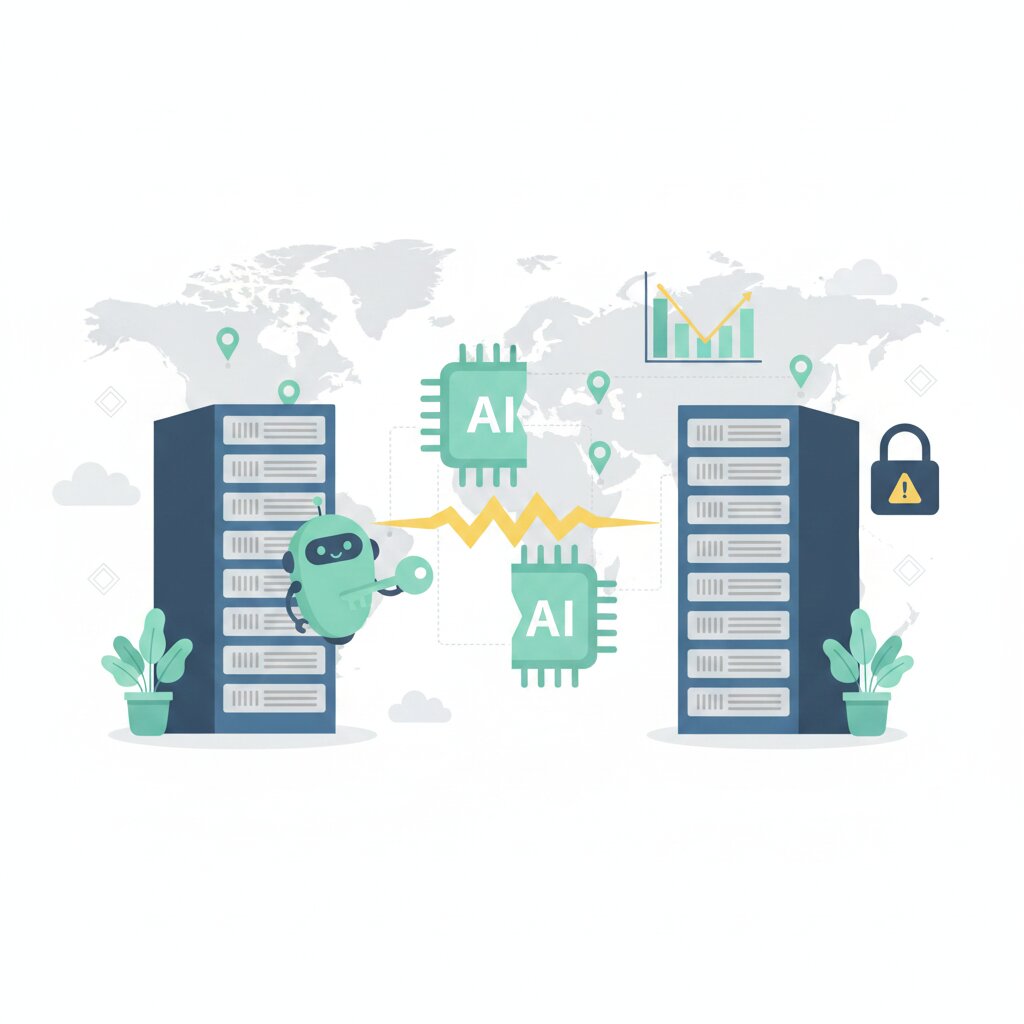

In March 2026, Google informed Meta it could no longer deliver full Gemini model capacity — cutting off one of the world’s largest AI users from a critical compute pipeline. Meta had relied on Gemini across content moderation, scam detection, advertising, and internal development. The notification landed without warning.
This was not a billing dispute or a capacity miscommunication. It was a structural signal — one that belongs to a pattern this series maps end to end. When the companies that provide AI infrastructure and models also compete in the application layer, access becomes a competitive weapon. The physical economics of compute — memory shortages, power constraints, cooling retooling timelines measured in years — amplify the tension.
This series traces the complete arc: what happened, how Meta responded, why the conflict is built into the industry’s structure, and how to audit your own dependencies before the restriction letter arrives.
In This Series
- What Happened When Google Cut Off Meta’s Gemini Access — The factual reconstruction of the March 2026 cut-off and the dual-explanation question: capacity shortage, competitive exclusion, or both.
- Meta’s Three-Pronged Strategy After Losing Gemini Model Access — How Meta pivoted within weeks: Muse Spark, Llama 5, token budgets, and the Meta Compute cloud play.
- When AI Model Providers Compete With Their Own Customers — The structural conflict built into the model-provider business model, and why it keeps producing access denials across the industry.
- How to Audit Your AI Supply Chain for Dependency Risk — A decision-making framework for evaluating whether your AI dependencies create an unacceptable competitive vulnerability.
What actually happened between Google and Meta over Gemini AI model access in March 2026?
In March 2026, Google informed Meta that it could no longer provide the full Gemini API capacity Meta relied on for content moderation, scam detection, advertising workflows, and internal development. The notification was a capacity-constrained reduction, not a complete termination — but the scale of Meta’s dependency made the impact immediate. Neither company has published a detailed timeline or the exact percentage reduction, and the silence itself is informative: both have reasons to avoid framing the incident as a competitive escalation in public.
The absence of a public timeline from either company makes sense from both sides. Google would rather not draw attention to cutting off a major customer. Meta would rather not signal vulnerability to competitors or advertisers. Reuters reports that both companies declined to comment publicly. What is known is that Meta’s Gemini dependency was extensive: the models ran across content moderation pipelines that process billions of pieces of content daily, scam detection systems that protect users and advertisers, advertising workflows that drive Meta’s core revenue, and internal development tooling used by thousands of engineers. The switching costs embedded in those integrations — fine-tuning investment, prompt engineering calibrated to Gemini’s specific behaviours, evaluation harnesses built around Gemini outputs — meant that even a partial reduction carried operational consequences that could not be absorbed overnight.
The physical economics of compute scarcity provide essential context. HBM memory supply is bottlenecked through SK Hynix, whose CFO stated the company had “already sold out our entire 2026 HBM supply.” TSMC’s CoWoS packaging is fully allocated through mid-2027. Data centres designed for 15 kW racks cannot cool 370 kW GPU racks without multi-year retooling. These constraints are structural, not transient, and they create the conditions under which the next question becomes unavoidable: was this scarcity allocation or competitive exclusion?
Read the full reconstruction: What Happened When Google Cut Off Meta’s Gemini Access →
Why did Google deny Meta full access to Gemini — was it a capacity shortage or a competitive move?
The most defensible reading is both. Genuine compute scarcity exists — HBM memory supply is bottlenecked through SK Hynix, TSMC’s CoWoS packaging is fully allocated through mid-2027, and data centres designed for 15 kW racks cannot cool 370 kW GPU racks without multi-year retooling. Google’s own cloud revenue was constrained by the same shortage: CEO Sundar Pichai said compute capacity limitations prevented higher growth even as the cloud unit’s backlog nearly doubled quarter on quarter.
The capacity-shortage case is well-supported. Beyond the HBM and CoWoS constraints, grid interconnection queues in primary data centre markets like Northern Virginia and Phoenix run 36 to 48 months. Liquid cooling retrofits cannot be deployed at the speed cloud demand is growing. Google is genuinely supply-constrained, and Meta’s consumption was large enough that even a partial reallocation would be felt. Google’s own cloud unit has lost revenue to the same capacity ceiling — this is not a problem manufactured to justify a competitive move.
But scarcity forces allocation decisions, and Google chose to allocate its limited Gemini capacity to its own products and non-competing customers. Meta competes with Google in advertising — the core revenue engine of both companies — and increasingly in AI, where Llama models compete directly with Gemini for developer mindshare and enterprise adoption. When Google decides whose workloads get deprioritised under capacity pressure, the decision is inherently competitive regardless of whether the underlying scarcity is genuine. The distinction between “capacity shortage” and “competitive move” is a false binary: scarcity creates the conditions; competitive interest determines the allocation. Both explanations are true at once, and accepting that dual explanation is essential to understanding the structural problem the next sections address.
Read the full reconstruction: What Happened When Google Cut Off Meta’s Gemini Access →
How did Meta respond strategically to losing Gemini capacity — what was its three-pronged pivot?
Meta’s response was not improvisation — it was a strategy waiting for its moment. Prong one: launch Muse Spark as a proprietary in-house model to replace Gemini across Meta’s internal workloads. Prong two: release Llama 5 as an open-weight model, turning a defensive vulnerability into an ecosystem move that makes dependency denial harder for everyone. Prong three: impose internal token budgets as an immediate stopgap while signalling Meta Compute — a plan to sell excess AI infrastructure as cloud capacity.
Prong one addresses the immediate operational need. Muse Spark is small and fast by design, matching the capability of far larger models while using a fraction of the compute, and it ranks fourth globally on the Artificial Analysis Intelligence Index. Unlike Gemini, which is optimised for multimodal ecosystem integration across Google’s product surface, Muse Spark is optimised for Meta’s specific workloads — content moderation at scale, advertising relevance, internal developer tooling. That design philosophy — fit-for-purpose rather than general-purpose — is itself a strategic signal: Meta is not trying to build a better Gemini; it is building a model that makes Gemini irrelevant for Meta’s use cases.
Prong two carries a strategic irony. Meta, locked out of a proprietary model, releases an open-weight alternative that makes denial harder for everyone. Llama 5 reached near-parity with GPT-5 on key benchmarks and leads on coding tasks. The open-weight release serves multiple strategic purposes: it keeps Meta in the ecosystem conversation even as it loses Gemini access, it pressures competitors on API pricing by providing a credible free alternative, and it provides a hedge for other companies facing the same dependency risk — companies that become natural allies and potential Meta Compute customers.
Prong three bridges the immediate and the long-term. Token budgets are the stopgap — a recognition that Meta cannot replace Gemini overnight and must ration compute while Muse Spark scales. Meta Compute is the long game: a plan to sell excess AI infrastructure as cloud capacity, positioning Meta against AWS, Azure, and GCP. With over 600,000 GPUs and infrastructure investment levels that exceed internal requirements, Meta is converting a competitive weakness into an offensive business line. The three prongs form one coherent strategy: Meta moved from dependent customer to independent competitor-provider.
Read the full case study: Meta’s Three-Pronged Strategy After Losing Gemini Model Access →
What is the inherent conflict of interest when an AI model provider also competes with its own enterprise customers?
When a company both provides the AI infrastructure and models you depend on and builds products that compete with yours, it faces an irreconcilable tension. Your usage data, your integration patterns, and your scaling requirements all flow through a competitor’s systems. The provider has the contractual right — often written into terms of service — to deprioritise or restrict your access. This is not a hypothetical risk: the Google-Meta incident is one instance of a pattern that includes Anthropic cutting off Windsurf, OpenAI, and xAI from model access.
Access denial, in this context, is any action by a vertically integrated provider that constrains a competitor-customer’s ability to use the provider’s infrastructure or models — whether through capacity reduction, pricing changes, API deprecation, or terms-of-service modification. The potency of the threat is a function of market concentration. The three largest foundation model API providers (Anthropic, OpenAI, and Google) command nearly 90% of the enterprise market by revenue. When three companies control nearly all access and each competes in the application layer, exclusion is not an edge case — it is a structural feature.
The contractual mechanisms are already in place. Each provider’s terms of service include language allowing them to restrict or terminate access for competitive reasons. The pattern extends beyond Google-Meta. Anthropic cut off Windsurf in April 2025, OpenAI in August 2025, and xAI in January 2026 — each time the trigger was competitive overlap between the provider’s products and the customer’s application. Early-warning signals exist for those watching: a provider launching products in your application category, terms-of-service updates that add competitive-exclusion language, the provider’s own AI products consuming increasing shares of published compute capacity, and changes in account team responsiveness or willingness to discuss capacity guarantees. The diagnosis is straightforward: this is not a series of unfortunate incidents — it is an expected outcome of a market structure where the same companies control model access and compete in the application layer.
Read the full analysis: When AI Model Providers Compete With Their Own Customers →
Why are AI foundation models becoming commodities, and what does that mean for the industry’s structure?
Foundation models are converging in capability while prices compress — Chinese models average one-sixth the cost of US equivalents, and open-weight alternatives like Llama 5 and Mistral increasingly match proprietary performance on common benchmarks. Meanwhile, hyperscalers are spending over $600 billion annually on AI infrastructure while model API revenue remains a fraction of that. This capex-revenue gap creates a structural pressure: if the model itself is not a durable moat, providers must capture value at the application layer — which is exactly where their customers already operate.
The convergence is measurable. Open-weight models now match or exceed proprietary models on standard benchmarks across reasoning, coding, and language understanding. Chinese providers — DeepSeek, Qwen, Zhipu — deliver comparable capability at a fraction of the price, compressing the premium that Western providers can charge. This is the commoditisation dynamic that Martin Casado and others have described: when the core technology converges, differentiation shifts to distribution, integration, and the application layer. Meanwhile, hyperscaler AI infrastructure spend exceeds $600 billion annually — a figure sourced from J.P. Morgan, Bloomberg Intelligence, and Menlo Ventures analysis — while model API revenue represents a fraction of that investment. The capex-revenue gap is widening, not narrowing.
Commoditisation is not a solution to the provider-customer conflict — it is the engine that drives it. When model APIs alone cannot recoup infrastructure investment, providers must push into the application layer to capture the margin their capital expenditure demands. That push is exactly the collision described in the previous section: providers entering the markets their customers already occupy, creating the competitive overlap that triggers access denials. The platform layer — AWS Bedrock, GCP Vertex AI — represents the infrastructure response: when models become fungible, the platform that routes between them captures the margin. But the platform play does not resolve the underlying tension; it shifts it to a different layer of the stack. The current pattern of access denials is a symptom of an unstable industry structure, not a phase that will pass.
Read the full analysis: When AI Model Providers Compete With Their Own Customers →
How should you evaluate whether your company’s core AI dependencies create an unacceptable competitive vulnerability?
A dependency becomes a vulnerability when four conditions intersect: the provider competes with you or could realistically enter your application space, switching costs are high, the provider has the contractual right to restrict or reprioritise your access, and the dependency sits in a revenue-generating or competitively sensitive workflow. The evaluation is a risk matrix — not every single-provider dependency demands action, but those scoring high on multiple dimensions do.
The four-dimension framework breaks down as follows. Provider competitive posture: does the provider currently compete with you, or is there a plausible path to competition given their product roadmap and market trajectory? Switching cost magnitude: AI-specific switching costs differ from generic vendor lock-in — fine-tuning investment, prompt engineering pipelines calibrated to model-specific behaviours, evaluation harnesses, and data gravity in the provider’s ecosystem are not portable in the way that cloud infrastructure often is. Contractual restriction rights: what do the provider’s terms of service actually permit regarding access restriction, deprioritisation, or termination for competitive reasons? Workflow criticality: does the dependency sit in a workflow that affects revenue, competitive position, or regulatory compliance? Meta’s Gemini dependency would have scored high on every dimension — the provider was a direct competitor in advertising and AI, switching costs were enormous given the depth of integration, Google’s terms permitted the restriction, and the workloads touched revenue-generating systems across content moderation, advertising, and scam detection.
The tactical output of this evaluation is a set of questions to ask providers before the dependency deepens: what are your access continuity policies? What criteria determine capacity allocation when supply is constrained? What competitive firewalls exist between your model-provision business and your application businesses? What is the escalation path if access is restricted? These questions, asked during procurement rather than after the restriction letter arrives, are the operational output of the vulnerability assessment. This evaluation is the diagnostic step that determines whether the audit framework in the next section is necessary.
Read the full framework: How to Audit Your AI Supply Chain for Dependency Risk →
What framework should you use to audit your AI supply chain for single-provider dependency risk?
The audit follows four steps. First, map every model dependency — which models, providers, workloads, and jurisdictions. Second, score each dependency on the vulnerability dimensions: provider competitive posture, switching cost, contractual exposure, and workflow criticality. Third, identify the highest-risk concentrations and evaluate mitigation options — diversification, open-weight substitution, architectural abstraction, or contract renegotiation. Fourth, produce a prioritised roadmap with timelines tied to switching-cost thresholds and regulatory deadlines.
Step one — dependency mapping — requires an inventory that captures not just which models are used but for which workloads, in which jurisdictions, and under which contracts. A model used for internal code generation carries different risk than one embedded in a customer-facing product governed by the EU’s Cloud and AI Development Act (CADA). The mapping must surface hidden dependencies: models accessed through third-party platforms, models embedded in SaaS tools, and models used by individual teams outside formal procurement.
Step two — scoring — applies the vulnerability dimensions from the previous section. For EU workloads, CADA’s four-tier sovereignty framework adds an additional filter: data locality requirements, provider jurisdiction constraints, and model provenance obligations may eliminate certain providers from consideration regardless of the other dimensions.
Step three — mitigation options — evaluates four paths. Diversification across providers reduces single-provider concentration but increases operational complexity. Open-weight substitution — using Llama 5, Mistral, or Zhipu GLM-5 — eliminates the provider’s ability to restrict access but shifts infrastructure burden in-house. Architectural abstraction layers — routing between providers based on availability, cost, and capability — provide flexibility but require investment in the routing layer. Contract renegotiation — securing explicit capacity guarantees, competitive-exclusion carve-outs, and defined escalation paths — strengthens the legal position but depends on negotiating leverage.
Step four — the roadmap — prioritises by risk score with timelines that account for switching-cost thresholds and regulatory deadlines. The audit is not a one-time exercise. It should be embedded in procurement and architecture review processes, re-run when provider competitive postures shift or model capabilities change, and treated as an ongoing governance practice rather than a compliance checkbox. The output is a document you can take to the board.
Read the full framework: How to Audit Your AI Supply Chain for Dependency Risk →
What criteria should you use to decide between building on proprietary model APIs versus adopting open-weight alternatives?
The decision turns on six criteria: capability requirements (does an open-weight model meet the performance threshold for your workload?), operational cost (who manages the infrastructure?), switching cost (how portable is the integration?), regulatory exposure (does CADA or equivalent regulation constrain your choice?), provider competitive posture (is the provider a current or plausible future competitor?), and ecosystem maturity (are tooling, support, and talent available?). The answer is rarely binary — most organisations will run a hybrid portfolio.
Open-weight models — Llama 5, Mistral, Zhipu GLM-5 — reduce dependency risk but increase operational burden. Someone must manage the GPU infrastructure, handle model updates, maintain evaluation pipelines, and ensure performance does not degrade as models evolve. For organisations without existing AI infrastructure teams, the operational cost can exceed the dependency risk premium of proprietary APIs. Proprietary APIs — Google, Anthropic, OpenAI — reduce operational burden but increase dependency risk. The provider controls access, pricing, and the product roadmap. Martin Casado’s infrastructure-commoditisation thesis is relevant here: if proprietary model APIs are on a path to commoditisation, the strategic calculus for building on them changes — the premium you pay for proprietary access may not be durable, and the dependency you incur may be unnecessary.
Multi-provider routing is a third path between the two poles, sending most traffic to cost-efficient models while reserving frontier-tier reasoning for the requests that genuinely require it. This architecture reduces single-provider dependency without requiring full self-hosting. Eighty-one per cent of enterprise leaders are concerned about AI vendor dependency, and only six per cent say they could switch AI vendors without material disruption. The six criteria framework surfaces which path is appropriate for which workload under which conditions. The decision is not static: the audit framework from the previous section should be re-run periodically as provider competitive postures and model capabilities shift. The build-versus-buy answer evolves as the market structure evolves, and the framework exists to keep the question live rather than answer it once and forget it.

Read the full framework: How to Audit Your AI Supply Chain for Dependency Risk →
Resource Hub: AI Infrastructure Denial Deep Dives
The Event and the Response
- What Happened When Google Cut Off Meta’s Gemini Access — The factual reconstruction of the March 2026 cut-off: what Google communicated, what Meta lost, and why the dual explanation — capacity shortage and competitive exclusion — is the right frame. Grounds the capacity narrative in the physical economics of HBM, liquid cooling, and data centre power constraints.
- Meta’s Three-Pronged Strategy After Losing Gemini Model Access — How Meta pivoted within weeks: Muse Spark as the proprietary replacement, Llama 5 as the open-weight hedge, and token budgets plus Meta Compute as the operational stopgap and long-game offensive. A case study in AI dependency decoupling at scale.
The Structural Problem
- When AI Model Providers Compete With Their Own Customers — Why the conflict between model providers and their enterprise customers is built into the industry’s structure. Covers market concentration, contractual exclusion clauses, the broader pattern of access denials, and the commoditisation pressure that drives providers into the application layer.
The Action Framework
- How to Audit Your AI Supply Chain for Dependency Risk — A decision-making framework for evaluating AI dependency vulnerability, auditing your supply chain for single-provider concentration, and deciding between proprietary APIs and open-weight alternatives. Includes the regulatory dimension (CADA, sovereign cloud) and the contract-assessment questions to ask before signing.
Suggested reading order: Start with the event, follow Meta’s response, understand the structural pattern, then apply the audit framework to your own dependencies. The series forms a complete arc: what happened, how they responded, why it keeps happening, what you do about it.
Frequently Asked Questions
Was the Google-Meta Gemini cut-off a complete termination or a partial reduction?
It was a capacity-constrained reduction, not a complete termination of access. Google informed Meta it could no longer provide the full Gemini capacity Meta had been consuming. The scale of Meta’s dependency — across content moderation, scam detection, advertising, and internal development — meant the reduction was operationally significant regardless of the percentage. Neither company has published the exact numbers. For the full factual reconstruction, see What Happened When Google Cut Off Meta’s Gemini Access.
Has this pattern of AI access denial happened to other companies?
Yes. Documented cases include Anthropic cutting off Windsurf (an AI coding assistant competitor), OpenAI, and xAI from Claude model access, with explicit terms-of-service provisions allowing the restriction. The pattern predates the Google-Meta incident and extends beyond it. For the full pattern evidence and the contractual mechanisms behind it, see When AI Model Providers Compete With Their Own Customers.
Is open-source AI actually cheaper than proprietary APIs when you factor in infrastructure costs?
It depends on scale and workload characteristics. Open-weight models eliminate per-token API charges but require you to own or rent the GPU infrastructure — at scale, the infrastructure cost often exceeds API pricing for low-to-moderate usage volumes. The break-even point shifts with utilisation. For the full decision framework, including the six criteria for evaluating proprietary vs. open-weight trade-offs, see How to Audit Your AI Supply Chain for Dependency Risk.
What physical constraints are actually causing the AI compute shortage?
Three bottlenecks dominate: HBM memory supply (SK Hynix dominates production, Samsung and Micron are ramping), TSMC’s CoWoS advanced packaging capacity (fully allocated through mid-2027), and data centre power infrastructure (grid interconnection queues of 36–48 months in primary markets like Northern Virginia and Phoenix). These are not short-term supply chain disruptions — they are structural constraints with timelines measured in years. For the full physical economics analysis, see What Happened When Google Cut Off Meta’s Gemini Access.
How long does it take to switch from one AI model provider to another?
Switching cost varies dramatically by integration depth. A simple API call with standardised prompting may switch in days. A deeply integrated model with fine-tuning investment, custom evaluation pipelines, prompt engineering built around model-specific behaviours, and data gravity in the provider’s ecosystem can take months. The audit framework in How to Audit Your AI Supply Chain for Dependency Risk includes switching-cost assessment as a core vulnerability dimension.
What is Meta Compute and is it actually happening?
Meta Compute is Meta’s signal that it plans to sell excess AI infrastructure capacity as a cloud service — turning the defensive vulnerability of losing Gemini access into an offensive business line. It is not a hypothetical. Meta has over 600,000 GPUs and has publicly indicated infrastructure investment levels that exceed its internal requirements. The move positions Meta against AWS, Azure, and GCP in the AI cloud market, and differentiates from neoclouds like CoreWeave through scale and integration with the Llama ecosystem. For the full strategic analysis, see Meta’s Three-Pronged Strategy After Losing Gemini Model Access.
What warning signs suggest your AI provider might restrict access or enter your market?
Watch for: the provider launching products in your application category; terms-of-service updates that add competitive-exclusion language; the provider’s own AI products consuming increasing shares of their published compute capacity; public statements about “capacity constraints” that coincide with new internal product launches; and changes in your account team’s responsiveness or willingness to discuss capacity guarantees. For the full set of early-warning indicators, see When AI Model Providers Compete With Their Own Customers.
Does the EU’s Cloud and AI Development Act (CADA) affect companies outside Europe?
CADA is the leading edge of a regulatory trend. Its four-tier sovereignty framework — establishing requirements for data locality, provider jurisdiction, and model provenance — is likely to influence regulation in other jurisdictions. Even if your company has no EU operations today, the framework it establishes changes what “compliant AI infrastructure” means and affects which providers are viable for any workload that may eventually need to meet sovereignty requirements. For how CADA fits into the dependency audit, see How to Audit Your AI Supply Chain for Dependency Risk.