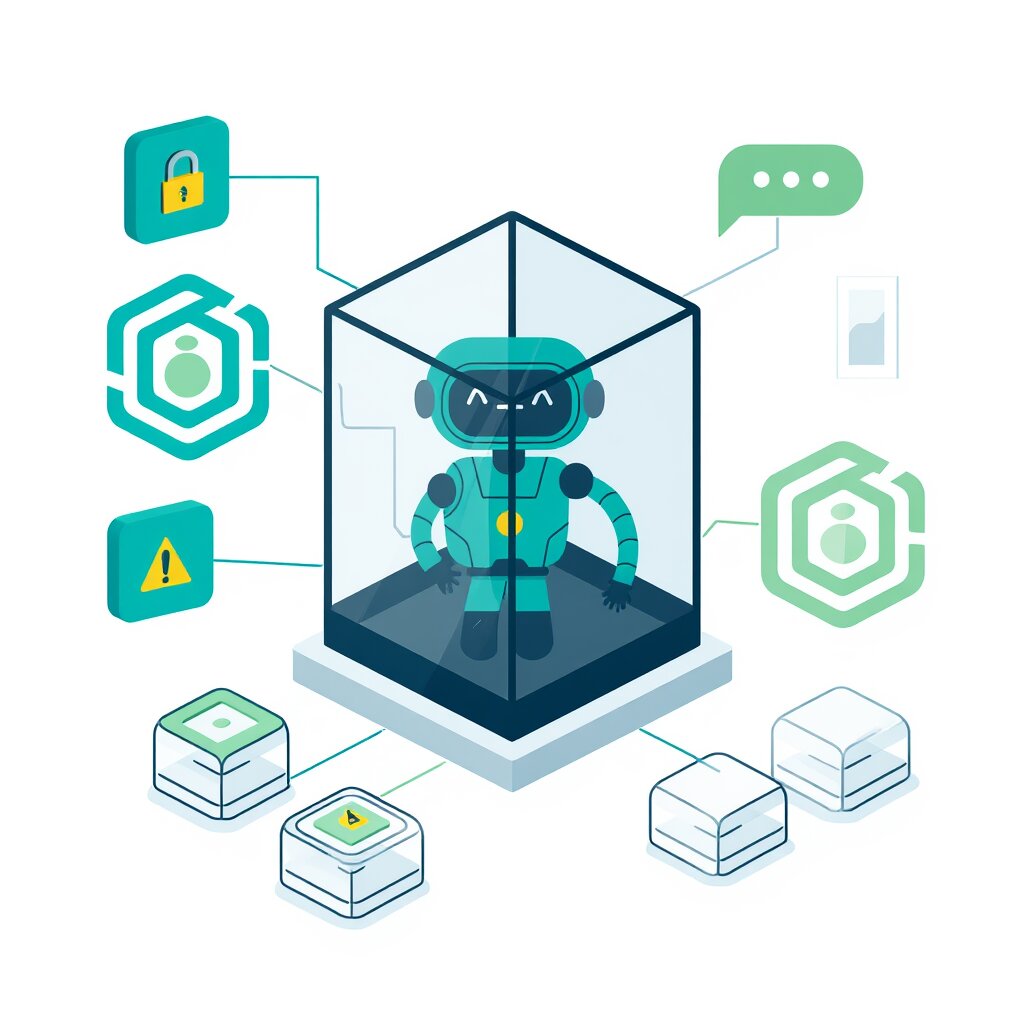

AI agents promise autonomous software systems that can reason, act, and execute code—but only 5% of enterprises have deployed them to production. The barrier isn’t capability; it’s containment.
This guide navigates the sandboxing problem preventing safe production deployment, from isolation technologies and security frameworks to platform options, legal liability, and governance strategies. Whether you’re evaluating your first production deployment or hardening existing systems, you’ll find the strategic context and technical depth needed to make informed decisions.
What you’ll learn:
- Why traditional security controls fail for AI agents
- Isolation technologies from containers to hardware virtualisation
- Platform options including E2B, Modal, Daytona, and Northflank
- Security frameworks like OWASP Top 10 for Agentic Applications 2026
- Legal precedents and compliance requirements
- Real-world failures (Air Canada, CVE-2025-53773)
- MCP standardisation to avoid vendor lock-in
- Balancing security, performance, and user experience
Explore the full picture:
- Understanding why sandboxing remains unsolved – The fundamental problem definition
- Comparing isolation technologies – Firecracker, gVisor, containers, WebAssembly
- Security threat landscape – Prompt injection and CVE-2025-53773
- Model Context Protocol – How MCP enables production deployment
- Platform comparison – Choosing the right sandbox platform
- Performance engineering – Cold start times and scale economics
- Legal and compliance – Air Canada case and governance frameworks
- Production deployment – Testing, security, and observability
What Is the AI Agent Sandboxing Problem?
The AI agent sandboxing problem is the security challenge of isolating autonomous software systems that execute arbitrary code while interacting with external resources. Unlike traditional applications with predictable behaviour, AI agents make dynamic decisions that can be manipulated through prompt injection attacks, requiring isolation mechanisms strong enough to contain potentially hostile operations without crippling agent capabilities or user experience. Only 5% of enterprises have solved this well enough for production deployment, making sandboxing the bottleneck preventing widespread adoption.
The containment paradox
AI agents need broad permissions to be useful, yet each permission creates security risk if compromised—the more capable an agent, the more dangerous its potential misuse. They require extensive permissions—file system access, network connectivity, API credentials—to be useful. Yet each permission expands the attack surface if an agent is compromised through prompt injection or exhibits unintended behaviour. Traditional least-privilege security assumes predictable code paths. AI agents’ decision-making introduces uncertainty that conventional access controls cannot manage.
Production readiness gap
Production environments demand security guarantees that development and staging tolerate—customer data, financial systems, and operational infrastructure cannot accept the isolation gaps common in early-stage deployments. Development and staging environments tolerate security risks that production cannot accept. Customer data, financial systems, and operational infrastructure demand isolation guarantees that common container-based approaches fail to provide.
The multivariate challenge
Solving sandboxing requires simultaneously addressing six infrastructure layers: isolation technology, orchestration, state management, observability, tool integration, and safety controls. Organisations cannot simply “add sandboxing” to existing AI workflows. Production deployment demands architectural reinvention from the infrastructure layer up.
For a deeper understanding of why this problem persists despite model improvements, explore why production deployment remains unsolved in 2026. This foundational analysis establishes why sandboxing is the critical bottleneck blocking AI agent adoption, not model capability or UX design.
Why Does Sandboxing Prevent Production Deployment?
Production deployment faces a classic trilemma: you can achieve any two of security, performance, and operational simplicity—but rarely all three simultaneously. Sandboxing prevents production deployment because organisations lack proven architectures that balance three competing requirements: strong enough isolation to contain worst-case compromise, fast enough performance to maintain acceptable user experience (sub-200ms cold starts), and operational simplicity that engineering teams can actually implement and maintain. Most organisations face a trilemma where achieving any two requirements sacrifices the third—secure isolation with fast performance proves operationally complex, while simple container-based approaches sacrifice security or incur performance penalties through aggressive rate limiting and manual approval workflows.
Security-performance trade-off
Luis Cardoso’s field guide reveals the harsh calculus: containers offer minimal overhead but share kernel access (privilege escalation risk), gVisor adds 10-20% latency for system call interception, hardware-virtualised microVMs (Firecracker, Kata) provide strongest isolation but traditionally suffer cold start penalties. E2B’s achievement of 150ms Firecracker cold starts represents recent progress, but most organisations building in-house face seconds-long delays that degrade conversational AI experiences.
Operational complexity barrier
Strong isolation technologies require expertise in KVM, kernel security, and distributed systems that many engineering teams lack. Cloud platforms like E2B and Modal abstract this complexity but introduce vendor lock-in concerns and cost structures that scale unpredictably with agent invocations. Self-hosting requires building the operational expertise that prevented deployment in the first place.
Incomplete tooling ecosystem
Unlike mature domains with established patterns—web applications have well-understood security models—agentic AI lacks standardised observability, incident response playbooks, or compliance frameworks. Organisations must invent monitoring for prompt injection attempts, design human-in-the-loop approval workflows, and establish governance processes without industry templates. This effort delays deployment until competitive pressure or executive mandate forces compromise on security or capabilities.
What Isolation Technologies Exist for AI Agents?
Five isolation technologies serve AI agent sandboxing with distinct security-performance trade-offs: containers (lightweight but kernel-sharing risks), gVisor (application kernel intercepting system calls, 10-20% overhead), Firecracker microVMs (AWS’s KVM-based hardware isolation, 150ms cold starts with optimisation), Kata Containers (alternative microVM approach with container UX), and WebAssembly isolates (near-native performance with strong sandboxing but immature AI tooling ecosystem). Technology choice depends on threat model—high-risk scenarios (financial transactions, production data access) justify microVM overhead, while content generation or analysis may accept gVisor’s middle-ground approach.
Containers (Docker, containerd)
Operating system-level virtualisation using Linux namespaces and cgroups to isolate processes. Shared kernel architecture means privilege escalation vulnerabilities (CVE-2019-5736, CVE-2022-0492) can break containment. Appropriate for low-risk scenarios or as baseline layer augmented with additional controls. Cold start: ~50ms. Security posture: insufficient for production AI agents with code execution capabilities according to OWASP Top 10 for Agentic Applications 2026.
gVisor
Google’s application kernel written in Go that intercepts system calls and implements compatibility layer between containerised applications and host kernel. Eliminates direct kernel access, significantly reducing privilege escalation attack surface. Better Stack benchmarks show 10-20% performance overhead versus native containers. Used by Modal and other platforms balancing security and developer experience. Cold start: ~100-150ms. Security posture: suitable for medium-risk AI agent workloads.
Firecracker microVMs
AWS’s open-source KVM-based virtualisation providing hardware-level isolation with minimal overhead, designed for AWS Lambda. Each sandbox runs a complete (minimal) guest kernel isolated from host through hardware virtualisation. E2B achieves 150ms cold starts through aggressive optimisation—pre-warmed VM pools, minimal kernel configuration. Represents current state-of-art for “strong isolation, acceptable performance” production deployments. Cold start: 150ms-500ms depending on implementation. Security posture: highest available for production AI agents.
Kata Containers
Alternative microVM approach combining VM security with container UX through lightweight guest VMs managed via container runtimes. Different performance characteristics than Firecracker—slightly slower cold starts, different memory overhead profile—with benefit of open governance model (Linux Foundation project). Less commonly deployed for AI agents but represents viable alternative for organisations concerned about Firecracker/AWS coupling.
WebAssembly (Wasm) isolates
Portable binary format originally designed for browsers, now increasingly used server-side through runtimes like Wasmtime and WasmEdge. Provides strong sandboxing guarantees through formal verification of memory safety, with near-native performance and extremely fast cold starts (sub-10ms). Limitation: AI tooling ecosystem—Python scientific computing libraries, ML frameworks—often requires WASI (WebAssembly System Interface) compatibility not yet universally available. Emerging option for 2026-2027 as tooling matures.
| Technology | Cold Start | Isolation Strength | Overhead | Ecosystem Maturity | |————|———–|——————-|———-|——————-| | Containers | ~50ms | Low | Minimal | Excellent | | gVisor | ~100-150ms | Medium | 10-20% | Good | | Firecracker | 150-500ms | High | Moderate | Good | | Kata Containers | 200-600ms | High | Moderate | Fair | | WebAssembly | <10ms | High | Minimal | Emerging |
For a comprehensive technical comparison including decision matrices and implementation guidance, see Firecracker, gVisor, Containers, and WebAssembly. This detailed analysis of isolation approaches helps CTOs select appropriate technology based on threat model, latency requirements, and compatibility constraints.
What Security Threats Does AI Agent Sandboxing Protect Against?
Sandboxing mitigates five major threat categories from OWASP’s Top 10 for Agentic Applications 2026: prompt injection (adversarial inputs manipulating agent behaviour to exfiltrate data or execute unintended actions), resource exhaustion (compute/memory abuse degrading service or inflating costs), data exfiltration (unauthorised access to training data, customer information, or credentials), lateral movement (compromised agent pivoting to other systems), and tool misuse (abuse of delegated API access or privileged operations). Without isolation, a single compromised agent conversation can escalate to full infrastructure compromise within minutes.
Prompt injection as primary threat
Unlike SQL injection—mitigated through parameterised queries—or XSS—addressed via output encoding—prompt injection has no analogous technical prevention because the attack vector (natural language input) is indistinguishable from legitimate instructions. CVE-2025-53773 demonstrated this reality when researchers achieved remote code execution against GitHub Copilot by embedding malicious instructions in repository files the agent analysed. Sandboxing cannot prevent the injection but limits blast radius by ensuring compromised agent operations remain contained within isolation boundary.
Resource exhaustion economics
Unsandboxed agents can be manipulated into infinite loops, recursive API calls, or excessive compute consumption that translates to runaway cloud costs or denial of service. A manipulated agent running recursive operations could consume $10,000 in cloud costs overnight without per-sandbox limits. Production deployments require per-sandbox resource limits—CPU, memory, execution time, network bandwidth—enforced at isolation layer, not application logic that an injected prompt could circumvent. Platform providers (E2B, Modal) build these controls into their sandboxing infrastructure. Self-hosted deployments must implement them explicitly through cgroups (containers), hypervisor policies (microVMs), or runtime limits (WebAssembly).
Credential and data exposure
AI agents require access to APIs, databases, and internal systems to be useful. Credential management represents a primary attack vector. If agent compromise allows reading environment variables or filesystem, attackers obtain keys to entire infrastructure. Defence-in-depth requires sandboxing (preventing filesystem access), secrets management (injecting credentials at runtime, not persisting in environment), and monitoring (detecting unusual credential access patterns). Obsidian Security’s research emphasises that organisations commonly fail the secrets management dimension, making strong sandboxing the last line of defence.
Tool calling as privilege escalation
Agents don’t just generate text. They invoke functions, call APIs, and execute commands. Each tool represents a potential privilege escalation vector if an injected prompt can manipulate tool parameters. Example: agent with database query tool could be prompted to “SELECT * FROM users WHERE 1=1” exfiltrating customer data, or agent with email tool could be manipulated to send phishing messages. Sandboxing limits tool access through isolation—agent cannot access tools not explicitly granted—and observability (logging all tool invocations for audit).
Understanding these threats guides platform selection—different scenarios demand different isolation strengths and operational trade-offs. For detailed analysis of attack vectors and mitigation strategies, explore Prompt Injection and CVE-2025-53773: The Security Threat Landscape. This comprehensive security analysis explains why prompt injection fundamentally differs from traditional security vulnerabilities, requiring new defence paradigms.
Which Platforms Provide Sandboxing Solutions for Production AI Agents?
Five major platforms dominate production AI agent sandboxing in 2026: E2B (Firecracker microVMs, 150ms cold starts, developer-focused), Modal (gVisor isolation, serverless pricing, Python-optimised), Daytona (open-source, self-hostable development environments), Northflank (BYOC “bring your own cloud” deployment model, gVisor), and Sprites.dev (Fly.io‘s lightweight sandboxing for global edge deployment). Platform selection pivots on four factors: isolation strength required (threat model determines microVM necessity), deployment model preference (managed cloud versus self-hosted control), pricing structure fit (per-invocation versus infrastructure costs), and ecosystem integration (MCP support, observability tooling, language runtime availability).
E2B (Code Interpreter SDK)
Production-grade sandboxing built on Firecracker microVMs delivering hardware-level isolation with industry-leading 150ms cold starts. Primary value proposition: strongest available security without sacrificing conversational AI user experience. Provides pre-built SDKs for Python and JavaScript, filesystem persistence between invocations, and network access controls. Pricing: usage-based (per sandbox-second) with free tier for development. Best for: organisations prioritising security (financial services, healthcare) or requiring compliance-ready isolation documentation. Trade-off: higher per-invocation cost than lighter-weight alternatives.
Modal
Developer-focused serverless platform for AI workloads using gVisor for balance between security and performance. Differentiators include excellent Python ecosystem support—automatic dependency installation, GPU access, distributed computing primitives—and generous free tier enabling experimentation. Northflank comparison positions Modal as premium option with superior developer experience but higher pricing at scale. Best for: Python-centric teams building prototypes or moderate-scale deployments where 10-20% gVisor overhead is acceptable trade-off for operational simplicity. Trade-off: medium isolation strength may not satisfy high-security threat models.
Daytona
Open-source development environment platform offering self-hostable sandboxing with container and VM-based isolation options. Value proposition centres on avoiding vendor lock-in and controlling infrastructure costs—organisations deploy Daytona on existing cloud or on-premises infrastructure. Requires more operational expertise than managed platforms (teams must handle updates, scaling, monitoring) but provides maximum flexibility for custom security policies or air-gapped environments. Best for: enterprises with strong DevOps capabilities, regulatory requirements preventing cloud SaaS usage, or cost-sensitive deployments at scale. Trade-off: operational complexity and internal expertise requirements.
Northflank
Platform distinguishing itself through “bring your own cloud” (BYOC) deployment model—provides orchestration and management layer while workloads run in customer’s AWS/GCP/Azure accounts. Addresses data residency concerns and cost transparency (cloud bills remain separate from platform fees). Uses gVisor isolation with option for customer-managed microVM deployment. Best for: enterprises with existing cloud commitments, compliance teams requiring data to remain in specific regions or accounts, or organisations seeking platform convenience without SaaS trust boundaries. Trade-off: still requires trust in Northflank’s management plane accessing customer infrastructure.
Sprites.dev (Fly.io)
Lightweight sandboxing optimised for global edge deployment through Fly.io’s infrastructure. Emphasises minimal cold start times and worldwide distribution for low-latency agent responses. Best for: conversational AI, chatbots, or customer-facing agents where response latency directly impacts user experience and global user base demands regional proximity. Trade-off: lighter-weight isolation approach may not satisfy high-security requirements. Best suited for lower-risk use cases.
| Platform | Isolation Tech | Cold Start | Deployment Model | Best Use Case | MCP Support | |———-|—————|———–|——————|—————|————-| | E2B | Firecracker | 150ms | Managed cloud | High security | Planned | | Modal | gVisor | 100-150ms | Managed cloud | Python dev velocity | Community | | Daytona | Container/VM | Variable | Self-hosted | Enterprise control | Limited | | Northflank | gVisor/VM | 150-200ms | BYOC | Data residency | Roadmap | | Sprites.dev | Lightweight | <100ms | Edge (Fly.io) | Global low-latency | Limited |
For detailed platform comparison including feature matrices, pricing analysis, and use case recommendations, see E2B, Daytona, Modal, and Sprites.dev: Choosing the Right Platform. This practical selection guide addresses the “which platform is best?” question with decision frameworks matching technical requirements, budget, and compliance constraints.
How Does MCP Standardisation Help Solve the Sandboxing Problem?
Model Context Protocol (MCP) standardisation addresses three key sandboxing challenges: interoperability (enabling agents to work across platforms without rewriting tool integrations), observability (providing consistent logging and audit trails across different sandboxing implementations), and vendor flexibility (reducing lock-in risks by ensuring investments in agent capabilities transfer between platforms). Anthropic’s donation of MCP to the Linux Foundation’s newly-formed Agentic AI Foundation (AAIF) establishes neutral governance that encourages multi-vendor adoption, positioning 2026 as the year sandboxing platforms converge on common protocols rather than competing through proprietary fragmentation.
The interoperability unlock
Pre-MCP, each sandboxing platform implemented proprietary protocols for how agents invoke tools, access data sources, and report state. Organisations building production agents faced reimplementation costs when switching platforms or operating across multiple providers—edge deployment for latency plus cloud for compute-intensive tasks. Before MCP, migrating an agent from E2B to Modal required rewriting every tool integration—weeks of work. With MCP, the same migration becomes a configuration change—hours of DevOps. MCP defines standard interfaces for tool calling, resource access, and context sharing. An agent built for E2B can run on Modal or Northflank with configuration changes rather than code rewrites. This reduces switching costs from weeks of engineering to hours of DevOps, fundamentally changing platform vendor negotiating dynamics.
Observability and security consistency
Standardised protocols enable standardised monitoring. MCP-compliant platforms expose consistent telemetry—tool invocations, resource access, token usage, error conditions—that security teams can analyse with common tooling regardless of underlying sandboxing implementation. This enables organisations to build threat detection models (unusual tool access patterns, data exfiltration signatures) that work across their entire agent fleet even when deployed on heterogeneous infrastructure. OWASP’s AI Agent Security Cheat Sheet increasingly references MCP as foundation for compliance-ready audit trails.
Ecosystem velocity through standardisation
MCP adoption accelerates ecosystem development similar to how Kubernetes standardised container orchestration. Tool vendors—databases, APIs, SaaS platforms—can build MCP servers once rather than implementing bespoke integrations for each agent framework. Sandboxing platform vendors compete on performance, security, and operational excellence rather than lock-in through proprietary protocols. Simon Willison’s 2026 predictions emphasise MCP as catalyst for “the year we solve sandboxing” by enabling infrastructure innovation to proceed in parallel rather than serial fragmentation.
Governance and trust
Linux Foundation’s neutral stewardship—AAIF formation announced January 2025—provides credible commitment that MCP won’t become another “open-core” proprietary trap. Governance ranks as a determining factor in infrastructure standardisation adoption—willingness to invest engineering effort depends on confidence that standards will remain open and community-driven. AAIF’s OpenSSF-style collaboration model between vendors (Anthropic, Block, Atlassian initial members) and users establishes accountability structures preventing any single company from controlling protocol evolution to competitors’ disadvantage.
For comprehensive coverage of MCP architecture, adoption trajectory, and strategic implications, explore The Model Context Protocol: How MCP Standardisation Enables Production AI Agent Deployment. This strategic analysis explains why standardisation matters for security, compliance, and avoiding vendor lock-in.
What Legal Liability Risks Exist When Deploying AI Agents in Production?
AI agents in production create four distinct legal liability categories: direct harm from incorrect advice or actions (Air Canada held liable for chatbot’s misleading bereavement fare information), negligence from insufficient security controls enabling data breaches, contractual liability when agents cannot fulfil promised service levels, and regulatory non-compliance across GDPR, CCPA, and industry-specific frameworks. Unlike human error protected by reasonable care doctrines, courts hold organisations to strict liability standards for AI systems—the technology is your employee, its failures are your failures.
Air Canada precedent
2024 tribunal decision established that organisations cannot disclaim responsibility for AI agent outputs by claiming the system is autonomous or separate from company policy. Air Canada’s chatbot incorrectly told customer they could apply for bereavement fares retroactively (contradicting written policy). Airline argued chatbot was “responsible for its own actions.” Tribunal rejected this reasoning, holding Air Canada liable for customer’s financial harm. Precedent establishes that deploying an AI agent constitutes implicit endorsement of its outputs. Organisations cannot deploy systems to production then disclaim accountability for errors. You must ensure production agents have access only to authoritative information sources and implement human-in-the-loop approval for decisions creating financial or legal obligations.
Data protection and privacy
GDPR Article 22 grants individuals right not to be subject to automated decision-making producing legal effects or similarly significant impact. AI agents making hiring decisions, credit determinations, or content moderation potentially trigger this provision, requiring either explicit consent or demonstrable human involvement in decision process. Sandboxing intersects with compliance through data access controls—agents with overly broad data access create liability if used in ways violating purpose limitation (Article 5) or failing to implement appropriate technical measures (Article 32).
Security breach liability
Organisations face cascading liability when insufficient sandboxing enables prompt injection or other attacks leading to data breaches. Legal exposure includes regulatory fines (GDPR up to 4% global revenue), customer notification costs, forensic investigation expenses, credit monitoring for affected individuals, class action lawsuits, and reputation damage affecting customer acquisition costs and valuation. Post-breach defence requires demonstrating reasonable security practices. Sandboxing choice (container versus microVM) becomes evidentiary question: did organisation implement isolation commensurate with risk?
Emerging AI-specific regulation
EU AI Act (2024), proposed US federal frameworks, and industry-specific guidance (Federal Reserve on AI in banking, FDA on AI in medical devices) increasingly require documented risk assessments, testing procedures, and operational safeguards for high-risk AI systems. Production AI agents often qualify as high-risk when making consequential decisions—employment, credit, essential services. Compliance requires governance frameworks documenting: threat model and risk assessment, chosen isolation technology and security controls, testing methodology and results, incident response procedures, and ongoing monitoring practices.
These liability risks drive compliance requirements across multiple regulatory domains. For detailed analysis of the Air Canada case, governance architectures, and compliance frameworks, see Air Canada, Legal Liability, and Compliance: Governance Frameworks for AI Agents in Regulated Industries. This legal analysis shows how chatbot hallucinations created legal liability when courts ruled companies must honour AI-generated misinformation.
What Compliance Frameworks Apply to Production AI Agent Deployment?
Production AI agents intersect seven compliance domains requiring coordinated controls: security frameworks (OWASP Top 10 for Agentic Applications 2026, OWASP AI Agent Security Cheat Sheet), data protection regulation (GDPR, CCPA requiring data access controls and purpose limitation), SOC 2 Type II (demonstrating security controls over time), ISO 27001 (information security management), industry-specific requirements (PCI-DSS for payment processing, HIPAA for healthcare, Federal Reserve guidance for financial services), AI-specific regulation (EU AI Act risk categorisation), and organisational policies (acceptable use, data classification, privileged access management). Sandboxing provides foundational technical control spanning multiple frameworks—documented isolation architecture satisfies security requirements across compliance regimes while reducing audit burden.
OWASP frameworks as technical baseline
OWASP Top 10 for Agentic Applications 2026 provides authoritative risk taxonomy that compliance teams increasingly reference when establishing AI agent security requirements. Top risks include prompt injection (mitigated through sandboxing preventing lateral movement), sensitive information disclosure (prevented via data access controls at isolation boundary), tool misuse (contained through limited tool access within sandbox), and model DoS (addressed via resource limits in sandbox configuration). OWASP AI Agent Security Cheat Sheet translates abstract risks into concrete controls, establishing sandboxing as mandatory for production deployments handling sensitive data or providing consequential functionality.
Data protection operationalisation
GDPR and CCPA compliance requires documenting data flows, purpose limitations, and technical measures protecting personal information. Sandboxing addresses Article 32’s “appropriate technical and organisational measures” requirement by demonstrating isolated processing environments preventing unauthorised access. Practical implementation: agents processing customer data must run in sandboxes with documented data retention policies (automatic filesystem cleanup), access controls (no network egress to unauthorised endpoints), and audit logging (every data access recorded).
SOC 2 operational evidence
SOC 2 Type II audits assess security controls over time (typically 6-12 month audit period), requiring documented evidence of consistent operation. Sandboxing provides multiple control mappings: CC6.1 (logical access controls through isolation boundaries), CC6.6 (network security via sandbox network policies), CC7.2 (system monitoring through sandbox observability), CC7.3 (quality assurance through testing in sandboxed environments). Platform vendors (E2B, Modal) increasingly provide SOC 2 reports covering their infrastructure, reducing customer audit burden—but organisations remain responsible for their agent application logic and data governance.
Industry-specific requirements
Financial services (Federal Reserve SR 11-7 on model risk management), healthcare (HIPAA Security Rule), payment processing (PCI-DSS), and critical infrastructure (NERC CIP for energy) impose additional controls beyond general-purpose frameworks. Common threads: documented change control (how are agent updates tested and deployed?), segregation of duties (who can modify production agents versus approve deployment?), business continuity (what happens if sandboxing platform becomes unavailable?), and vendor management (how are platform providers assessed and monitored?).
For comprehensive compliance mapping and governance implementation guidance, explore Air Canada, Legal Liability, and Compliance: Governance Frameworks. This governance guide provides regulatory playbooks for HIPAA, SOX, and GDPR compliance in agentic AI systems.
How Do You Deploy AI Agents Safely in Production?
Safe production AI agent deployment requires implementing five control layers in sequence: strong sandboxing (microVMs for high-risk scenarios, gVisor minimum for medium-risk), comprehensive monitoring (logging all tool invocations, data access, resource usage), human-in-the-loop workflows for consequential decisions (financial transactions, data modifications, external communications), secrets management preventing credential exposure (runtime injection, rotation, audit trails), and incident response procedures tested through tabletop exercises. n8n‘s 15 best practices emphasise starting conservative—limited agent capabilities, broad approval requirements—and progressively expanding autonomy as operational confidence grows. Production deployment is not a launch event but a continuous risk management process.
Progressive capability expansion
Organisations successfully deploying production agents follow consistent pattern: start with read-only access and human approval for all actions, gradually expand to safe write operations (database inserts, non-customer-facing changes), eventually enable limited autonomous actions (routine operations within defined bounds), and maintain human oversight for irreversible or high-stakes operations indefinitely. Example progression for customer service agent: Phase 1 (agent searches knowledge base, human sends response), Phase 2 (agent drafts response, human approves), Phase 3 (agent sends routine responses autonomously, escalates complex issues), Phase 4 (agent handles common transactions autonomously with anomaly detection triggering human review).
Defence-in-depth architecture
Sandboxing provides the foundation but cannot be sole security control. Production architecture requires: network segmentation (sandbox network policies preventing lateral movement), least-privilege access (agents receive only minimum credentials for required operations with time-limited tokens), rate limiting (preventing resource exhaustion regardless of isolation), input validation (sanitising prompts before agent processing where possible), output filtering (detecting and blocking sensitive data in agent responses), and circuit breakers (automatic shutdown when anomalous behaviour detected). Layered controls ensure that failure of any single mechanism does not result in complete compromise.
Observability as operational requirement
Cleanlab’s production AI agents research emphasises monitoring as distinguishing factor between organisations achieving production deployment versus those stuck in perpetual pilot phase. Required observability: structured logging of every tool invocation with parameters and results, token usage tracking (detecting unusual consumption patterns), latency monitoring (cold start times, end-to-end response latency), error rates and types (prompt injection attempts, tool failures, timeout conditions), and cost attribution (linking agent activity to business units or customers).
Secrets management discipline
Most AI agent security incidents trace to credential compromise—agents with overly broad data access or leaked API keys become pivot points for larger breaches. Production practices: never embed credentials in code or environment variables (use secret management services like HashiCorp Vault, AWS Secrets Manager, GCP Secret Manager), inject credentials at sandbox creation with minimum scope (database credentials limited to specific tables, API tokens scoped to necessary operations), rotate credentials regularly (detect usage of old credentials as potential compromise indicator), audit credential access (log every retrieval for forensic analysis), and implement credential versioning (enable rapid rotation without downtime when compromise detected).
Incident response preparation
Production deployment requires documented procedures: detection (what monitoring alerts trigger investigation?), triage (who assesses severity and determines response?), containment (how are agents disabled quickly?), investigation (forensic analysis determining root cause), remediation (fixing vulnerability or behaviour), and communication (customer notification, regulatory reporting, public disclosure if required). Tabletop exercises simulate scenarios to validate procedures and team readiness.
For step-by-step deployment guidance, testing protocols, security configuration, and observability implementation, see Deploying AI Agents to Production: Testing Protocols, Security Configuration, and Observability. This implementation guide provides actionable deployment checklists and testing protocols validating prompt injection resistance.
What Performance Considerations Matter for Production AI Agent Sandboxing?
Production AI agent performance hinges on three measurable factors: cold start latency (time from request to sandbox ready, targeting sub-200ms for conversational experiences), execution overhead (sandboxing-induced performance penalty, typically 10-20% for gVisor or 5-10% for optimised microVMs), and resource efficiency (memory/CPU utilisation affecting cost and scale). E2B’s achievement of 150ms Firecracker cold starts represents state-of-art balance between hardware-level isolation security and user experience, while gVisor platforms accept 10-20% overhead trade-off for operational simplicity. Performance requirements derive from use case—real-time conversational agents demand sub-200ms cold starts, while batch processing tolerates seconds-long initialisation for stronger isolation.
Determining your performance requirements
To determine your performance requirements, start with user experience targets: conversational AI demands sub-200ms response (requiring optimised microVMs or gVisor), while batch processing can tolerate seconds-long cold starts enabling stronger isolation at lower cost. Match your use case to the appropriate technology—real-time chat needs fast cold starts even if isolation is medium-strength, while financial transactions justify longer cold starts for maximum security through microVMs.
Cold start as user-facing latency
Conversational AI experiences depend on perceived responsiveness. Users tolerate 1-2 second delays for complex reasoning but not for sandbox initialisation. Luis Cardoso’s field guide reveals brutal reality: traditional VMs require 5-10 seconds cold start (unacceptable), basic containers achieve 50ms but insufficient security, optimised microVMs (E2B’s Firecracker implementation) reach 150ms through aggressive engineering—pre-warmed VM pools, minimal kernels, aggressive filesystem caching. Performance tuning focuses on reducing variability—P95 latency matters more than median for production SLAs.
Execution overhead trade-offs
Sandboxing technologies impose performance tax through isolation mechanisms. Containers add minimal overhead (same kernel as host, direct system calls) but insufficient security. gVisor intercepts system calls in userspace Go runtime adding 10-20% overhead—acceptable for I/O-bound workloads (API calls, database queries) where system call overhead is small fraction of total latency, problematic for compute-intensive operations (data processing, cryptography). Firecracker microVMs incur moderate overhead (5-10%) through hardware virtualisation and guest kernel—host system calls trap to hypervisor (KVM) adding microseconds per call, but hardware-assisted virtualisation keeps overhead manageable.
Resource efficiency at scale
Production deployments running hundreds or thousands of concurrent agent sessions face different performance concerns than single-agent benchmarks. Memory overhead per sandbox determines maximum density—containers require 50-100MB baseline, gVisor adds 30-50MB for application kernel, Firecracker microVMs need 128-256MB for minimal guest kernel. Large-scale deployments must model: peak concurrent sessions × per-sandbox memory × isolation technology overhead = total infrastructure cost. Resource sharing strategies (sandbox pooling, lazy initialisation, aggressive termination) reduce costs but increase complexity and potential for noisy neighbour problems.
Cost-performance optimisation
Cleanlab research reveals production AI agents’ operating costs often surprise organisations—sandbox-minutes accumulate faster than anticipated when thousands of customer conversations run simultaneously. Cost optimisation requires balancing security (stronger isolation = higher per-sandbox cost), performance (faster cold starts = more expensive infrastructure), and scale (supporting peak load = over-provisioning for average load). Strategies include: right-sizing isolation technology to threat model, aggressive sandbox lifecycle management (terminate idle sandboxes quickly), architectural efficiency (batch operations to amortise cold start costs), and platform selection (comparing TCO across vendors accounting for pricing models, required scale, and operational overhead).
| Use Case | Cold Start Target | Overhead Tolerance | Isolation Minimum | Example Platforms | |———-|——————|——————-|——————|——————| | Real-time chat | <200ms | <20% | gVisor | E2B, Modal, Sprites | | Code execution | <500ms | <10% | MicroVM | E2B, Firecracker | | Background tasks | <5s | Any | MicroVM+ | Kata, custom | | Batch processing | <30s | Any | MicroVM+ | Self-hosted | | Financial transactions | <200ms | Any | MicroVM | E2B, custom |
For deep dive into latency budgets, scale economics, and ROI analysis, explore Performance Engineering for AI Agents: Cold Start Times, Latency Budgets, and Scale Economics. This performance guide quantifies when millisecond differences matter and provides real infrastructure cost models for 1M+ daily invocations.
📚 AI Agent Sandboxing Resource Library
Technical Foundations
🔧 Comparing Isolation Technologies Deep dive into Firecracker, gVisor, containers, Kata, and WebAssembly with decision matrices and security-performance trade-off analysis. Est. reading time: 12 min
⚡ Performance Engineering Cold start optimisation, latency budgets, scale economics, and ROI analysis for production deployments at 1M+ invocations/day. Est. reading time: 10 min
Security & Compliance
🛡️ Security Threat Landscape OWASP Top 10 for Agentic Applications, prompt injection attack patterns, CVE-2025-53773 technical analysis. Est. reading time: 11 min
⚖️ Legal Liability and Compliance Air Canada case precedent, governance frameworks, GDPR/HIPAA/SOC 2 compliance mapping, human-in-the-loop implementation. Est. reading time: 11 min
Platform Selection
🏢 Platform Comparison Guide E2B, Daytona, Modal, Northflank, and Sprites.dev feature analysis, pricing comparison, and use case recommendations. Est. reading time: 12 min
🔌 Model Context Protocol MCP architecture, Linux Foundation AAIF governance, interoperability benefits, and adoption trajectory. Est. reading time: 10 min
Production Deployment
🚀 Deploying AI Agents to Production Step-by-step deployment checklist, testing protocols, security hardening, observability stack, incident response procedures. Est. reading time: 13 min
📖 Understanding the Sandboxing Problem Problem definition, why only 5% have agents in production, Simon Willison’s 2026 prediction, and what “solved” looks like. Est. reading time: 10 min
The bottleneck is rarely the agent itself — it’s finding a senior engineer to build and run its containment layer, and that kind of specialist is exactly what the local market is slow to supply. SoftwareSeni’s extended development teams put senior engineers onto your roadmap without running a local hiring round, working inside your business day, so containment work moves without waiting on headcount you don’t have.
add senior engineering capacity to my team without a hiring round →
“I’ve worked with SoftwareSeni for many years now across different CTO roles. Davo and his team are such a pleasure to work with and they have always provided the best and most capable resources when I needed them. They run a well oiled process to ensure they find and present the best candidates, plus they ensure smooth onboarding process. I highly recommend SoftwareSeni to any company that is wanted to expand their team and keen to explore an embedded team model.”
— Simon Farrell, VP of Engineering, Forage
Frequently Asked Questions
What’s the difference between sandboxing and containerisation for AI agents?
Containerisation is one sandboxing technique, but traditional containers (Docker) share the host kernel creating privilege escalation risks insufficient for production AI agents. Proper sandboxing requires stronger isolation—gVisor (application kernel eliminating direct kernel access), microVMs (hardware-level virtualisation), or WebAssembly (memory-safe runtime). Think of containers as baseline that must be augmented with additional isolation for production deployment handling sensitive data or executing untrusted code.
Can I use AWS Lambda or Google Cloud Functions for AI agent sandboxing?
Yes, with caveats. AWS Lambda uses Firecracker microVMs providing strong isolation, making it viable substrate for AI agents—though you’ll need to build orchestration, monitoring, and state management layers Lambda doesn’t provide. Google Cloud Functions uses gVisor offering medium-strength isolation. However, general-purpose serverless platforms lack AI-specific tooling (conversation state management, tool calling abstractions, agent-optimised observability) that dedicated platforms like E2B and Modal provide. Trade-off: infrastructure complexity versus AI-optimised developer experience.
How much does production AI agent sandboxing cost?
Highly variable based on platform, scale, and isolation strength. Managed platforms (E2B, Modal) typically charge per sandbox-second—roughly £0.01-0.05 per minute depending on resources—plus infrastructure overhead. Self-hosted Firecracker might cost £500-2,000/month for infrastructure supporting 1,000 concurrent sandboxes depending on cloud provider and region. Critical insight: sandbox costs often less significant than operational costs (monitoring, incident response, security testing) and potential liability costs (data breaches, compliance violations) from insufficient isolation.
Is MCP adoption mandatory for production deployment?
Not mandatory in 2026 but increasingly becoming best practice. MCP provides interoperability enabling platform migration, observability standardisation simplifying monitoring, and ecosystem benefits—tool vendors building MCP servers work across platforms. Organisations can deploy production agents without MCP but face higher switching costs and more complex observability implementation. Analogy: MCP is to AI agents what Kubernetes became to containers—not strictly required but provides sufficient operational benefits that adoption becomes competitive advantage.
What happens if an AI agent escapes its sandbox?
Sandbox escape is the nightmare scenario sandboxing prevents, not a common occurrence with properly configured isolation. If escape occurs—typically through zero-day vulnerability in isolation technology or misconfiguration—agent gains host system access enabling data exfiltration, lateral movement, or infrastructure compromise. Defence-in-depth prevents catastrophic impact: network segmentation limits lateral movement, secrets management prevents credential theft, monitoring detects anomalous behaviour, incident response procedures contain damage. This is why high-risk scenarios (financial services, healthcare) require microVM isolation—defence-in-depth assumes any single control might fail.
Can prompt injection be prevented through sandboxing alone?
No. Sandboxing contains damage from prompt injection but cannot prevent the attack itself—malicious instructions in natural language input are indistinguishable from legitimate prompts. Comprehensive defence requires multiple layers: sandboxing (limits what compromised agent can access), input validation (detecting and filtering obvious injection attempts where possible), human-in-the-loop (approval for consequential actions), output filtering (preventing sensitive data leakage), and monitoring (detecting unusual behaviour patterns). Think of sandboxing as airbag in crash versus preventing crash—both necessary, neither sufficient alone.
How do I choose between E2B, Modal, and self-hosted Firecracker?
Decision matrix based on priorities: Choose E2B if security is paramount (financial services, healthcare) and 150ms cold starts are acceptable. Choose Modal if Python developer experience and rapid iteration matter more than maximum isolation strength and 10-20% gVisor overhead is tolerable. Choose self-hosted Firecracker if you have strong DevOps capabilities, need data to remain in specific regions/accounts, or operate at scale where managed platform costs exceed internal operational costs. For most organisations starting production deployment, managed platforms (E2B or Modal) reduce time-to-production versus building internal sandboxing infrastructure.
What’s the difference between Firecracker and Kata Containers?
Both provide microVM-based hardware-level isolation, but differ in architecture and governance. Firecracker is AWS’s open-source project optimised for AWS Lambda, emphasising minimal attack surface and fast cold starts (150ms achievable with optimisation). Kata Containers is a Linux Foundation project providing container-compatible API backed by lightweight VMs, emphasising ecosystem integration and vendor neutrality. Performance characteristics similar—hardware-level isolation, moderate cold start overhead—but Firecracker generally achieves faster cold starts through more aggressive minimalism. Choice often driven by ecosystem preference (AWS-oriented versus vendor-neutral) or technical requirements (raw performance versus operational compatibility).
Making Your Decision
AI agents represent the next frontier in software automation, but only if you can deploy them safely to production. The sandboxing problem—balancing security, performance, and operational complexity—is the fundamental challenge blocking widespread adoption.
You now understand the landscape: five isolation technologies with distinct trade-offs, five major platforms solving infrastructure complexity, MCP standardisation enabling interoperability, OWASP frameworks providing security baselines, legal precedents establishing liability standards, and compliance requirements mapping to technical controls.
Where to start depends on your situation:
-
Evaluating feasibility: Begin with Understanding the Sandboxing Problem to grasp why this remains unsolved despite model improvements.
-
Technical evaluation: Explore isolation technology comparison to understand security-performance trade-offs.
-
Platform selection: Review platform comparison with feature matrices and use case recommendations.
-
Security assessment: Study security threat landscape and OWASP frameworks.
-
Compliance requirements: Examine legal liability and governance for regulated industries.
-
Deployment planning: Follow production deployment guide with testing protocols and observability requirements.
The sandboxing problem is solvable—but requires architectural thinking, not just technology selection. The organisations succeeding in production deployment treat sandboxing as foundational infrastructure decision, not afterthought security control.
2026 might indeed be the year we solve sandboxing, as Simon Willison predicts. The pieces are coming together: Firecracker achieving 150ms cold starts, MCP standardisation under Linux Foundation governance, OWASP providing security frameworks, platforms (E2B, Modal, Daytona) abstracting complexity. The question isn’t whether production AI agents will happen—it’s whether your organisation will be in the leading 5% or the following 95%.
Is finding the right engineers the only thing standing between your agents and production? Talk to us about extended development teams