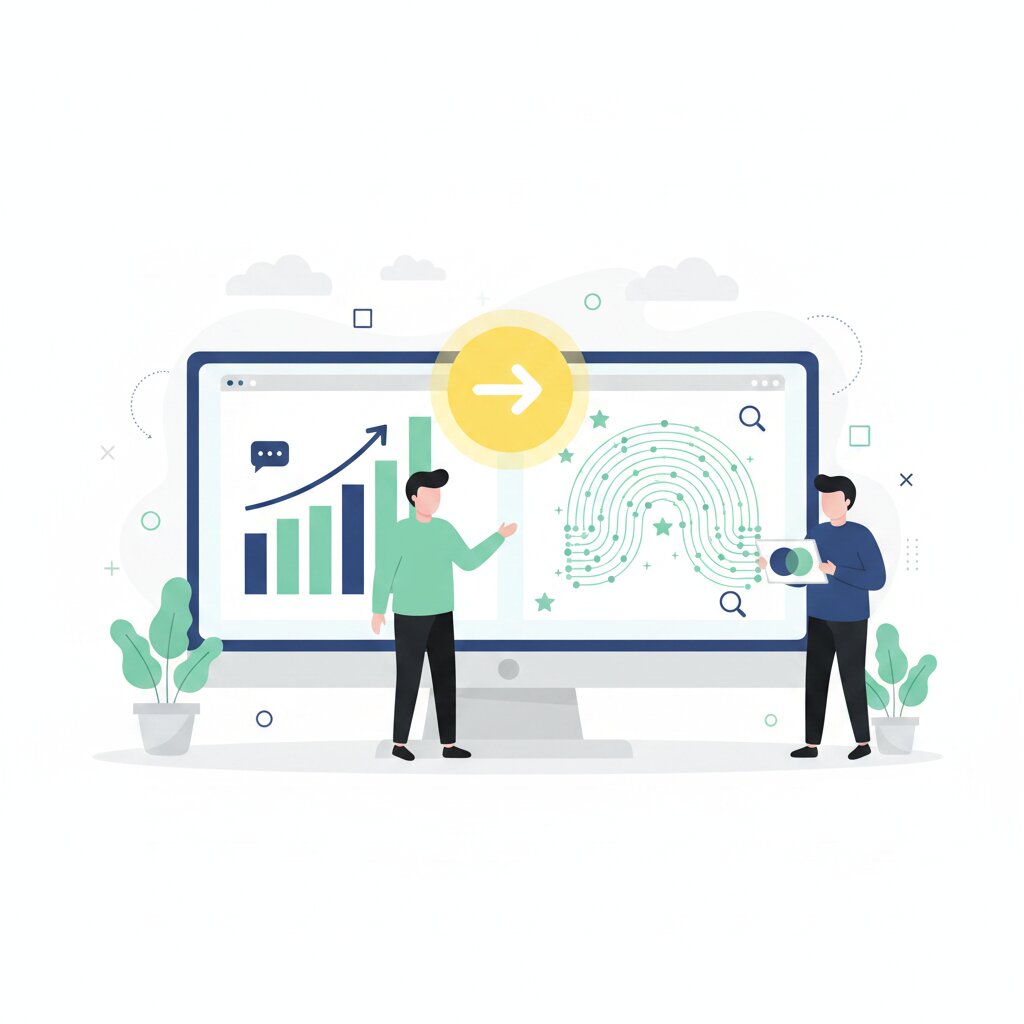

Sixty percent of searches now end without a click. When users do engage, it’s with AI-generated summaries — not individual pages. Organic CTR is no longer the right thing to be measuring at the top of your funnel.
Three terms have emerged to describe what comes next: SEO, GEO, and AEO. They’re not synonyms. They describe distinct practices with very different operational implications.
Conductor’s analysis of 17 million AI citations found only 17% overlap between AI-cited sources and traditional top-10 organic rankings. Five out of every six AI citations come from content that isn’t on page one. Ranking well doesn’t reliably predict whether you get cited. That’s a significant problem if you’re running the old playbook. This guide is part of our comprehensive look at the AI search zero-click crisis, where we examine what the data means and how to respond.
In this article we’ll explain how all three disciplines fit together, why entity building is the thing you need to get right first, and how to decide which platforms to prioritise. It’s written for people who need to brief a team or allocate budget — not implement schema markup themselves. To understand the zero-click data that makes these disciplines necessary, the statistics article in this series has the full breakdown. If you want the full background on the structural shift driving this new optimisation landscape, the pillar article has everything you need.
Is Traditional SEO Still Enough — or Has Something Fundamentally Changed?
SEO is still the prerequisite. Pages need to be technically sound, indexable, and authoritative before AI systems can evaluate them at all. GEO and AEO don’t change that.
What’s changed is the relationship between ranking and visibility. For queries where an AI Overview appears, organic CTR has dropped 61%. There are businesses that have held their rankings and still lost 40–70% of their traffic in a single year.
Historically, 76% of AI Overview citations came from top-10 organic results. That number is now 38% and falling. For ChatGPT, 80–90% of cited pages rank outside the top 10. When 51% of B2B software buyers now start research with an AI chatbot more often than Google, SEO alone isn’t enough anymore.
What Is the Conductor 17% Finding — and Why Does It Change the Calculation?
Conductor analysed 17 million AI responses and 100 million citations. Only 17% of AI-cited content overlaps with the sites that traditionally appear on page one. BrightEdge tracked this independently across 16 months and found 16.7% — flat the whole time. The divergence isn’t a blip. It’s structural.
It gets more striking when you dig into ChatGPT specifically. Only 6.82% of ChatGPT results overlap with Google’s top-10 organic results. One Ahrefs study found 28.3% of ChatGPT’s most-cited pages have zero organic visibility. A page that ranks nowhere can still be ChatGPT’s primary source on a topic.
And if you’re in B2B, consider this: G2’s April 2026 research found 85% of B2B buyers think more highly of a vendor when AI includes them in an answer. If half your buyers start research in ChatGPT or Perplexity, a strategy focused exclusively on ranking is a strategy for a shrinking share of the journey.
One honest caveat: the Conductor report page is JavaScript-rendered and wasn’t directly accessible during research. The 17% figure is consistent with BrightEdge’s independently published 16.7% and corroborated across multiple sources. Treat it as directionally solid — not as a number to quote in a board deck without a footnote.
What Is GEO — and How Is It Different from Traditional SEO?
GEO — Generative Engine Optimisation — is the practice of structuring content, entity relationships, and authority signals so that AI models cite your brand when synthesising responses.
Traditional SEO targets ranking algorithms that score pages holistically. GEO targets RAG pipelines — AI systems that retrieve individual content chunks and synthesise a response from them. Because retrieval happens at the chunk level, page-level optimisation is no longer the whole game. That’s a meaningful difference in how you actually approach the work.
Lumar’s framework organises GEO into three layers. Entity GEO: who you are, resolved in the Knowledge Graph. Brand Authority GEO: whether you can be trusted — backlinks, media mentions, E-E-A-T signals. Content-Level GEO: passage structuring, schema, FAQ format.
The terminology is contested, for what it’s worth. Graphite calls it “AEO”; AthenaHQ calls it “GEO”; SurferSEO uses “AI SEO.” That last label has 250,000 monthly searches versus 1,300 for GEO — but it conflates two operationally distinct tracks. In this article we use GEO for AI-summary citation and AEO for direct-answer citation, because the distinction changes what you actually do day-to-day.
What Is AEO — and When Does It Differ from GEO?
AEO — Answer Engine Optimisation — is the practice of optimising content to be selected when AI platforms generate direct, single-intent answers. Voice-style queries, factual questions, comparisons where the user wants one authoritative answer rather than a synthesised summary.
It grew out of Position Zero and Featured Snippet strategies that were prominent around 2016–2019. First Page Sage became the first agency to formally offer AEO as a named service in 2023 — their own description. The term spread as Perplexity branded itself an “answer engine” and practitioners needed a term to distinguish direct-answer optimisation from the broader GEO discipline.
In short: GEO handles complex multi-source summaries. AEO handles direct-answer retrieval. AEO requires shorter, more declarative passages optimised for voice extraction. In practice, most content teams end up optimising for both at the same time — question-format headings, declarative openings, and FAQ sections serve both tracks without needing to pick one.
Entity GEO: Why Brand Entity Resolution Comes First
Before a generative AI system can cite your content, it needs to answer one question: who are you?
This is Step 0. If your brand isn’t a resolved entity in Google’s Knowledge Graph, you don’t enter the candidate pool for retrieval. Without entity resolution, content-level optimisation produces inconsistent results no matter how well-structured your content is.
Lumar’s framework identifies five mechanisms to get this right: schema markup for Organisation, Product, and Person; consistent brand descriptions across your website, LinkedIn, Google Business Profile, and industry directories; Wikipedia inclusion (the most-cited domain across AI Overviews, AI Mode, and ChatGPT responses); B2B review platform listings on G2 and Trustpilot; and topical authority content clusters.
One measurement nuance worth knowing before you start tracking results: ChatGPT cites sources 87% of the time but mentions brand names in only 20.7% of answers. These ghost citations — source link, no brand mention — mean raw citation rate can significantly overstate actual brand visibility. Entity GEO reduces that risk.
On schema specifically: position.digital’s finding that “schema markup has no major impact on AI visibility” applies to schema as a general ranking booster. Schema for entity signals — Organisation, Product, Person — operates at the entity resolution layer. Implement those for entity resolution. Don’t rely on schema alone as a citation driver.
For the full evidence on the empirical research on what actually predicts AI citation, the research article in this cluster goes deeper.
Which Platform Should You Prioritise — Google AI Mode, ChatGPT, or Perplexity?
There is no single platform-agnostic strategy that works across all three. They have different citation patterns and a different relationship to traditional SEO.
Google AI Overviews have the strongest correlation with traditional SEO of any AI platform — though it’s falling fast, from 76% to 38%. Organic CTR is 35% higher when your brand is cited in an AI Overview, versus 61% lower when you’re absent. If your buyers come via Google search, your existing SEO investment transfers most directly here.
Google AI Mode is a separate interface with a 93% zero-click rate. AI Mode and AI Overviews share only 13.7% of cited domains — despite both being Google products. Treating “Google AI” as a single optimisation target is a good way to misallocate your resources.
ChatGPT drives 87.4% of all AI referral traffic. Its most-cited sources are Wikipedia (47.9%), Reddit (11.3%), and Forbes (6.8%). Entity signals and third-party mentions are stronger predictors here than ranking.
Perplexity weights recency heavily — 50% of its citations are content published in 2025 alone. For research-intensive B2B queries, structured declarative content performs better here than on Google.
Microsoft Copilot is worth adding to the list if you’re a B2B team working in Microsoft 365 environments. Claude has expanded web search to all users as of May 2025 — check that your robots.txt doesn’t block ClaudeBot or Claude-SearchBot.
For measurement, tools like Profound, Peec AI, Ahrefs Brand Radar, HubSpot AI Search Grader, and Otterly track AI citation share across platforms. (What changes when the searcher is an AI agent rather than a human is explored in the agentic search article in this cluster; the prioritisation question shifts again there.)
What Changes in Your Content — Passage-Level Structuring in Practice
AI engines don’t evaluate pages holistically. They retrieve individual content chunks via RAG pipelines.
44.2% of all LLM citations come from the first 30% of a page’s text. A declarative opening sentence is citation infrastructure, not a stylistic preference. In practice that means: declarative opening sentences per section, self-contained sections of 120–180 words, question-format headings, inline statistics, and FAQ sections formatted for AI extraction.
Content freshness matters too. Content updated in the past three months averages 6 citations versus 3.6 for outdated pages. Refreshing priority pages every 60–90 days is a practitioner recommendation, not an experimentally validated interval — but the directional signal is consistent across sources.
The third-party finding is the one that surprises most content teams: brands are 6.5 times more likely to be cited through third-party sources than their own domains. Building presence on Reddit, Wikipedia, G2, and industry publications is a more direct path to AI citation than publishing more owned content. That’s a genuine shift in where your effort should go.
Here’s an honest summary of where the evidence stands: entity building is well-validated, passage-level structuring is well-corroborated, and third-party citation building has multiple independent studies behind it. Specific refresh intervals, specific GEO content length targets, and update frequency signals borrowed from SEO without transfer validation are still hypothesis. GEO and AEO are young disciplines. The foundation is solid. The fine-tuning is still being worked out.
Frequently Asked Questions
What is the difference between AEO and GEO?
GEO targets AI models synthesising multi-source summaries in response to complex queries. AEO targets direct-answer retrieval — factual or single-intent questions where users expect one authoritative answer. Most structural practices serve both tracks at once. AEO additionally requires shorter, more extractable passages for voice output.
Does strong SEO automatically mean good AI citation performance?
No. BrightEdge’s tracking found only 16.7% overlap between AI-cited sources and traditional top-10 organic rankings, flat across 16 months. For ChatGPT, 80–90% of cited pages rank outside the top 10. SEO is necessary but doesn’t reliably predict AI citation. A separate GEO/AEO effort is required.
What is entity resolution in the context of GEO?
Entity resolution means an AI system can unambiguously identify and describe your brand — a resolved node in the Knowledge Graph. Without it, AI engines may misattribute your content, cite a similarly-named competitor, or omit you entirely. Entity GEO is the practice of achieving entity resolution before you attempt content-level optimisation.
What is a “ghost citation” and why does it matter?
A ghost citation occurs when an AI response links to your domain but doesn’t name your brand in the answer text. ChatGPT cites sources 87% of the time but mentions brand names in only 20.7% of answers. AI citation rate is not the same as AI brand mentions — teams tracking citation share may be significantly overcounting their actual visibility.
Is schema markup worth doing for GEO?
For entity signals — Organisation, Product, Person schemas — yes. position.digital’s finding that “schema markup has no major impact on AI visibility” applies to schema as a broad ranking booster, not as an entity-signal mechanism. Implement Organisation and Product schema for entity resolution. Don’t expect schema alone to drive citation frequency.
Should a small tech team prioritise Google AI Mode or ChatGPT for AI citation?
Start with Google AI Mode if your current traffic comes from Google search — entity signals and passage structure transfer to AI Overviews as well. Prioritise ChatGPT entity signals — Wikipedia inclusion, G2 listings, Reddit mentions — if your buyers research in AI assistants. ChatGPT cites lower-ranked pages 80–90% of the time, so SEO rank is a weaker predictor there. Either way, entity GEO is the prerequisite.
Is GEO/AEO the same as “AI SEO”?
“AI SEO” positions the discipline as a direct evolution of traditional SEO. GEO and AEO treat AI citation optimisation as materially different from ranking optimisation, because the evidence shows ranking and citation are largely decoupled. “AI SEO” has the highest search volume (250K/month) but the conflation creates real operational confusion for teams trying to allocate effort between the two tracks.
How do I measure whether my GEO/AEO efforts are working?
Track AI citation share: the percentage of relevant AI-generated responses that cite your brand or domain. Tools like Profound, Peec AI, Ahrefs Brand Radar, HubSpot AI Search Grader, and Otterly track this across platforms. Run prompt harnesses simulating buyer queries across Google AI Mode, ChatGPT, and Perplexity. And remember: a source link is not the same as a brand mention.
How does B2B differ from B2C for GEO/AEO?
G2’s April 2026 research found 51% of US B2B software buyers now start research with an AI chatbot more often than Google. For B2B SaaS, the AI citation moment arrives earlier in the buyer journey than most teams expect. Microsoft Copilot is disproportionately relevant for B2B teams in Microsoft 365 environments — a platform most B2C practitioners don’t need to think about.
Where to Go Next
GEO and AEO are new disciplines but they rest on a clear sequence: entity resolution first, passage-level structuring second, third-party citation building third. The Conductor 17% finding tells you why the sequence matters — the old ranking-to-visibility relationship is broken, and a separate optimisation track is the only way to close the gap.
For a complete overview of the structural shift driving this new optimisation landscape — including the full data picture, the mechanism behind the click collapse, and how the publisher revenue crisis connects — see our AI search zero-click crisis guide.